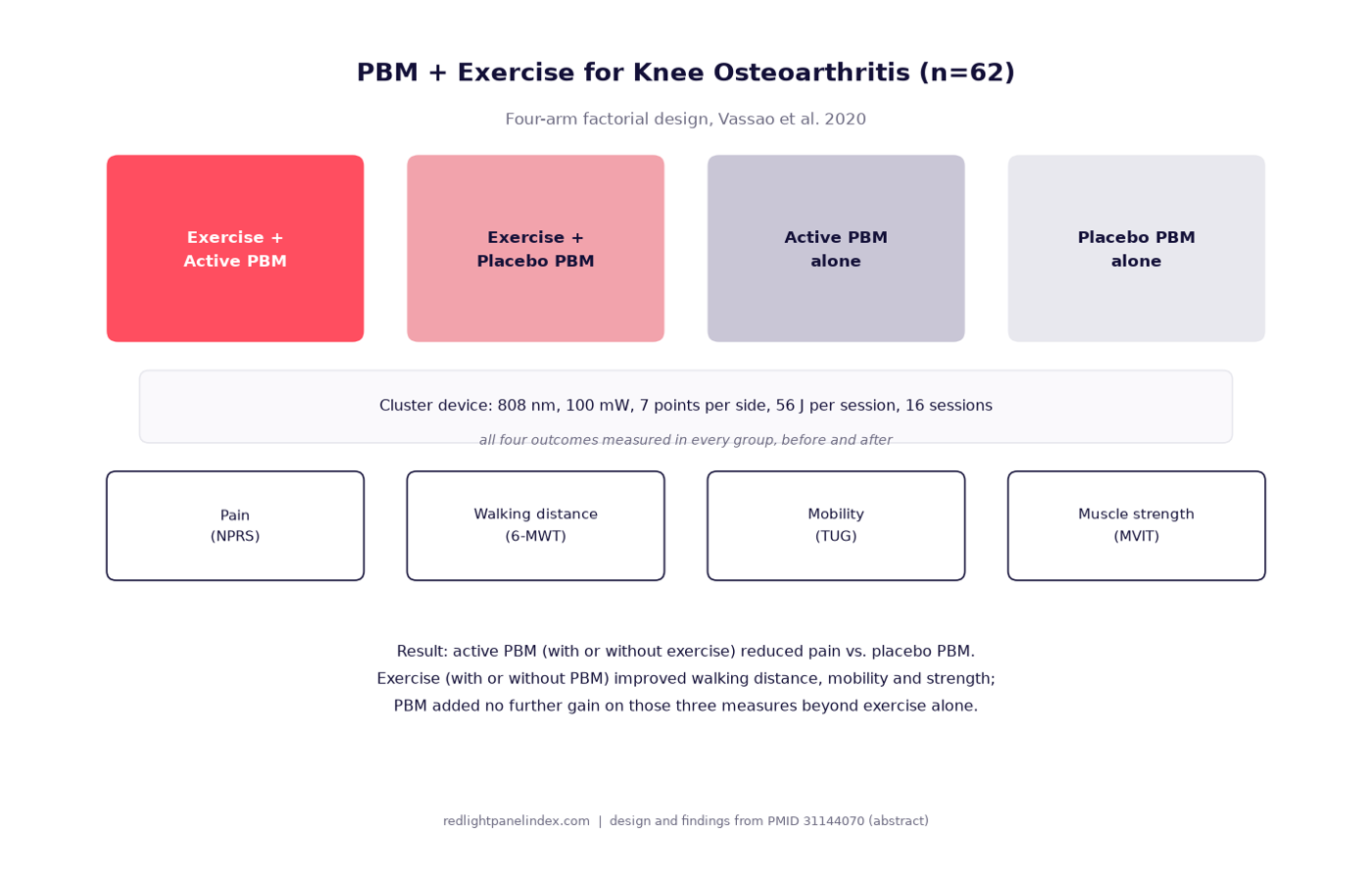
A 2020 randomized placebo-controlled trial in Lasers in Medical Science tested whether adding photobiomodulation to a leg-strengthening exercise program helped women with knee osteoarthritis more than exercise alone, and found that light reduced pain on its own but added nothing measurable to what exercise already did for walking distance, mobility, or muscle strength (PMID 31144070). It is the trial design most home panel users actually follow, light layered onto activity rather than instead of it, which is what makes its mixed result worth reading past the headline.
Choosing a panel? Our ranking of the best red light therapy panels is computed from published, method-labeled specs across 188 devices. For a trial like this one, the spec that matters is near-infrared output density, not total wattage.
What the study asked
Vassão and colleagues set out to test the effect of incorporating photobiomodulation into a physical exercise program on pain, lower limb muscle strength, and physical capacity in women with knee osteoarthritis. The design isolates two questions in one trial: does light reduce pain by itself, and does adding light to an exercise program produce a better functional outcome than the exercise program alone. A sham-controlled design like this one is what makes either answer trustworthy, since a placebo PBM device was used in the non-active arms.
Who was studied
Sixty-two female volunteers with a diagnosis of knee osteoarthritis were enrolled and split into four groups: exercise with placebo PBM, exercise with active PBM, active PBM alone with no exercise, and placebo PBM alone with no exercise. That four-arm structure is a full factorial design, light or sham crossed with exercise or no exercise, which is more rigorous than most trials in this index's joint pain register and knee osteoarthritis page, most of which run light against sham without a separate exercise comparison. The abstract does not report how the 62 women split across the four groups, so this review does not either. The population is middle-aged and older women only; no men were enrolled.
Device and parameters as stated
- Wavelength: 808 nm
- Optical power: 100 mW
- Application sites: 7 points on each side of the knee
- Energy delivered: 56 J total per session
- Sessions: 16, paired with lower limb strengthening exercises in the exercise groups
- Delivery: a cluster device, applied point by point
The device is a clinic cluster probe rather than a panel, applied directly to marked points around the joint, the same device class as the 790nm knee trial reviewed elsewhere on this site and a different geometry from an LED array used at a working distance. Run through the dose calculator, 56 J delivered across 14 points (7 per side) works out to an average of 4 J per point, in the same range the knee osteoarthritis meta-analysis named as effective for near-infrared light at the joint.
What was measured and what was found
Pain was measured with the numeric pain rating scale (NPRS); physical capacity with the 6-minute walking test (6-MWT) and the timed up and go test (TUG); and lower limb muscle strength with maximal voluntary isometric torque (MVIT). All four were assessed before and after the 16-session course.
The abstract reports two separate results rather than one. On pain, the groups that received active PBM, with or without exercise, showed a significant decrease in pain compared with the women treated with placebo PBM. On function and strength, the picture is different: the trained groups, whether or not they also received active PBM, showed higher 6-MWT distance and higher MVIT load comparing before and after treatment, and TUG likewise improved in every group that exercised. Photobiomodulation on its own did not add a further improvement in walking distance, timed mobility, or muscle strength on top of what exercise alone produced.
The abstract states direction and significance without giving the numeric values behind either result. No NPRS point change, no meters walked, no torque figures, and no p-values appear in it, so none appear here.
Limitations
- No effect sizes in the abstract. As with the direction-only result reported above, there is no way from this abstract alone to judge how large the pain reduction or the exercise gains actually were.
- Group sizes not reported. Sixty-two women across four arms is already a modest sample; without knowing how evenly they split, it is hard to judge how precisely each comparison was estimated.
- Women only. The trial says nothing directly about men with knee osteoarthritis.
- A cluster laser, not a panel. Seven points per side at 100 mW is a fundamentally different delivery than a broad LED array, and no published work converts one to the other, the same gap the 790nm knee trial review describes for a different device in the same condition.
- Short course, no follow-up reported. Sixteen sessions is the tested window; whether the pain reduction lasted beyond it is not addressed in the abstract.
What this means for a home panel
The practical read for a panel owner is the split result itself. This trial does not support expecting light to speed up strength gains or walking distance on top of a good exercise program, at least not at this dose and device. What it does support, cautiously, is using light for pain relief alongside exercise rather than as a substitute for it, since the pain reduction held in the light groups regardless of whether exercise was also happening.
The device gap matters here more than in most reviews. A cluster probe pressed to seven points per side at 100 mW is not the same exposure as a panel lighting the whole joint from a few inches away, and this trial gives no figure that converts between the two. If you are pairing a panel session with the same kind of leg-strengthening routine used here, the reasonable approach is to judge the pain effect and the exercise effect separately rather than assume the panel is doing double duty, and to use the dose calculator with your panel's method-verified irradiance to hold your own light dose consistent while you do.
Read together with the 790nm three-arm trial, the pattern across this index's knee register is the same: photobiomodulation shows up reliably for pain, and far less reliably, or not at all, for the functional measures that exercise itself already moves. That is a reason to keep exercising, with or without a panel, rather than a reason to expect a panel to replace it.
Both individual trials sit inside a larger picture. Our review of the 2019 pooled meta-analysis covers the 22-trial, 1,063-participant analysis that found the same pain benefit at a population level, and the dose window that separated the trials that worked best from the ones that did not.
On timing specifically, this trial's abstract states its 16-session course without stating how many weeks it spanned, one of the few gaps in this index's results timeline guide, which otherwise finds most trials report a single before-and-after measurement at 15 weeks or more.