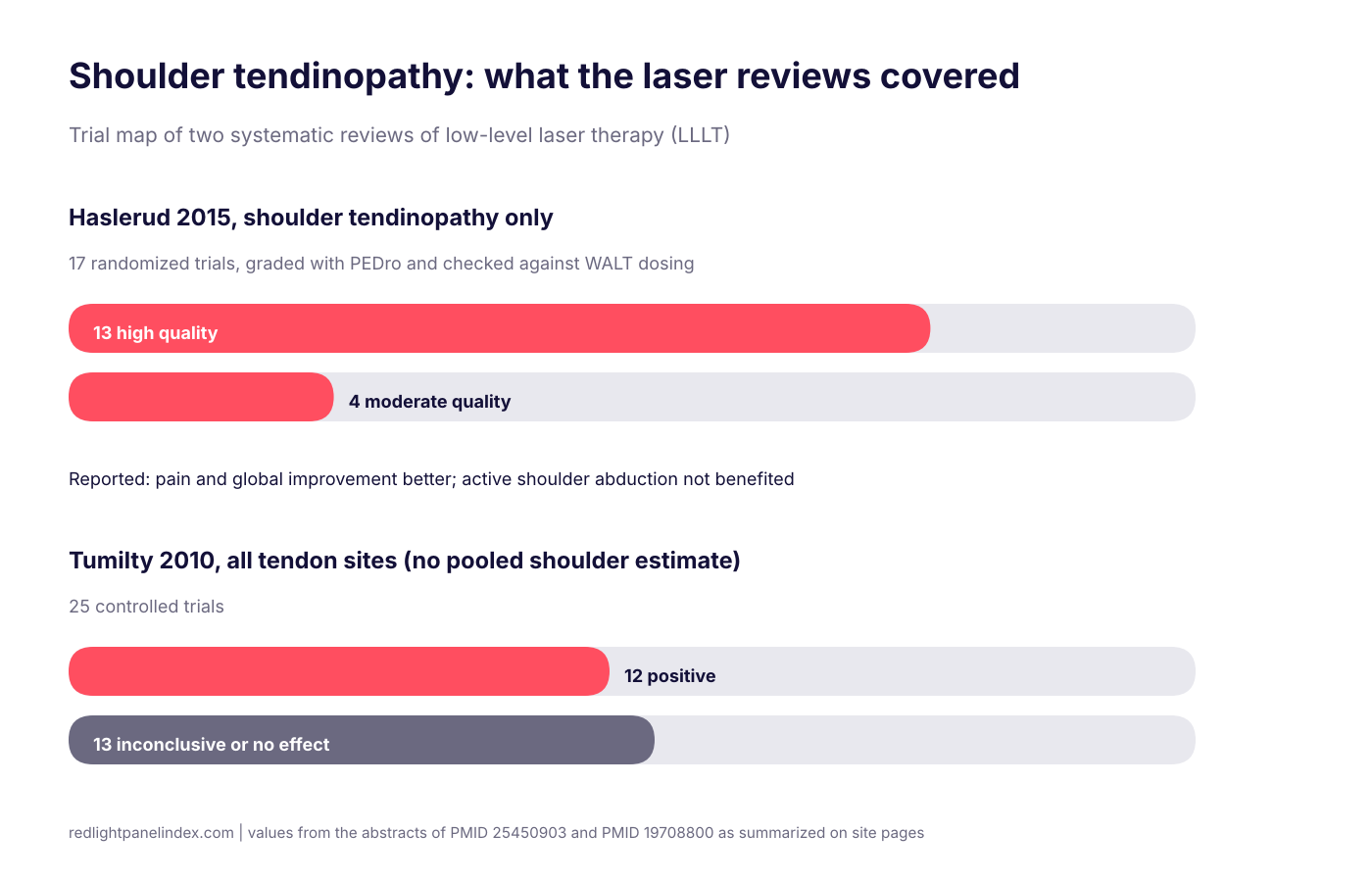
The evidence grade for red and near-infrared light in shoulder tendinopathy is Moderate for clinical laser and Limited for home panels: one systematic review and meta-analysis pooled 17 randomized controlled trials and reported that pain and global improvement outcomes improved, but the evidence is low-level laser therapy trials, not home panels (PMID 25450903). The grade stops short of Strong because the review reported that active shoulder abduction was not benefited, the included trials varied in dose, and the evidence base is laser therapy, not panels.
Choosing a panel? Our ranking of the best red light therapy panels is computed from published, method-labeled specs across 188 devices. For shoulder tendon pain, the spec that matters is method-labeled near-infrared irradiance at the distance you will actually use, because the shoulder's tendons sit under muscle and bone.
How this page grades the evidence
Grades on this site run from Strong to Moderate, Limited and Insufficient, and are explained in how this site grades evidence. For a joint condition with a Limited grade, see the rheumatoid arthritis page. Shoulder tendinopathy earns a split grade for one reason: the research question has been asked directly, with a meta-analysis built only on shoulder trials, but the intervention in those trials was low-level laser therapy, dosed per treated point, not a panel delivering light across a wide area. That mismatch is the main thing a panel owner needs to carry away from this page.
The wider tendon picture, including the Achilles, plantar fascia and elbow, is graded Moderate on the tendinopathy evidence page. The shoulder has its own page because the joint is anatomically different: the tendons of the rotator cuff run beneath the deltoid and the bony arch of the shoulder, so light has more tissue to cross than it does at the Achilles.
The studies
Haslerud shoulder meta-analysis (2015)
A systematic review and meta-analysis by Haslerud and colleagues, published in Physiotherapy Research International, pooled randomized controlled trials of low-level laser therapy (LLLT) in shoulder tendinopathy (PMID 25450903). It was described as the first review to focus only on this condition. The abstract reports that 17 randomized controlled trials were included, 13 of high and 4 of moderate methodological quality. The primary outcomes were pain on a 100 mm visual analogue scale and relative risk for global improvement. Two independent assessors scored the trials on the PEDro scale, and the laser doses and procedures were assessed against the dosing recommendations of the World Association for Laser Therapy (WALT).
The authors reported that outcomes were improved when LLLT was used alone and when it was added to another treatment. They also reported that active shoulder abduction, the movement of raising the arm out to the side, was not benefited by treatment. The abstract text we could read did not include the pooled pain difference or its confidence interval, so this page does not quote a number for it. Rather than guess, we describe the direction of the finding: improved pain and global outcomes, with no benefit reported for active abduction.
That last point deserves attention. Raising the arm sideways is exactly the movement that is painful and limited in many people with a rotator cuff problem. A treatment that eases pain at rest or on testing, but does not change that movement, is not the same as one that restores function. The finding is a reminder to read "improved" narrowly.
Tumilty tendinopathy meta-analysis (2010)
An earlier systematic review pooled 25 controlled trials of LLLT across tendon sites. Twelve trials reported a positive effect and 13 were inconclusive or showed no effect, and the authors reported that the dosages in the positive trials were close to recommended guideline ranges (PMID 19708800). Only lateral epicondylitis and Achilles tendinopathy had enough comparable data to pool, so the 2010 review does not give a shoulder-specific estimate. Its value for shoulder readers is the pattern it identified: dose, not the mere presence of a laser, appeared to separate trials that reported benefit from those that did not. Our study review of the Tumilty meta-analysis covers it in detail.
What the two reviews have in common
- Both pooled randomized or controlled trials and both assessed the trials against WALT-style dosing guidance, which makes dose the shared theme.
- Both were built on low-level laser therapy trials, not on home LED panels.
- Both reported a favorable direction on pain, and neither promises a large or guaranteed effect.
- Neither review establishes that longer or more frequent sessions are better. The point of both is a dose inside a studied window.
Reading the evidence for joints next door
The shoulder is also a joint, and the best-graded joint evidence on this site is for the knee. Two knee reviews, a meta-analysis of knee osteoarthritis trials and a trial of photobiomodulation added to exercise, show the same structure as the shoulder work: the useful results came when the light was combined with a rehabilitation program or delivered at a dose close to guidance. That does not transfer automatically to the shoulder, because cartilage and tendon are different tissues, but it supports a general reading that light has been studied as an add-on to exercise, not as a replacement for it. The broader joint pain and arthritis evidence hub sets these side by side.
What was not studied
- Home LED panels. The shoulder meta-analysis was of low-level laser therapy trials. No source here tested a multi-wavelength LED panel held at a distance from the shoulder.
- Active abduction. The review reported that active shoulder abduction was not benefited, so the movement that matters most to many people with shoulder pain has no supporting result in this source.
- Specific shoulder diagnoses. The review title says shoulder tendinopathy. This page does not claim results for frozen shoulder, a full-thickness tear, a recent dislocation or post-surgical shoulders.
- Long-term outcomes. We could not read follow-up lengths from the abstract, so this page makes no statement about how long any change lasted.
- Panel doses. Laser guidance is written in joules per point. No source here defines an equivalent for a panel placed at a distance, which spreads the same light over a much larger area at lower irradiance.
- Direct comparison with exercise or injections. Neither review, as read here, tells you how light compares with a loading program.
A practical section for panel owners
Because dose was the thread running through the tendon research, the useful step is to compute it. Take a method-labeled irradiance figure for the distance you will actually sit or stand at, multiply by minutes, and run the result through the dose calculator. Our page on WALT dosing recommendations explains why per-point laser guidance does not turn directly into minutes of panel time, which is the reason to treat any panel protocol for the shoulder as an estimate and not a prescription.
Wavelength is the second lever. Near-infrared light travels further into tissue than red light, as covered on our 810nm page and in the wavelengths overview. The tendons of the rotator cuff lie deeper than the skin-level tendons that most trials favor, so the share of a panel's output in the near-infrared band is worth checking. How that irradiance was measured matters as much as the number itself, and the irradiance explainer shows how to read a labeled figure against a claimed one. If you are comparing models for joint use, the best panels for joint pain page applies the same method-labeled criteria to every brand, and how rankings work lists those criteria.
Coverage is a practical question too. A shoulder is a broad area, and a panel placed at a working distance can cover the whole joint without repositioning, but that is a convenience point, not something the trials tested.
Cautions
- Shoulder pain after a fall, a sudden loss of strength, a visibly deformed joint, or pain with chest tightness or arm numbness needs assessment, not a light session.
- Light was studied as a stand-alone or an add-on in controlled trials. It was not shown to replace rehabilitation, imaging or medical care.
- People who are pregnant, have a history of skin cancer over the site, or take photosensitizing medication should speak with a clinician first.
- Eye protection matters with bright near-infrared sources, even though the band is invisible.
- Pain scores are self-reported, and the review reported no benefit for active abduction, so expect pain relief to be the realistic target and not a restored range of motion.
- Judge any change over several weeks of consistent use, and stop if pain worsens.