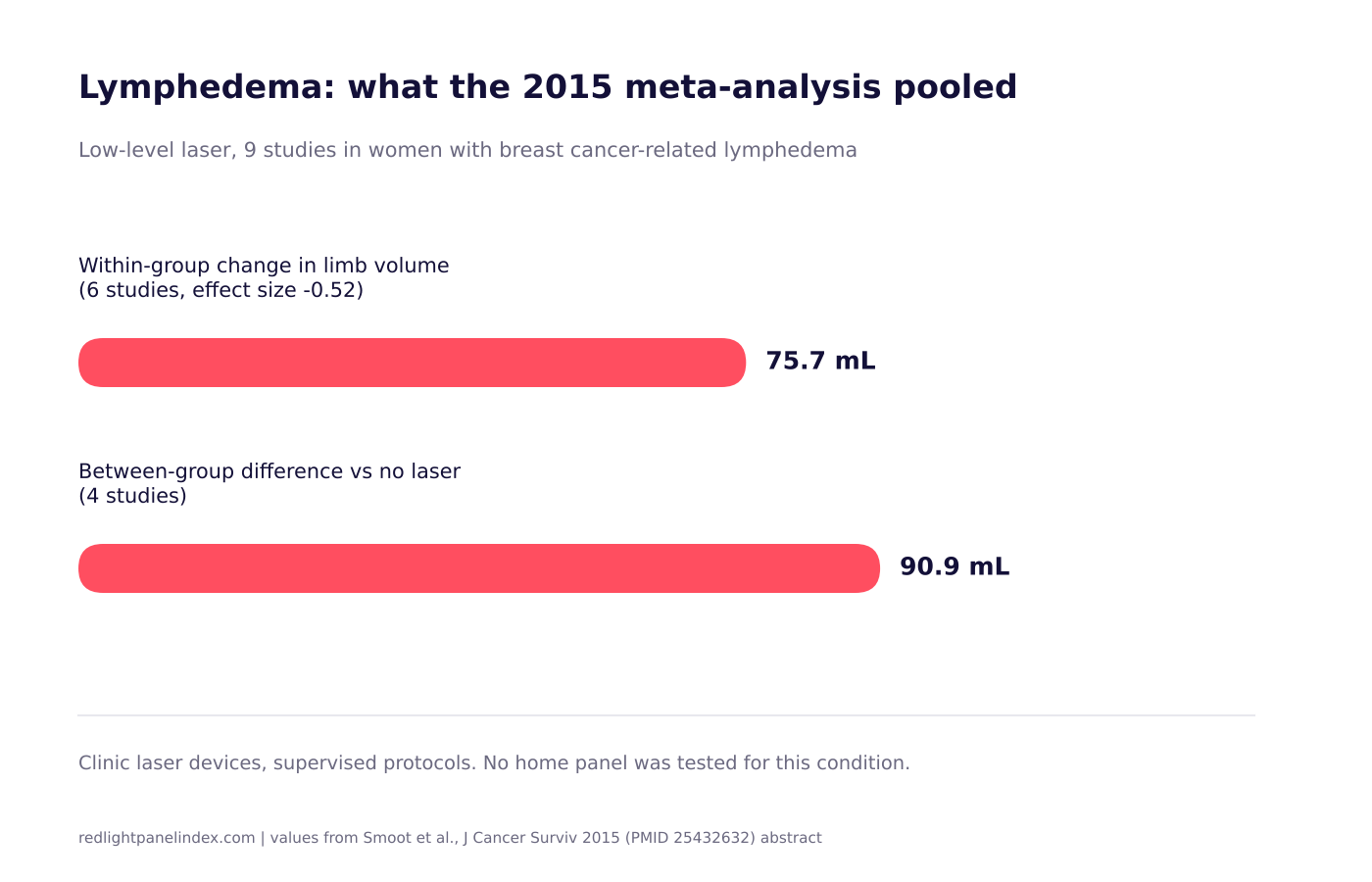
The evidence grade for red light therapy and breast cancer-related lymphedema is Limited for home use: a 2015 meta-analysis pooled nine studies of low-level laser therapy and reported reductions in limb volume, but those studies used clinic laser devices under supervision, and no home LED panel has been tested for this condition.
Choosing a panel? Our ranking of the best red light therapy panels is computed from published, method-labeled specs across 188 devices. For lymphedema, the spec that matters is less any panel number than whether the setup resembles the clinic devices in the trials, and none of the panels in the index has been tested that way.
The condition in brief
Lymphedema is swelling of an arm, hand or chest area that can follow breast cancer surgery or radiation, when lymph fluid does not drain normally. It is a medical condition managed by oncology and lymphedema specialists, and light therapy in the research literature is studied as an add-on to that care, not as a replacement for it. This page describes what was reported and does not give treatment advice.
The main evidence: a 2015 meta-analysis
The key source is a systematic review and meta-analysis of low-level laser therapy in women with breast cancer-related lymphedema, published in the Journal of Cancer Survivorship in 2015 (PMID 25432632). The authors searched PubMed, PEDro, CINAHL and Cochrane, with a last search in October 2014, and nine studies met their inclusion criteria.
What the abstract reports:
- For limb volume, the pooled within-group effect size across six studies was -0.52 (95 percent interval -0.78 to -0.25), which the authors translate to a 75.7 mL reduction in limb volume after laser therapy.
- For between-group comparisons, the pooled effect across four studies favored treatment that included laser over treatment without it, corresponding to about 90.9 mL greater volume reduction.
Those are group averages from pooled studies, so they do not predict what any one person would see. The within-group figure compares a group with itself before and after, which cannot separate the effect of light from the effect of time or of other treatment. The between-group figure is the more informative of the two, and it rests on only four studies.
What the studies used
The meta-analysis pooled trials of laser devices applied in clinic settings. This site has not read the full text of each included trial, so it does not quote wavelengths, power or joules for them. The pooled abstract does not give a single dose, and the trials differed. That matters for a home reader: a pooled effect is not a recipe. You cannot take the numbers above, find a panel with similar specs and expect a similar result.
The wavelength page explains why laser and LED sources are not interchangeable on paper, and the LED versus laser page covers the differences in beam, power and treatment area that make a clinic laser a different tool from a panel.
What about safety in cancer patients
A reasonable worry is whether shining light on tissue near a cancer site could stimulate residual tumor cells. A 2019 systematic review in Oral Oncology asked that question across photobiomodulation used for cancer treatment toxicities, including lymphedema (PMID 31109692). The abstract describes the science as promising for prevention and management of breast cancer-related lymphedema and oral mucositis, among other toxicities. This site treats that as indirect reassurance: the review was a look at clinic use with oncology supervision, and the abstract is not a statement that home use is established as safe for people with a cancer history. The safety and side effects page lists the same limitation, and its Limited grade reflects that safety was a secondary outcome in most trials.
How to read the numbers
Volume in milliliters is a measurement of limb size, usually estimated from circumferences along the arm, and it is not the same as comfort, function or quality of life. A person can have a small change in volume and a large change in how the arm feels, or the reverse, and the abstract's volume figures say nothing about either. Because the dose in the pooled trials was not uniform, the biphasic dose response page is also worth a read: more light is not reliably better, which is another reason to avoid improvising a schedule.
Reviews published after 2015 have continued to pool these trials, and this page rests on the 2015 paper because it is the one listed in the register and the one whose abstract was read for this page. A newer review may reach a different pooled figure as trials accumulate, so treat the numbers above as a snapshot of one analysis and not as a settled effect size.
What was not studied
- A home LED panel used on a lymphedema arm. No trial of that kind is in the register.
- Long-term outcomes after the clinic course ended, and whether any benefit persists.
- Whether light adds anything beyond standard care such as compression, manual lymph drainage and exercise, in each person's circumstances.
- Safety of home use for people with active cancer, recent radiation or recent surgery.
- Lymphedema from causes other than breast cancer treatment, which this page does not cover.
- Children and teens, a group covered on the kids safety guide.
What this means for a home panel
Because the trials are clinic-laser trials, the practical answer for most readers is to raise the question with the oncology team or lymphedema therapist who already manages the swelling. Do not start a panel on an affected arm, chest wall or underarm without that conversation, and do not use light in place of compression, drainage or a clinic's protocol.
If a clinician does agree to home light, the dose calculator converts a panel's method-labeled irradiance and a session length into a surface dose in joules per square centimeter. It lets you and the clinician see what a given distance and time deliver. It does not say what dose is right for lymphedema, since the trials differ and no single dose is established. The irradiance science page explains why two panels with the same claimed number can deliver different amounts of light.
Heat is another point to raise. The thermal versus photochemical page notes that panels give off some warmth, and an arm with reduced sensation or swelling needs particular care about it.
Cautions
- Lymphedema can signal infection or a clot. New swelling, redness, warmth or pain needs prompt medical attention and not a light session.
- Skin that is irradiated, broken or healing from surgery is a question for the treating team.
- Eye protection applies to any panel with a blue or violet channel, as the eye protection guide explains.
- Photosensitizing medications are a separate question; see the guide to photosensitizing medications.
- Light does not disinfect tissue or replace wound care. The wound healing page makes the same point about adjunct use.
How this compares with other pages
Lymphedema sits with the conditions where the research base is real but built on clinic devices. The cellulite page is a similar case, with a green clinic laser and no home panel tested, and the hypothyroidism trial review shows how a single clinic-laser RCT is read. For another cancer-care topic, see the chemotherapy neuropathy page.
Bottom line
Pooled clinic-laser studies reported lower limb volume in breast cancer-related lymphedema, and an indirect safety review did not flag tumor-safety problems in supervised use. Neither finding covers a home panel. Treat light as a topic for your oncology team, not a self-directed treatment.