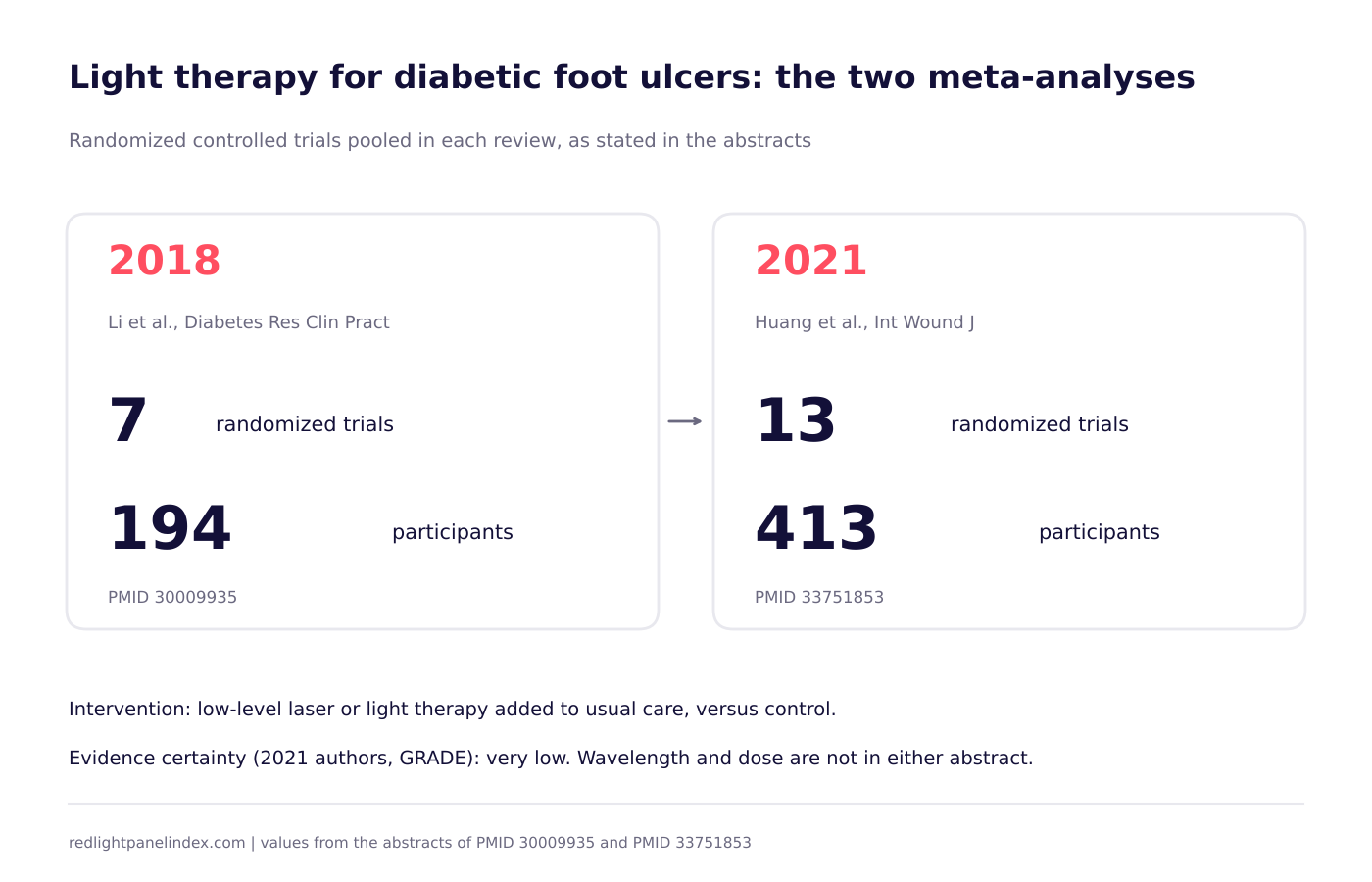
The evidence grade for diabetic foot ulcers is Moderate: two meta-analyses of randomized controlled trials, published in 2018 and 2021, both reported that low-level laser therapy was associated with better healing than control, but the trials were small, mostly used clinic lasers rather than home panels, and the 2021 authors rated the certainty of the evidence as very low. A diabetic foot ulcer is an open wound on a foot that often has reduced sensation, and it is managed by clinicians; nothing here is a reason to treat one at home.
Choosing a panel? Our ranking of the best red light therapy panels is computed from published, method-labeled specs across 188 devices. For a topic like this one, the spec that matters is the dose delivered at the skin, and no panel spec turns a consumer device into wound care.
How the grade was assigned
The site's evidence grades use four levels. Moderate means controlled trials exist, but there are fewer of them, they are smaller, and they may have used clinic devices whose wavelength, irradiance or session length differ from a home panel's. That description fits this topic closely. The broader wound healing evidence page covers light and wounds in general; diabetic ulcers are graded separately here because the biology and the risks are different. For a different tissue, see the Limited-grade page on red light therapy and bone healing.
What the studies found
Li and colleagues, 2018
This systematic review and meta-analysis pooled seven randomized controlled trials with 194 participants (PMID 30009935). The abstract reports that low-level light therapy was associated with a reduction in ulcer area (weighted mean difference 34.18, 95% CI 19.38 to 48.99) and a higher complete healing rate (odds ratio 6.72, 95% CI 1.99 to 22.64). The included trials also suggested faster granulation tissue formation, shorter time to ulcer closure and less foot ulcer pain, and no treatment-related adverse events were reported. The abstract does not state the measurement units for the area result, so that number should be read as a direction of effect rather than a size.
Huang and colleagues, 2021
A later meta-analysis searched eight databases through August 2020 and pooled 13 randomized controlled trials with 413 patients (PMID 33751853). Compared with controls, low-level laser therapy was associated with a higher complete healing rate (risk ratio 2.10, 95% CI 1.56 to 2.83), a larger reduction in ulcer area and a shorter mean healing time. The authors rated the quality of the evidence as very low under the GRADE system, called laser therapy a promising adjunct, and asked for larger, higher-quality trials to confirm the effect and to identify the best parameters. The abstract reports no breakdown by wavelength, energy density or treatment duration.
For a closer reading of both papers, including their limits, see our study review of the two meta-analyses.
What was not studied
- Home panels. The abstracts describe low-level laser or light therapy delivered in trial settings. They do not report consumer LED panels used at home, so these results do not show what a panel would do. Laser and LED differ in beam and delivery; see LED versus laser.
- A best wavelength or dose. Neither abstract identifies one, and the 2021 authors say the optimal parameters remain unknown.
- Prevention. The trials enrolled people who already had ulcers. Nothing here tests whether light prevents one from forming.
- Light on its own. Trial participants were also receiving standard care, and the evidence supports light only as an add-on, as the authors describe it.
- Long-term outcomes. The abstracts do not report recurrence, amputation or follow-up beyond healing.
The neuropathy connection
Many people with diabetic foot ulcers also have peripheral neuropathy, and that is a separate evidence question. The neuropathy evidence page covers a 200-patient trial of a helium-neon laser, which reported improved neuropathy symptoms but made no claim to reverse nerve damage; our review of that trial explains its design. Symptoms improving is not the same as an ulcer closing, and neither result should be read across to the other.
Practical notes for home users
If you have diabetes, the practical point is about sequence. A foot wound needs a clinician first: debridement, offloading, infection control and glucose management are what the trials were adding light to. Light does not disinfect a wound or replace dressings.
If a clinician has said that adding light is reasonable for you, a few items help the conversation:
- Ask which wavelength and dose the clinic would target. The dose calculator converts a panel's irradiance and your distance and time into joules per square centimeter, so you can compare a panel's output with a clinic's stated dose. The background is in the explainer on joules per square centimeter.
- Check the irradiance claim before comparing anything. The irradiance explainer shows why a number without a measurement method cannot be compared, and the wavelengths page lists what red and near-infrared bands are generally used for.
- Remember that reduced sensation can mask heat or damage. A device that feels comfortable is not evidence that the dose is appropriate for numb skin.
The sham-controlled trials explainer is worth reading before weighing any trial, because it shows how a control arm changes what a result can claim.
Why the mechanism does not settle the question
The proposed biology is that red and near-infrared light is absorbed by mitochondrial enzymes, which is the subject of the photobiomodulation explainer. A plausible mechanism is a reason to run trials, not a result. In a diabetic foot the picture is complicated by reduced blood flow, reduced sensation and infection risk, none of which a light source addresses by itself. The meta-analyses are the more useful guide, and they are cautious in their own wording: the 2021 authors describe a promising adjunct and ask for better trials, not for home use.
How this differs from other pages on the site
Pages on skin, hair or joints can reasonably end with a home protocol, because the trials there used parameters a panel can approach. This page cannot, because the evidence is about a clinical wound in a high-risk population. That is also why the title says clinic evidence. If you are comparing how strong the case is across conditions, the evidence grades explainer places Moderate between Strong and Limited, and the wound healing page shows how the broader wound literature is handled.
Cautions
- Do not delay medical care for a foot wound, redness, swelling, warmth, drainage or odor. Infection in a diabetic foot can progress quickly.
- Do not use a panel in place of dressings, offloading or prescribed treatment.
- Do not apply light over a wound without clinician direction.
- Eye safety applies as with any panel; see the eye protection guide.
- This page describes published research. It is not medical advice and does not say a panel will help any wound.
Bottom line
Two meta-analyses report an association between low-level laser therapy and better ulcer healing, which is why the grade is Moderate rather than Limited. The very low certainty rating, the small trials and the clinic delivery are why it is not higher, and why the practical conclusion is clinic evidence, not a home protocol. For how we weigh sources, see how rankings work.