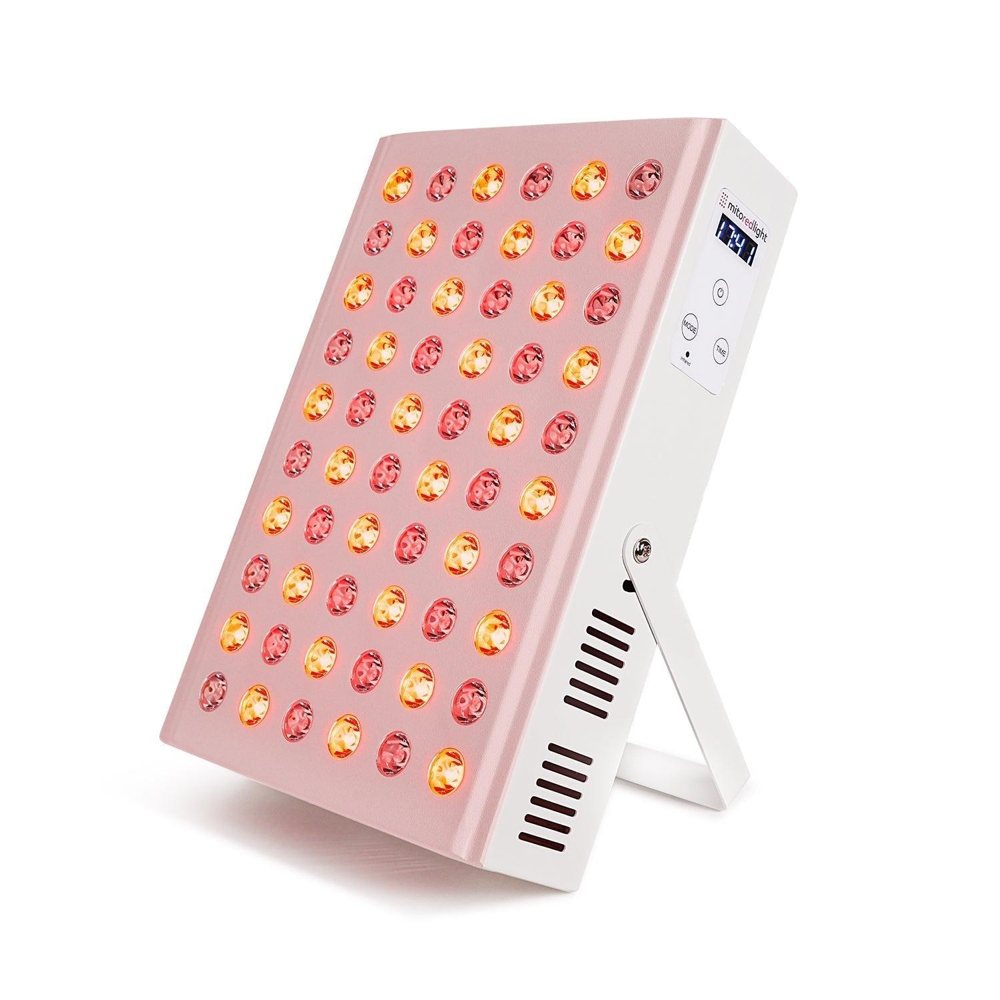
The best red light panel under $500, on the database fields this site ranks by, is the Mito Red Light MitoMIN 2.0 at $249: it is the one model in this tier whose irradiance figure is disclosed by two named methods, it carries a 3-year warranty, and it offers a 60-day trial. Below $500 you can buy a credible panel, but you will not find spectrometer-measured data for most models, a 1064 nm band is rare, and large coverage is thin.
Choosing a panel? Our ranking of the best red light therapy panels is computed from published, method-labeled specs across 188 devices. For a panel under $500, the spec that matters is an irradiance figure that names its measuring instrument.
How this list was ranked
The ranking uses the same fields as every best-of page; see how rankings work for the full method. Models are ordered by, first, whether the irradiance figure is labeled with a method and a distance, then trial and warranty terms, then coverage and wavelength mix, with price shown for context. RLT Home is one brand among 41 and gets the same criteria and cautions as any other. This page covers the models under $500 whose database pages were checked for this update; a model that sits close to $500 or was not checked may be missing, so the full panel database remains the place to filter by price; for the next band up, see the best red light panels under $1,000.
All prices below are database prices with the date each was verified. Prices change, so confirm on the seller's page before buying.
The criteria
| Criterion | What counts |
|---|---|
| Irradiance | A figure at a stated distance, with the method named (solar meter, spectrometer, or both) |
| Trial and returns | Length of the trial window, restocking fees, who pays return shipping |
| Warranty | Length stated by the brand |
| Coverage | Panel dimensions as listed |
| Wavelengths | Number and mix of bands |
| Price | Database price and verification date |
Why the method label matters: a solar meter reads roughly twice as high as a spectrometer on LED panels, because it responds to a broader part of the spectrum. The site's analysis of claimed versus measured irradiance found that claimed headline figures averaged 2.11 times the spectrometer figure across 44 panels, mainly from instrument differences. Our explainer on irradiance and how it is measured covers the detail. A number without a method, or quoted at a different distance, cannot be compared with one that has both.
The ranked picks
| Rank | Model | Price (verified) | Irradiance as listed | Trial | Warranty | Dimensions |
|---|---|---|---|---|---|---|
| 1 | MitoMIN 2.0 | $249 (2026-08-13) | 115 mW/cm2 at 6 in, solar meter and spectrometer both disclosed | 60 days | 3 years | 12x9x3 in |
| 2 | Rouge Nano | $236 (2026-08-12) | Brand claim over 100 mW/cm2 at 6 in; third-party 164 solar meter and 90 spectrometer at 6 in, plus a lab report | 60 days | 3 years | 5.9x2.99x1.18 in |
| 3 | CytoLED Zero | $323 (2026-08-13) | 33 mW/cm2 at 6 in, spectrometer-corrected | 30 days | 2 years | 24x23x6.5 cm |
| 4 | Hooga HG500 | $359 (2026-09-12) | 94 mW/cm2 at 6 in, method not stated | 60 days | 3 years | 18.8x8.2x2.7 in |
| 5 | Hooga HG300 | $199 (2026-09-12) | 73 mW/cm2 at 6 in, method not stated | 60 days | 3 years | 12.2x8.2x2.5 in |
| 6 | Hooga HG200 | $149 (2026-09-12) | 100 mW/cm2 at 6 in, method not stated | 60 days | 3 years | 9.5x6x1 in |
| 7 | GembaRed Rex 2.0 | $379 (2026-08-13) | 5 mW/cm2 at 6 in, listed from third-party spectrometer peaks | 60 days | 2 years | 12x12x1.4 in |
| 8 | Kala Mini 2.0 | $295 (2026-08-13) | Brand claim 100 mW/cm2 at 0 in; 135-161 mW/cm2 at 6 in, instrument unspecified | 30 days | 2 years | 102x146x35 mm |
| 9 | LifePro BioHeal | $180 (2026-08-13) | 82 mW/cm2 at 6 in, method not stated | 30 days | Lifetime | 10.2x8.8x3.4 in |
| 10 | Bestqool BQ60 | $189 (2026-08-12) | 95.6 mW/cm2 at 3 in, not comparable to 6-in figures | 30 days | 2 years | 13.1x8.4x2.1 in |
| 11 | Bestqool BQ40 | $149 (2026-08-12) | 70 mW/cm2 at 3 in, not comparable to 6-in figures | 30 days | 2 years | 11.3x5.6x1.3 in |
| 12 | Comfytemp K4037 55W | $120 (2026-08-13) | 143 mW/cm2 at 6 in, method not stated | 30 days | 1 year | listed as arm to 40 in |
All twelve list 660 nm and 850 nm, except the Rex 2.0 and the Kala Mini 2.0, which add 630 nm and 830 nm.
Why the order falls this way
MitoMIN 2.0. It is the only model here where the brand itself discloses both instruments on its database page, so the 115 mW/cm2 figure is interpretable. The 60-day trial has no restocking fee, though return shipping is the buyer's cost unless an optional paid add-on was bought. At 12x9x3 inches it suits one body area at a time.
Rouge Nano. The page cites a third-party measurement of 164 on a solar meter and 90 on a spectrometer at 6 inches, plus an integrating-sphere lab report, which is more measurement detail than most of the tier. The trade-off is size: at 5.9 by 2.99 inches it is a small targeted device, and the buyer pays all return shipping.
CytoLED Zero. Its 33 mW/cm2 is lower than the headline numbers above it, but it is labeled spectrometer-corrected, which is the more conservative method. That figure is not worse than 115 on a solar meter; it is measured differently. The 30-day trial comes with no return-shipping coverage.
The Hooga trio. All three offer a 60-day trial and a 3-year warranty, which is the strongest trial-and-warranty combination in the sub-$400 range. The caveat is that the brand figures carry no stated method, and the database notes independent testing measured roughly half of the stated value. The HG500 ranks highest of the three on coverage. The HG300 versus PRO300 versus ULTRA360 guide shows what changes up the Hooga line.
The rest. The Rex 2.0 is listed with a low spectrometer-peak figure but a wider four-band mix and a 60-day trial. The Kala Mini 2.0 has a brand claim measured at 0 inches, which is not comparable with the 6-inch figures elsewhere; its database page also flags the "FDA Cleared" badge as unverified, and there is a $15 restocking fee. LifePro is the only lifetime warranty on the list. The Bestqool pair quotes irradiance at 3 inches, so its figures should not be set beside the 6-inch ones; see the Bestqool versus Comfytemp comparison for those two side by side. The Comfytemp K4037 is the cheapest at $120 but has the shortest warranty and a 15% restocking fee.
What is missing at this price
- Spectrometer data. Only a few pages carry a spectrometer figure (the CytoLED Zero, the Rouge Nano via a third-party test, the Rex 2.0, and the MitoMIN 2.0 alongside a solar meter reading). Most of the tier quotes a bare number.
- 1064 nm. Among the models checked here, none has a 1064 nm band. The panels listing shows one model near the top of the tier, the Helio Spark, with a 1064 nm band; check its page for current price and terms. For background on why that band is discussed, see penetration depth.
- Large coverage. The largest listed here is the 18.8-inch HG500. A full-body setup costs well above this tier; for context, see the budget panel ranking and how to choose a panel.
- Close distance figures. Three models quote 3-inch or 0-inch figures, which overstate what you will get at a normal treatment distance. The inverse square law explains why. For a buyer's checklist covering these gaps and return terms, see whether cheap red light panels are worth it.
If this is your first panel, the best first panel for beginners ranks a shorter list with the mistakes to avoid.
Using the numbers
Whatever you buy, the useful step is to convert irradiance to dose for your planned distance and session length with the dose calculator. A method-unlabeled 100 mW/cm2 may deliver closer to half that on a spectrometer, which changes how long a session needs to be. The irradiance versus total power explainer shows why a small, bright panel and a large, dimmer one are not interchangeable.
Bottom line by use case
- One area, best-documented numbers: MitoMIN 2.0 or Rouge Nano.
- Longest trial and warranty for the money: a Hooga model, knowing the brand figure has no stated method.
- Lowest entry price: Comfytemp K4037 or Bestqool BQ40, with shorter warranties and 30-day windows.
- Most conservative labeled measurement: CytoLED Zero.
None of these is a substitute for checking the seller's current price, return terms and trial window on the day you buy.