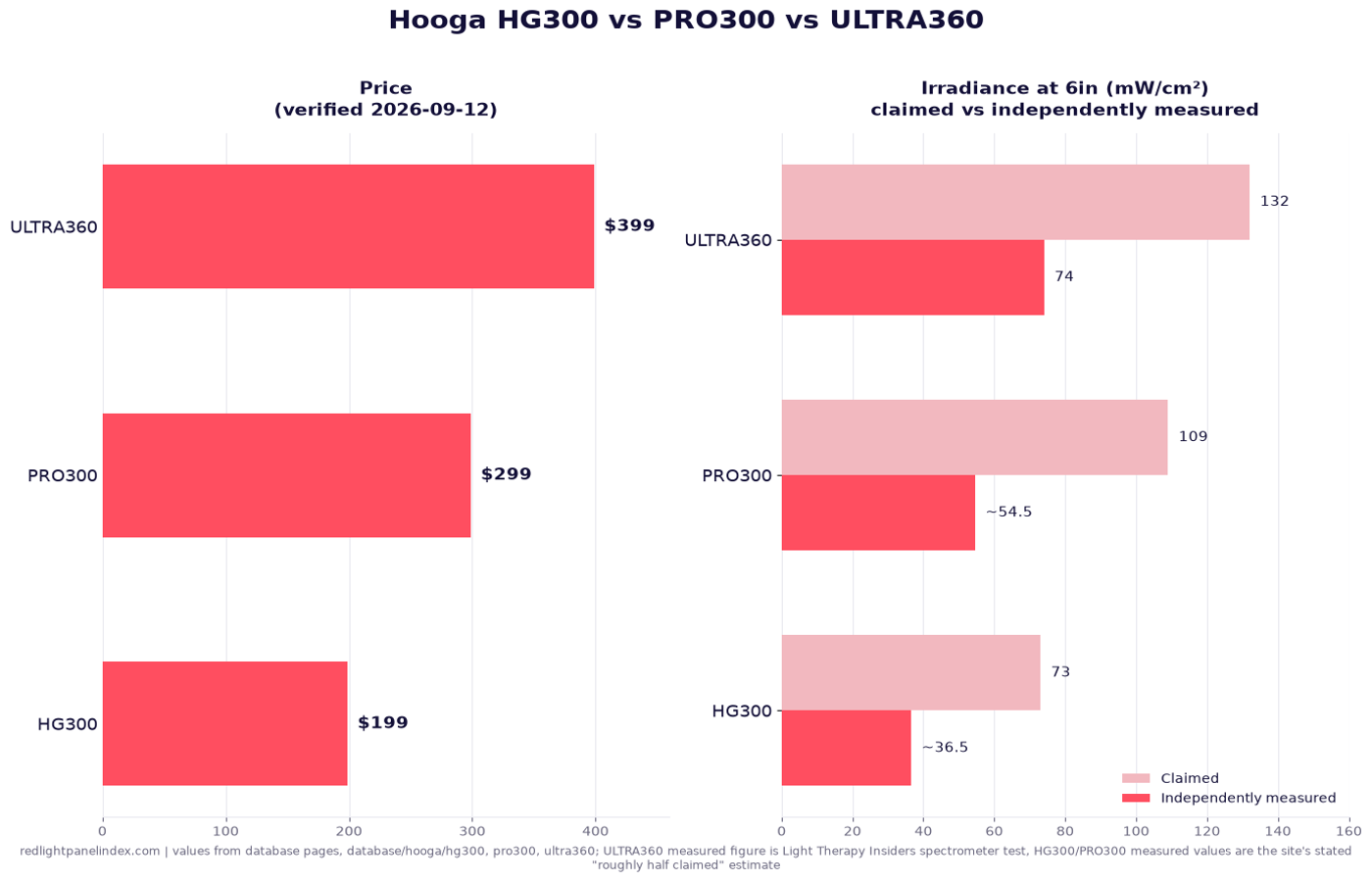
Hooga sells three panels in a single product line: the HG300 at $199, the PRO300 at $299, and the ULTRA360 at $399 (all verified 2026-09-12). The names suggest a simple ladder, but the actual differences between the three are not evenly spread across that $200 gap, and one tier changes in a way the other two do not: it is the only one of the three with an independently measured irradiance figure behind its claim.
Choosing a panel? Our ranking of the best red light therapy panels is computed from published, method-labeled specs across 188 devices. For a within-brand decision like this one, the spec that matters is which tier actually changes wavelength coverage, not just LED count.
The three tiers, side by side
| Spec | HG300 | PRO300 | ULTRA360 |
|---|---|---|---|
| Price (verified 2026-09-12) | $199 | $299 | $399 |
| Wavelengths | 660, 850nm | 660, 850nm | 630, 660, 810, 850nm |
| LED count and type | 60 single-chip | 60 dual-chip | 72 quad-chip (2 red + 2 NIR per LED) |
| Claimed irradiance at 6in | 73 mW/cm² | 109 mW/cm² | 132 mW/cm² |
| Independently measured at 6in | Not tested by name; site notes it runs roughly half of similar Hooga models' claims | Not tested by name; same roughly-half note | 74 mW/cm² (Light Therapy Insiders spectrometer test) |
| Dimensions | 12.2 x 8.2 x 2.5in | 12.7 x 8.6 x 3.1in | 12.7 x 8.6 x 2.5in |
| Extras | None listed | Foldable tabletop stand, EMF measured at 0.0 uT at 6in | Flicker-free operation, adjustable brightness, programmable pulse (1 to 9,999 Hz), remote panel sync |
| Warranty | 3 years | 3 years | 3 years |
| Trial and returns | 60 days, no stated restocking fee, prepaid US return label cost deducted from refund, open-box non-refundable | Same terms as HG300 | Same terms as HG300 and PRO300 |
Wavelengths: the real split is between two tiers and one
The HG300 and PRO300 both ship the same two wavelengths, 660nm and 850nm, the most commonly studied red and near-infrared pair on this site's evidence pages. The ULTRA360 is the only tier that adds anything to that mix: 630nm and 810nm on top of the same 660/850nm base, for four wavelengths total. If wavelength coverage across the red and near-infrared range is the deciding factor for you, rather than raw output, the ULTRA360 is the only Hooga tier that gives you a broader spread; the HG300 and PRO300 are identical to each other on this spec, meaning the extra $100 between them buys something other than wavelength coverage.
LED design follows a similar pattern. The HG300 uses 60 single-chip LEDs, the PRO300 uses 60 dual-chip LEDs at the same count, and the ULTRA360 steps up to 72 quad-chip LEDs, each combining two red and two near-infrared emitters. More chips per LED is Hooga's way of packing more wavelength diversity into the same panel footprint, which is consistent with the ULTRA360 being the only tier with four wavelengths instead of two.
Irradiance: one claim you can check, two you cannot
This is where the tiers diverge most, and not in the direction the price ladder alone would suggest. Hooga's own claimed irradiance rises steadily with price: 73 mW/cm² for the HG300, 109 for the PRO300, 132 for the ULTRA360, all stated at 6 inches with no measurement instrument named by the brand. But only the ULTRA360 has an independently measured figure behind it: a Light Therapy Insiders spectrometer test put its real output at roughly 74 mW/cm² at the same distance, a little more than half the brand's claimed 132. The HG300 and PRO300 pages do not report a spectrometer test specific to those models; the site's own database notes that independent testing on similar Hooga models found output running roughly half of the claimed figure, which is the same ratio the ULTRA360's tested result shows, but it is an inference from a related model, not a direct measurement of the HG300 or PRO300 themselves.
That matters because brand-claimed irradiance figures across the industry run roughly double the spectrometer-verified figure on average, so treating any unlabeled claim as a ceiling rather than a floor is the safer read. If you apply that same rough halving to the HG300 and PRO300, you land at an estimated 36 to 37 mW/cm² for the HG300 and roughly 55 mW/cm² for the PRO300, both well below the ULTRA360's tested 74. Whatever tier you buy, run the actual number, not the brand's raw claim, through the dose calculator to size a session length at your real working distance; a device with a method-labeled irradiance figure is always the more trustworthy starting point than a claim with no named instrument behind it.
Extras: stand, pulse mode and flicker
Past the core wavelength and irradiance specs, each step up adds a feature the tier below does not have. The PRO300 includes a foldable tabletop stand, useful if you want the panel to sit upright on a desk or counter rather than being wall-mounted or handheld, and its listing reports an EMF reading of 0.0 uT at 6 inches, which is a low-EMF claim worth noting if that is a concern for you specifically. The ULTRA360 goes further still, adding flicker-free operation, adjustable brightness, a programmable pulse mode running from 1 to 9,999 Hz, and remote panel sync for controlling multiple units together. None of these extras change the core photobiomodulation mechanism the wavelength science pages describe; they are convenience and control features layered on top of the same underlying red and near-infrared output.
Price and value across the ladder
The HG300 is Hooga's own budget standout: it holds the number one spot on this site's best budget panels list, scored on database fields only, the same criteria used for every brand (see how rankings work), and it earns that spot specifically for offering single-chip 660/850nm output at a starter price with a 60-day trial and 3-year warranty. Stepping up to the PRO300 buys a dual-chip LED design at the same two wavelengths, a stand, and a low EMF reading, for $100 more, without adding wavelength coverage. Stepping up again to the ULTRA360 buys two more wavelengths, more LEDs, the pulse and sync features, and the only independently tested irradiance figure of the three, for another $100.
Judged purely on dollars per claimed mW/cm², the PRO300 and ULTRA360 both improve on the HG300's rate, but claimed numbers are not measured numbers, and the ULTRA360 is the only one of the three where that comparison rests on an actual spectrometer test rather than an assumption carried over from a similar model.
Verdict by use case
If you want the lowest entry price, the two most heavily studied wavelengths, and you are comfortable estimating real output at roughly half of Hooga's claim, the HG300 is the pick; it is also the model this site's budget ranking already scores highest among Hooga's line for exactly that combination of price and terms. If you specifically want a tabletop stand and a slightly higher claimed output at the same two wavelengths as the HG300, and $100 more is not a barrier, the PRO300 fills that gap, though it does not add anything the HG300 lacks in wavelength coverage. If broader wavelength coverage across 630, 660, 810 and 850nm matters to you, or you want the reassurance of an independently measured irradiance figure rather than an inferred one, the ULTRA360 is the only tier that delivers both, and it is the more defensible buy of the three on transparency grounds even though it costs twice the HG300's price. All three carry the same 3-year warranty and 60-day trial terms, so the decision comes down to wavelength coverage and how much you value a tested, rather than assumed, output figure. For how a different brand's tiers handle the same trade-offs at a slightly higher price point, the MitoPRO 1500X vs BioMax 900 comparison covers a similar claimed-versus-measured gap one price tier up.