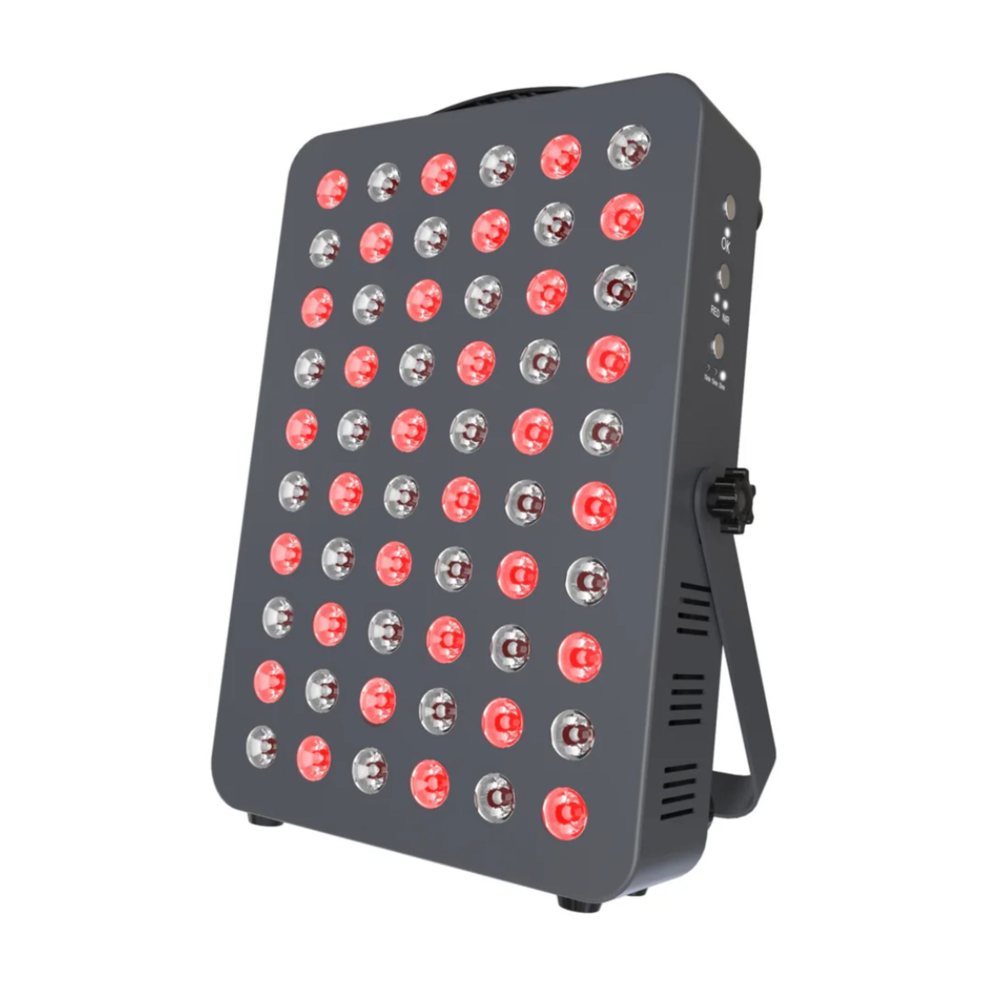
If you started on a Hooga and want more from the next panel, the useful upgrades are a wider wavelength mix, an irradiance figure tied to a named instrument, and a longer warranty or a more flexible return policy, and five panels from four other brands offer at least one of those at a similar size. Hooga is the value brand in the database, and its panels are a fair purchase when budget is the hard limit; this guide is for the buyer who has outgrown that or wants to compare before buying.
Choosing a panel? Our ranking of the best red light therapy panels is computed from published, method-labeled specs across 188 devices. For a step up from a budget panel, the spec that matters is irradiance with a named measurement method, because Hooga's claimed figures and independent spectrometer readings differ by roughly half.
Where Hooga sits
The Hooga page tracks 13 models in three lines. HG is the entry line (single-chip, 660 and 850nm only, from $149 for the HG200 to $899 for the HG1500). PRO is dual-chip, also 660 and 850nm, from $299 for the PRO300 to $3,099 for the PRO4500. ULTRA is quad-chip with four bands (630, 660, 810 and 850nm), from $399 for the ULTRA360 to $3,499 for the ULTRA4500. Prices were verified September 12, 2026. If you are still choosing among Hooga's own tiers, start with HG vs PRO vs ULTRA.
What Hooga does well: low entry prices, a 60-day trial, no stated restocking fee, goggles in the box, a tabletop stand with PRO and ULTRA panels, and flicker-free output on PRO and ULTRA. Where it stops short: no line includes 480nm blue, 830nm or 1064nm; the warranty is 3 years; the LED lifespan the brand publishes is 50,000 hours (see how LED hour ratings work); and the irradiance figures are brand-stated at 6 inches with no method named. In the database, independent spectrometer readings from Light Therapy Insiders (LTI) came in at about half the claimed number: 74 mW/cm2 measured against 132 claimed on the ULTRA360, and 81.7 average (104 peak) against 165 claimed on the ULTRA1500. The site's claimed versus measured analysis explains why a solar-meter claim and a spectrometer reading are not interchangeable.
What to compare
Four things changed between a budget Hooga and a step-up panel in this database:
- Wavelength mix. More bands, and whether the brand publishes how its LEDs are split among them. The wavelength guide covers what each band is for.
- Irradiance method. A figure with a named instrument is worth more than a bigger unlabeled one. Where a brand publishes both a solar-meter and a spectrometer figure, this guide uses the spectrometer one.
- Return terms. Trial length, restocking fees and who pays return shipping. These differ more between brands than the prices do.
- Warranty. Length first, then what it covers; see the warranty comparison.
Price is shown with its verification date. Rankings elsewhere on the site follow how rankings work; this guide is a size-matched list, not a ranking.
Five alternatives at three sizes
Around 20 inches: MitoPRO 750X. The MitoPRO 750X is $749 (verified August 13, 2026) against $799 for the 20.4 x 8.6 inch Hooga ULTRA750. It has six bands (590, 630, 660, 810, 830 and 850nm) against Hooga's four, and Mito publishes both a solar-meter claim (above 160) and a spectrometer figure (above 70 mW/cm2 at 6 inches). The Hooga ULTRA750 lists 161 claimed with no method. Terms: 3-year warranty, 60-day trial, no restocking fee, customer pays return shipping unless the paid protection add-on was bought, and the stand is sold separately. The Mito alternatives guide covers Mito's own measurement caveats.
Around 18 inches: BlockBlueLight PowerPanel MID. The PowerPanel MID is $699.95 (verified September 12, 2026), 460 x 220 mm (about 18.1 x 8.7 inches), with five bands (630, 660, 810, 830 and 850nm) and a published split of 660nm 40%, 850nm 40%, 630nm 10%, 830nm 5% and 810nm 5% of LEDs. The brand lists both figures at 6 inches: above 158 by solar meter and above 61 by spectrometer. Its 5-year warranty is the longest on this list. The trial is 30 days, with no restocking fee on panels but return shipping at your cost, and floor stands are sold separately. The 61 spectrometer figure is below what LTI measured on some Hooga ULTRA models, so this is a pick for wavelength coverage and warranty, not for output. See the BlockBlueLight vs Hooga comparison.
Around 19 inches: PlatinumLED BioMax 450. The BioMax 450 is 19 x 12 x 3 inches at $799 (verified August 13, 2026) with seven bands (480, 630, 660, 810, 830, 850 and 1060nm), the widest coverage in this list. PlatinumLED shows no numeric irradiance on the product page and points to a third-party lab, so there is no figure to compare. It has a 3-year warranty, a 60-day trial and a 20% restocking fee on elective returns, with return shipping at your cost. It is the option with the most bands and the harshest return terms. See the PlatinumLED alternatives guide and the Hooga vs PlatinumLED comparison.
Around 36 inches: BlockBlueLight PowerPanel MAX. The PowerPanel MAX is 920 x 220 mm (about 36.2 x 8.7 inches) at $1,099.95 (verified September 12, 2026), with the same five bands, a 5-year warranty and above 82 mW/cm2 at 6 inches by spectrometer (above 162 by solar meter). It sits between the Hooga HG1500 at $899 (35.8 x 11 inches, 660 and 850nm) and the PRO1500 at $1,199 (36 x 8.6 inches, 660 and 850nm), and it adds three bands to either.
Around 30 inches: RLT Home Total Spectrum COMPACT. The Total Spectrum COMPACT is 30.3 x 11.8 inches at $1,095 (verified September 12, 2026), $104 below the Hooga PRO1500 and $304 below the ULTRA1500. It has seven bands with published shares (480nm 6%, 630nm 19%, 660nm 19%, 810nm 19%, 830nm 14%, 850nm 9%, 1064nm 14%) and 99.0 mW/cm2 at 6 inches measured by an outside lab, Electropossible Ltd, with an HP350IR spectrometer. It includes a stand, has a 60-day trial with no restocking fee, a 3-year warranty and a 100,000 hour LED rating. Like every brand here it is one option among 41, held to the same criteria; its panel is shorter than a 36 inch Hooga.
Side by side
| Alternative | Against | Size (in) | Bands | Irradiance at 6 in and method | Price | Warranty | Trial and fee |
|---|---|---|---|---|---|---|---|
| MitoPRO 750X | Hooga ULTRA750 ($799) | 10 x 23 | 6 | above 70 (brand-published spectrometer) | $749 | 3 years | 60 days, no fee |
| BlockBlueLight PowerPanel MID | Hooga PRO750 ($599) / ULTRA750 | about 18.1 x 8.7 | 5 | above 61 (brand-published spectrometer) | $699.95 | 5 years | 30 days, no fee |
| PlatinumLED BioMax 450 | Hooga ULTRA750 ($799) | 19 x 12 x 3 | 7 | Not published | $799 | 3 years | 60 days, 20% fee |
| BlockBlueLight PowerPanel MAX | Hooga HG1500 ($899) / PRO1500 ($1,199) | about 36.2 x 8.7 | 5 | above 82 (brand-published spectrometer) | $1,099.95 | 5 years | 30 days, no fee |
| RLT Home COMPACT | Hooga PRO1500 ($1,199) / ULTRA1500 ($1,399) | 30.3 x 11.8 | 7, shares published | 99.0 (outside-lab spectrometer) | $1,095 | 3 years | 60 days, no fee |
For reference, the Hooga side reads 74 (ULTRA360) and 81.7 average (ULTRA1500) by LTI spectrometer, against 132 and 165 claimed. The readings come from different sources and dates, and the brand-published figures use a ">" minimum, so small gaps are not a ranking. Prices change; check the linked pages for the current figure.
What the numbers mean for session time
A dose is irradiance multiplied by time, so a lower irradiance means a longer session for the same target. Using a 20 J/cm2 reference dose and the formula in the dose calculator, at 6 inches:
- Hooga ULTRA360 at 74 (LTI): about 4.5 minutes
- Hooga ULTRA1500 at 81.7 (LTI average): about 4.1 minutes
- BlockBlueLight MID at above 61: up to about 5.5 minutes
- Mito 750X at above 70: up to about 4.8 minutes
- BlockBlueLight MAX at above 82: up to about 4.1 minutes
- RLT Home COMPACT at 99.0: about 3.4 minutes
The spread is about two minutes per area, which is small for one area and adds up if you sit for several in a row. Planning from a claimed solar-meter number would understate your session time by half or more on most of these panels. Distance matters more than any of this, as the irradiance guide and inverse square law explain, so keep the measuring distance constant when you compare.
Which one fits which buyer
- You want the cheapest improvement in wavelength coverage: the BlockBlueLight MID adds three bands over a PRO750 for $100.95 more, with a longer warranty.
- You want the most bands and do not mind return terms: the BioMax 450, accepting no irradiance figure and a 20% restocking fee on elective returns.
- You want a method-labeled figure and a flexible return: Mito 750X (brand spectrometer figure, no fee) or the RLT Home COMPACT (outside-lab figure, no fee).
- You want the longest warranty: either BlockBlueLight panel at 5 years. The warranty comparison shows the conditions on longer terms elsewhere.
- Budget is still the hard limit: staying with Hooga is reasonable. Pick the ULTRA line over HG or PRO if you want four bands.
What this guide does not tell you
The database holds no head-to-head test of these panels at the same distance, with the same meter, on the same day. Mixed sources (LTI, outside lab, brand-published) cannot be ranked against each other with confidence. Check the current price, trial and warranty on the brand's own page before you buy, and use a panel within the trial window to see how it handles in your room. If you are also weighing Infraredi, the Infraredi alternatives guide matches its panels against price-tier options, and if you are weighing BON CHARGE, the BON CHARGE alternatives guide matches its three panels against price- and size-matched options, including some of the panels covered here.