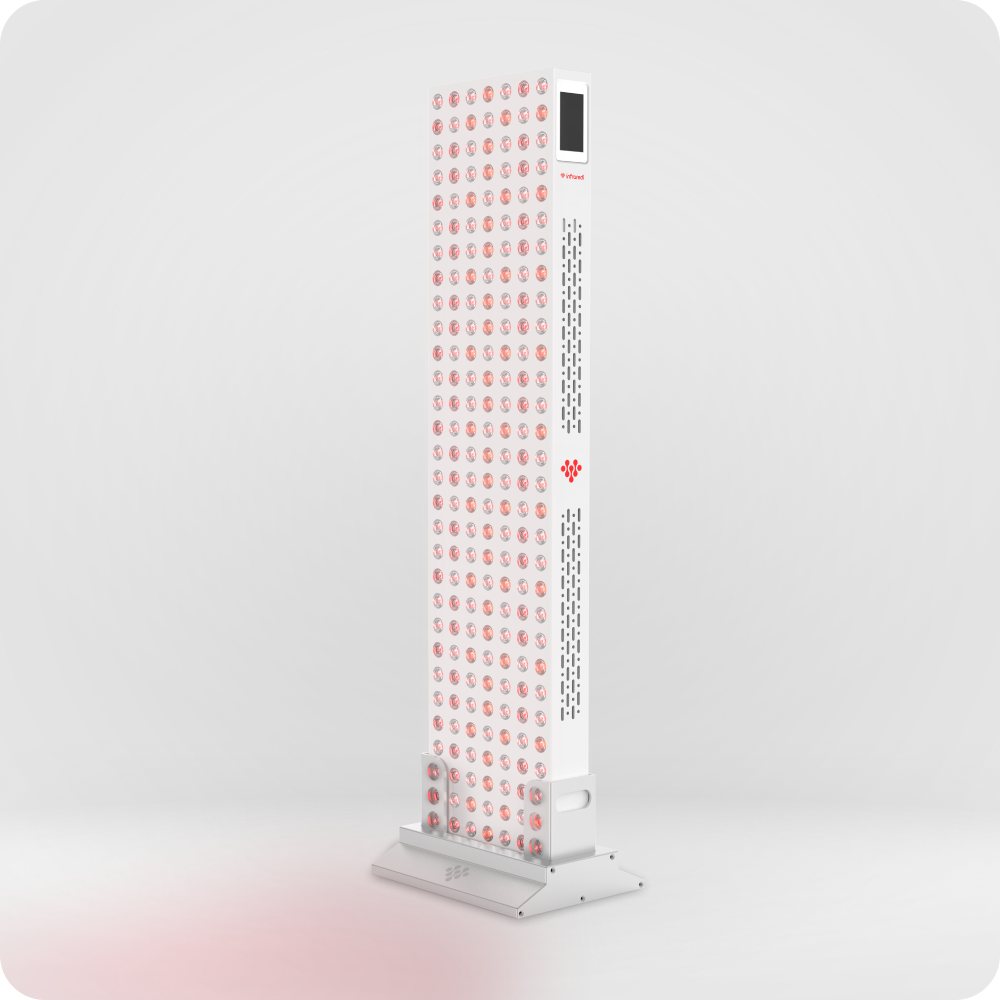
If you are weighing an Infraredi against other panels, the useful comparison is by price tier and by how each brand states its irradiance, because Infraredi's 250 mW/cm2 figure is a solar-meter reading and the database advises working from roughly half of it. At the $1,199 tier that makes the Pro Max 2.0 comparable with the Hooga PRO1500, the Scienlodic BioEpic P1500 and the Helio Glow, and the choice comes down to wavelength mix, measurement method and return terms rather than headline output.
Choosing a panel? Our ranking of the best red light therapy panels is computed from published, method-labeled specs across 188 devices. For an Infraredi comparison, the spec that matters is irradiance with a named measurement method, because a solar-meter figure and a spectrometer figure are not interchangeable.
Where Infraredi sits
The Infraredi page tracks eight models, all in the Pro 2.0 line, from the Pro Mini 2.0 at $699 to the Pro Elite Plus 2.0 at $6,099. Every model lists the same five bands (630, 660, 810, 830 and 850nm), and the brand does not publish how the LEDs are split among them. The LEDs are dual-chip, so each diode divides its power between two wavelengths. Seven of the eight models list 250 mW/cm2; the Mini lists no irradiance figure.
On the terms side, Infraredi has a 3-year warranty and a 60-day trial, with no restocking fee stated. Return shipping is the buyer's cost and is deducted from the refund. Shipping is free by express courier from local warehouses, including Melbourne, Australia. A door hook is the default mount, and stands are extra: Mini $99, Base $149 to $199, Vertical $399, Horizontal $949. The database found no goggles-in-box statement.
The point to keep in mind is the measurement. The brand table labels its figure as a solar meter, and the database pages disagree with themselves about the distance (6 inches in one table, not stated in another). The Pro Max 2.0 page recommends working from roughly half the stated value. The site's claimed versus measured analysis explains why. No independent spectrometer reading for an Infraredi panel is in the database.
What to compare
- Irradiance method and distance. A figure with a named instrument and a distance is worth more than a larger unlabeled one. See the irradiance guide and how to read irradiance labels.
- Wavelength mix. More bands, and whether the split is published. The wavelength guide covers what each band is for.
- Return terms. Trial length, restocking fees and who pays return shipping differ more between brands than prices do.
- Mounting and extras. A stand, goggles or a hook add cost or save it.
Prices below show their verification dates. Rankings elsewhere follow how rankings work; this guide is a price-matched list, not a ranking.
Four alternatives
Hooga PRO1500, $1,199 (verified September 12, 2026). The PRO1500 is 36 x 8.6 x 3.1 inches with 300 dual-chip LEDs in two bands only, 660 and 850nm, split 1:1. The brand states 189 mW/cm2 at 6 inches with no method named, and the page has no independent reading for this model. A Light Therapy Insiders spectrometer test of a different Hooga model, the ULTRA360, came in at about half its claim (74 against 132). Terms: 3-year warranty, 60-day trial, no restocking fee stated, a prepaid return label whose cost is deducted from the refund, and a tabletop stand included. Against Infraredi you trade three bands for a flicker-free line and the included stand. The Hooga alternatives guide covers the brand in more depth, and the Hooga vs Infraredi comparison puts the two side by side.
Scienlodic BioEpic P1500, $1,199 (verified August 13, 2026). The P1500 is 88 x 28 x 7.1 cm with 300 LEDs and the same five bands as Infraredi, again with no published split. The brand states above 170 mW/cm2 at 3 inches by an unnamed method, which the database says is not directly comparable to 6-inch figures. There are no third-party readings. Terms: 3-year warranty, 60-day trial, and a $30 restocking fee on opened returns, with return shipping at your cost. It has three light modes (red, NIR, mixed), six pulse frequencies and five brightness levels. The stand is extra. The page also notes that the brand's "FDA cleared" wording cites a registration listing, not a 510(k) clearance.
Helio Glow, $1,199 (verified September 12, 2026). The Glow is 29.9 x 11.8 x 2.4 inches with 216 single-chip LEDs and six bands (630, 660, 810, 830, 850 and 1064nm), and it is the only one here with a published split: 19.4% each for 630, 660, 810 and 1064nm, 13.9% for 830nm and 8.3% for 850nm. The brand states 71 mW/cm2 at 6 inches by spectrometer, and an outside measurement by LightLab averaged 71.7. It is the lowest number on this list and the best documented. Terms: 3-year warranty, 60-day trial, no restocking fee stated, and it is sold as a panel-plus-stand bundle.
Vital Elite 2.0, $1,499 (verified August 13, 2026). The Elite 2.0 is 36.6 x 8.5 x 2.3 inches with 216 LEDs and nine bands from 480 to 1060nm, with no published split. The brand claims 150 mW/cm2 with no distance, while an Outliyr spectrometer measured 78.3 mW/cm2 at 12 inches. Different distances, so the two are not a like-for-like gap. Terms: 3-year warranty and a 30-day trial, the shortest here, with no restocking fee stated and the customer paying return shipping. The page notes that the "FDA Cleared" claim has no verifiable 510(k) number. The Infraredi vs Vital Red Light comparison goes through the flagship models.
For a larger panel, the Rojo Refine 3600 at $3,699 (verified August 13, 2026) has the same five bands and 1,200 LEDs as the Infraredi Pro Elite Plus 2.0 at $6,099, a brand figure of 75 mW/cm2 at 6 inches disclosed by both solar meter and spectrometer, an LTI reading of 72, a 60-day trial with no restocking fee on panels, goggles in the box and a desk stand. See the Infraredi vs Rojo comparison.
Side by side
| Panel | Price | Bands | Irradiance and method | Warranty | Trial and fee |
|---|---|---|---|---|---|
| Infraredi Pro Max 2.0 | $1,199 | 5 | 250 at 6 in, solar meter (distance conflict) | 3 years | 60 days, none stated |
| Hooga PRO1500 | $1,199 | 2 | 189 at 6 in, method not stated | 3 years | 60 days, none stated |
| Scienlodic BioEpic P1500 | $1,199 | 5 | above 170 at 3 in, method not named | 3 years | 60 days, $30 on opened |
| Helio Glow | $1,199 | 6 | 71 at 6 in, spectrometer (LightLab 71.7) | 3 years | 60 days, none stated |
| Vital Elite 2.0 | $1,499 | 9 | 150 claimed, no distance; 78.3 at 12 in (Outliyr) | 3 years | 30 days, none stated |
Readings come from different sources, distances and dates, so small gaps are not a ranking. Prices change; check the linked pages for the current figure.
What the numbers mean for session time
A dose is irradiance multiplied by time, so lower irradiance means a longer session for the same target. Using a 20 J/cm2 reference dose and the formula in the dose calculator, at 6 inches:
- Infraredi at half of 250, or 125: about 2.7 minutes
- Hooga PRO1500 at half of 189, or 94.5: about 3.5 minutes
- Helio Glow at 71: about 4.7 minutes
- Rojo Refine 3600 at the LTI 72: about 4.6 minutes
The halving for Infraredi and Hooga follows the database's guidance for unlabeled or solar-meter figures; it is a planning assumption, not a measurement. Even so the spread is about two minutes per area. The Scienlodic and Vital figures are left out because their distances differ from 6 inches. Distance matters more than any of this, as the inverse square law explains, so keep the measuring distance constant when you compare.
Which one fits which buyer
- You want a documented output figure: the Helio Glow, with a brand spectrometer reading and an outside measurement that agree.
- You want a flicker-free panel with a stand in the box: the Hooga PRO1500, accepting two bands.
- You want the most bands: the Vital Elite 2.0, accepting a 30-day trial and an unverified clearance claim.
- You want the Infraredi band set at a lower return risk: staying with Infraredi's 60-day trial is reasonable; treat its output as about half the label.
- You want a bigger panel: compare the Rojo Refine 3600 with the Pro Elite Plus 2.0 on price and measurement.
What this guide does not tell you
The database holds no head-to-head test of these panels at the same distance, with the same meter, on the same day. Check the current price, trial and warranty on each brand's page before you buy, and use a panel within the trial window to see how it handles in your room. If you are also looking at other brands, the BON CHARGE alternatives guide matches that brand's panels against price- and size-matched options.
A Rouge Pro G4 sits at nearly the same price with eight bands and a different irradiance disclosure; the Rouge alternatives guide runs the same price-matched comparison for that brand.
At a similar price, the Vellgus alternatives guide compares the Vellgus Pro, whose irradiance claim has no stated distance, against four other panels on the same criteria.