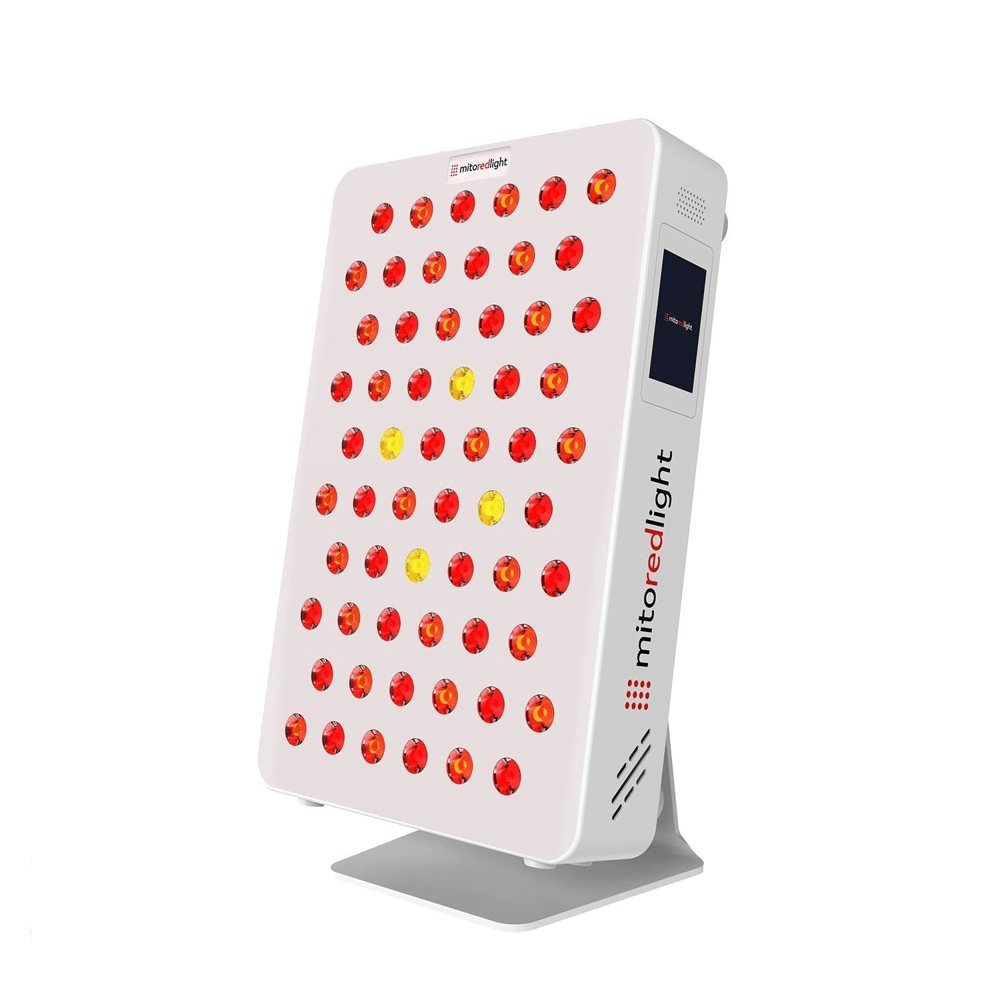
The best Mito Red Light alternatives are panels that match a MitoPRO's size and price while publishing an irradiance figure with a named instrument behind it, because Mito's own numbers come from two measurement methods that its labeling does not always keep apart. Below are five panels from three other brands, lined up against three MitoPRO X sizes and checked against this site's database.
Choosing a panel? Our ranking of the best red light therapy panels is computed from published, method-labeled specs across 188 devices. For a Mito alternative, the spec that matters is the irradiance figure and the instrument that produced it, since Mito's claimed and independently measured numbers differ by a wide margin.
Where Mito sits
The Mito database page tracks 15 models in five lines. The X series is the widest: the MitoPRO 300X at $449, the 750X at $749, the 1500X at $1,299 and the MegaX at $2,649 (all verified August 13, 2026). Each carries six bands (590, 630, 660, 810, 830 and 850nm), a 3-year warranty and a 60-day trial. There is no restocking fee, but return shipping is the customer's cost unless the optional paid protection add-on was bought, and stands are sold separately at about $139 for one panel or $349 for a multi-panel stand.
Sizes run from 9.5 x 14.5 inches for the 300X to 17 x 64 inches for the MegaX. The database records Mito's claims as dual-disclosed, meaning a solar meter and a spectrometer figure are both published, and it notes the labeling is internally inconsistent: 130 mW/cm2 at 6 inches for the 300X and MegaX, and 160 for the 750X and 1500X. Independent testing by Light Therapy Insiders (LTI) with a spectrometer recorded a 51.8 mW/cm2 average for the 300X (60 peak) and 56.5 average for the MegaX (63 peak). The 750X and 1500X pages carry a separate note of about 76.5 measured against more than 170 claimed, recorded against the 1500+ line, so this guide does not treat it as a clean reading for either X model. The site's claimed versus measured analysis explains why a solar-meter figure and a spectrometer reading are not interchangeable.
Mito has real strengths worth keeping in view. It is the only brand in this comparison with a 590nm band, its X series has six bands across all sizes, and it carries no restocking fee. The alternatives below trade on measurement disclosure, price and return handling, not on being uniformly better.
Five alternatives at three sizes
Small tier: Hooga ULTRA360. Against the $449 MitoPRO 300X, the Hooga ULTRA360 is a 12.7 x 8.6 x 2.5 inch panel at $399 (verified September 12, 2026) with 630, 660, 810 and 850nm. Hooga claims 132 mW/cm2 at 6 inches with no method stated, and LTI measured about 74 with a spectrometer, roughly half. That measured figure is still higher than LTI's 51.8 for the 300X. The ULTRA360 costs $50 less and includes a tabletop stand, but it has two fewer bands and no 590nm. Hooga lists no restocking fee; the prepaid US return label's cost is deducted from the refund and open-box items are non-refundable.
Mid tier against the 1500X: RLT Home Total Spectrum COMPACT. The RLT Home Total Spectrum COMPACT is a 30.3 x 11.8 inch panel at $1,095 (verified September 12, 2026), $204 under the 1500X. Its 99.0 mW/cm2 at 6 inches was measured by an outside lab, Electropossible Ltd, with an HP350IR spectrometer. Its seven bands come with published shares (480nm 6%, 630nm 19%, 660nm 19%, 810nm 19%, 830nm 14%, 850nm 9%, 1064nm 14%), and it includes a stand with no restocking fee. It is much shorter than the 43 inch 1500X, and it has no 590nm band.
Mid tier against the 1500X: Hooga ULTRA1500. The Hooga ULTRA1500 is a 39.5 x 8.6 x 2.5 inch panel at $1,399 (verified September 12, 2026), $100 more than the 1500X and close to it in length. Hooga claims 165 mW/cm2 with no method; LTI measured 104 peak and 81.7 average. It has four bands to the Mito's six, and it includes a tabletop stand. It is the closest match for a buyer who wants the long, narrow shape.
Small-to-mid tier: PlatinumLED BioMax 300. The PlatinumLED BioMax 300 is 19 x 9 x 3 inches at $659 (verified August 13, 2026) with seven bands (480, 630, 660, 810, 830, 850 and 1060nm), sitting between the Mito 300X and 750X on price. PlatinumLED publishes no irradiance figure for it. The nearest evidence is LTI's spectrometer reading of the BioMax 900 at 90.3 average against 185 claimed, which is a different model. It also carries a 20 percent restocking fee on elective returns plus customer-paid return shipping, and a stand costs extra. It is the option with the widest wavelength coverage and the harshest return terms.
Large tier against the MegaX: RLT Home Total Spectrum MAX. The RLT Home Total Spectrum MAX is 49.2 x 11.8 inches at $1,795 (verified September 12, 2026), $854 under the $2,649 MegaX. It reads 100.53 mW/cm2 at 6 inches by the same lab method as the COMPACT and has the same published seven-band mix, a stand included and no restocking fee. It is a single long panel, not the MegaX's 17 x 64 inch array, so it covers a narrower area.
Side by side
| Alternative | Against | Size (in) | Bands | Irradiance at 6 in and method | Price | Restocking |
|---|---|---|---|---|---|---|
| Hooga ULTRA360 | MitoPRO 300X ($449) | 12.7 x 8.6 x 2.5 | 4 | 74 measured (LTI); 132 claimed | $399 | None stated |
| PlatinumLED BioMax 300 | 300X / 750X | 19 x 9 x 3 | 7 | Not published | $659 | 20% |
| RLT Home COMPACT | MitoPRO 1500X ($1,299) | 30.3 x 11.8 | 7, shares published | 99.0 (lab spectrometer) | $1,095 | None |
| Hooga ULTRA1500 | MitoPRO 1500X ($1,299) | 39.5 x 8.6 x 2.5 | 4 | 81.7 avg measured (LTI); 165 claimed | $1,399 | None stated |
| RLT Home MAX | MitoPRO MegaX ($2,649) | 49.2 x 11.8 | 7, shares published | 100.53 (lab spectrometer) | $1,795 | None |
For reference, the Mito side reads 51.8 average (300X) and 56.5 average (MegaX) by LTI spectrometer, with 130 to 160 claimed on the Mito pages. The measurements come from different labs and test dates, so small gaps are not a ranking. Prices carry the verification dates above and change; check the linked pages. For how the site weighs these fields, see how rankings work.
What the measured numbers mean for session time
A dose is irradiance multiplied by time, so a lower measured irradiance means a longer session for the same target. Using a 20 J/cm2 reference dose and the dose calculator formula at 6 inches, the Mito 300X at 51.8 mW/cm2 needs about 6.4 minutes and the MegaX at 56.5 about 5.9 minutes. The ULTRA360 at 74 needs about 4.5 minutes, the ULTRA1500 at 81.7 about 4.1 minutes, the COMPACT at 99.0 about 3.4 minutes and the MAX at 100.53 about 3.3 minutes. That is roughly three minutes between the slowest and the fastest, which matters if you sit for several body areas in a row.
Claims can mislead planning. Using the 130 mW/cm2 claimed for the 300X would suggest about 2.6 minutes, well under half the time its measured figure requires. Distance matters more than any of this, as the inverse square law explainer shows, so keep the measuring distance the same when comparing. How to read those labels is covered in the irradiance label guide.
What Mito still does better
Mito keeps three advantages. It is the only brand here with a 590nm band. Its X series holds six bands from the $449 300X up to the MegaX, whereas the Hooga panels have four. And it has no restocking fee, unlike PlatinumLED's 20 percent. The MegaX is also a far larger array than any single alternative in this guide. The costs are a stand sold separately, customer-paid return shipping without the add-on, and the labeling inconsistency between claimed and measured figures.
For a small first panel, the ULTRA360 is cheaper, shows a higher measured figure and includes a stand. For a mid-size panel, the COMPACT wins on price and on a lab-verified number, while the Mito 1500X wins on length and on six bands. For full-body coverage, the MAX is the lower-cost disclosed option and the MegaX is the larger one. For head-to-head detail, read the Hooga versus Mito comparison, the Mito versus BestQool comparison, the MitoPRO 1500X versus BioMax 900 guide and the Total Spectrum MAX versus MitoPRO 1500X guide. The same exercise for other brands is in the Joovv alternatives guide and the PlatinumLED alternatives guide. RLT Home is one of 41 brands in this database and gets the same criteria and cautions as every other brand.