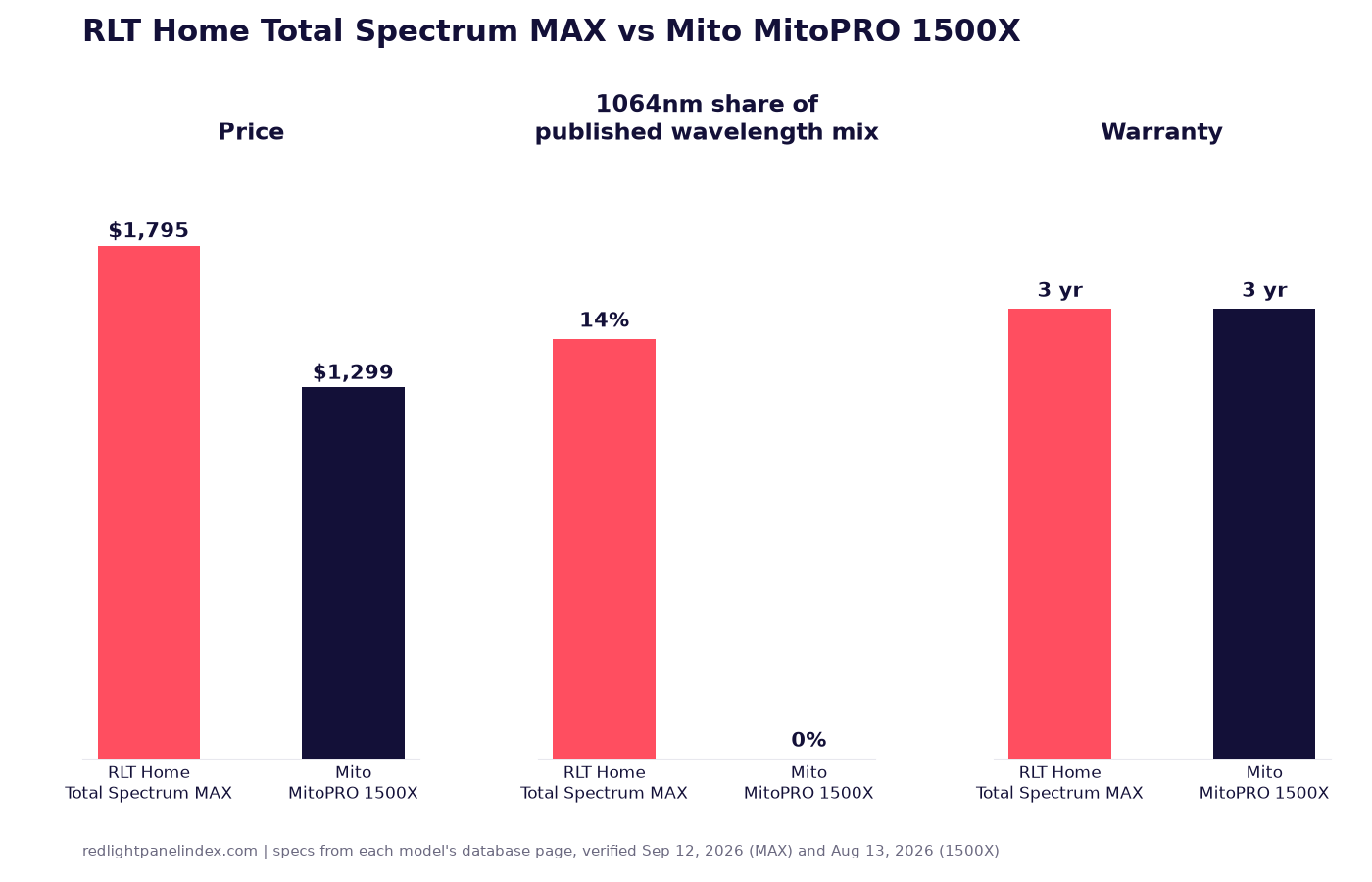
The RLT Home Total Spectrum MAX at $1,795 and the MitoPRO 1500X at $1,299 (verified September 12, 2026 and August 13, 2026) both belong to a short list of brands that publish a per-wavelength breakdown rather than a single blended irradiance number, which makes this one of the more direct allocation comparisons this index can run. The two panels split their output very differently across the spectrum, and one of them carries a wavelength the other does not stock at all.
Choosing a panel? Our ranking of the best red light therapy panels is computed from published, method-labeled specs across 188 devices. For a matchup like this one, the spec that matters is how each brand's published percentages add up across the wavelengths it lists, not the total LED count.
The two panels, side by side
- RLT Home Total Spectrum MAX: 480nm (6%), 630nm (19%), 660nm (19%), 810nm (19%), 830nm (14%), 850nm (9%), 1064nm (14%). 360 LEDs, single-chip 5W type, 49.2 x 11.8 inches, 30-degree beam angle, stand included, 9 modes, vertical mounting only.
- MitoPRO 1500X: 590nm (6%), 630nm (22%), 660nm (22%), 810nm (17%), 830nm (17%), 850nm (17%). 300 LEDs, dual-chip design (600 total chips), 10 x 43 inches, 60-degree beam angle, stand sold separately (about $139 for one panel or $349 for a multi-panel setup).
Wavelength allocation: the real difference
The MAX carries a 1064nm-class deep near-infrared band at 14% of its published output; the MitoPRO 1500X's wavelength mix stops at 850nm and includes none. If reaching deeper tissue with the longer near-infrared band matters for your use case, that is a real, published difference rather than a marketing distinction, since both brands disclose their allocation rather than a single blended figure. The MitoPRO 1500X compensates with a 590nm amber band the MAX does not carry, and it spreads its red and near-infrared output more evenly across 630, 660, 810, 830, and 850nm (17 to 22% each) than the MAX does, which weights more heavily toward 630, 660, and 810nm (19% each) and tapers off at 850nm (9%).
Beam angle also differs by a wide margin: 30 degrees on the MAX versus 60 degrees on the MitoPRO 1500X. A narrower beam concentrates output more tightly at a given working distance, while a wider beam spreads it over more area at the cost of peak irradiance directly ahead of the panel; neither is simply better, and the effect on your actual dose depends on the distance you use, which you can check with the dose calculator.
LED architecture and controls
The two panels also take different bets on how the LEDs themselves are built. The MAX uses 360 single-chip 5W LEDs, a design that, per this index's single-chip versus dual-chip explainer, concentrates each diode's power into one wavelength for a cleaner spectral peak and stronger per-band output, which is the more common approach among brands weighting toward deep-tissue wavelengths. The MitoPRO 1500X instead uses a dual-chip design across its 300 LED housings (600 total chips), splitting each diode's power across two wavelengths for a more even surface blend at the cost of peak strength in any single band. Neither architecture is simply better; a single-chip panel suits a reader chasing the highest published irradiance in a specific band, while a dual-chip panel suits one who wants a smoother mix from every LED position on the panel face.
Controls differ too. The MAX ships with 9 fixed onboard modes and no app, while the MitoPRO 1500X pairs a touchscreen with app control and can add modes through software updates, at the cost of relying on an app for anything beyond the handful of modes built into the touchscreen at purchase. The MAX's listing also states an EMF reading of roughly 0.0 uT at 6 inches; the MitoPRO 1500X's database entry does not publish an EMF figure at all, so that comparison cannot be made from what either brand discloses.
Irradiance disclosure and what to trust
The MAX publishes one number: 100.53 mW/cm2 at 6 inches, from an independent Electropossible Ltd spectrometer reading, with no separate brand-claimed figure alongside it. That is the more straightforward disclosure of the two, since there is only one figure to evaluate and it already comes from a third-party instrument rather than the manufacturer.
The MitoPRO 1500X's listing is messier. Mito claims 160 mW/cm2 at 6 inches for the 1500X, dual-disclosed via solar meter and spectrometer. This index's own database entry flags that the labeling on this page is internally inconsistent, and that the independent spectrometer figure sometimes shown alongside the claim actually belongs to the separate MitoPRO 1500+ model, not the 1500X reviewed here. In practice that means a reader cannot treat the low, independently measured number often associated with this product line as confirmed for the 1500X specifically; the only number that can be attributed to the 1500X with confidence is Mito's own 160 mW/cm2 claim, unverified by a matching independent reading on this page. That is a meaningfully weaker disclosure than the MAX's single, independently measured figure, and it is worth checking the irradiance methodology page before comparing either brand's number to a competitor's.
Price, warranty and trial terms
At $1,795, the MAX costs $496 more than the MitoPRO 1500X at $1,299, though the 1500X's stand is sold separately, adding roughly $139 to $349 depending on configuration, while the MAX includes its stand. Both carry a 3-year warranty and a 60-day trial with no restocking fee, though the MitoPRO 1500X's return policy adds that return shipping costs apply unless an optional paid protection plan was purchased, a condition the MAX's listing does not carry. Coverage differs by shape rather than by a clear winner: the MAX is a narrower, taller panel at 49.2 x 11.8 inches, while the MitoPRO 1500X is wider and shorter at 43 x 10 inches, which changes how each fits a standing versus a seated setup more than it changes total treated area.
Verdict by use case
If a deep near-infrared band above 850nm is a priority and you want the more straightforward of the two irradiance disclosures, the RLT Home Total Spectrum MAX is the more defensible published spec sheet, at a real premium over the MitoPRO 1500X and with the stand included in that price. Its narrower 30-degree beam and single-chip LEDs also suit a reader who wants the strongest published number in each band at a fixed working distance, and its near-zero published EMF may matter to anyone specifically avoiding electromagnetic field exposure close to the body.
If you would rather have a more even spread across the red and near-infrared range plus an amber band, do not need 1064nm, and are willing to budget separately for a stand, the MitoPRO 1500X is the cheaper way into a per-wavelength-disclosed panel. Its wider 60-degree beam and dual-chip LEDs suit a reader more interested in a broad, blended surface exposure than in the single highest number in one band, and its touchscreen and app control suit someone who wants to add modes over time rather than settle for what ships in the box. Whichever direction you lean, treat the MitoPRO 1500X's independently measured irradiance figure as unconfirmed for this specific model rather than assuming the number sometimes associated with the wider MitoPRO line applies here, and use the dose calculator with each panel's own confirmed number, not the other's, before setting a session length. Compare both against the brand-level RLT Home versus Mito rundown before deciding, since that page covers the rest of each brand's lineup beyond these two models.