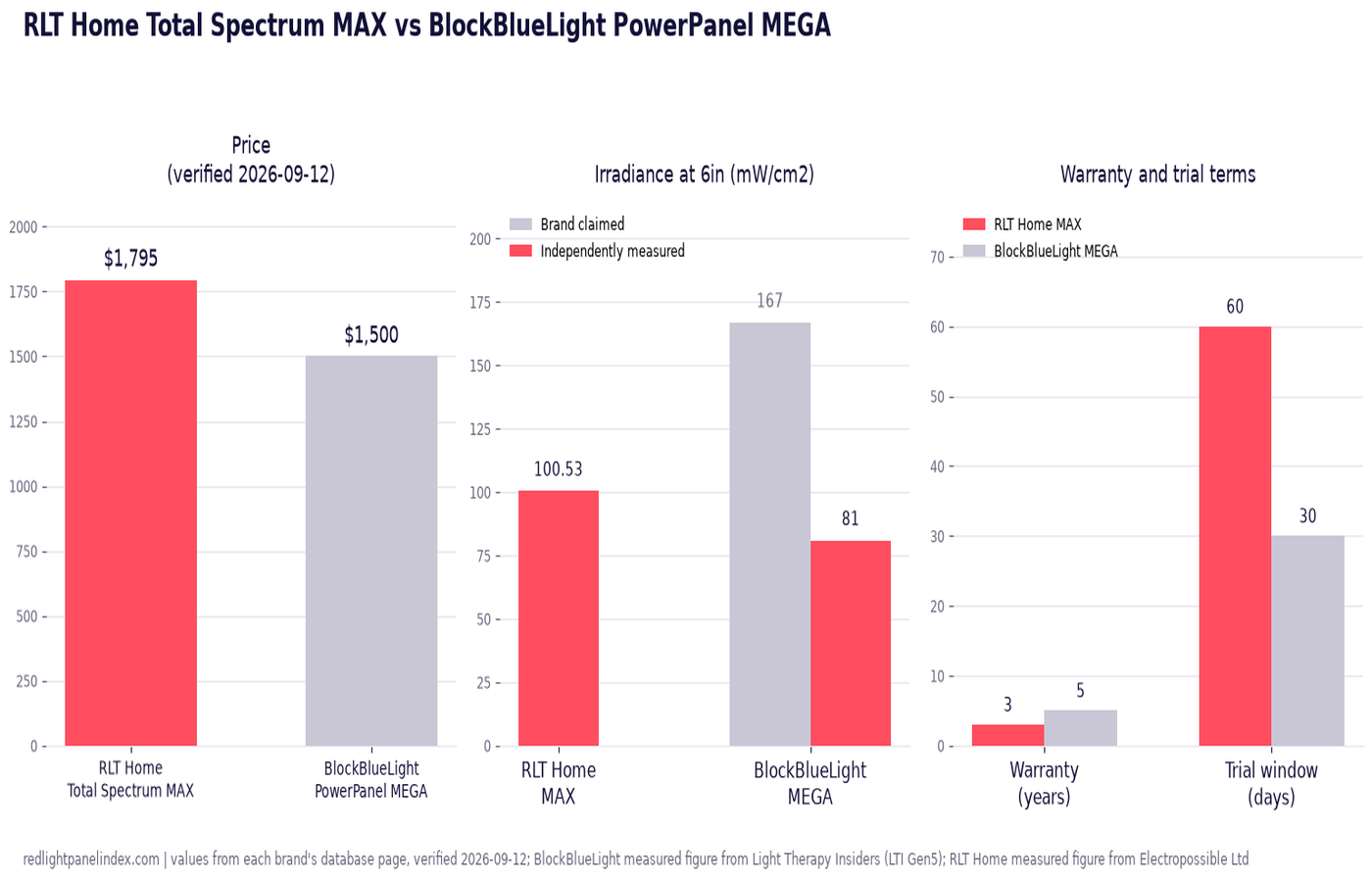
The RLT Home Total Spectrum MAX at $1,795 and the BlockBlueLight PowerPanel MEGA at $1,500 (both verified September 12, 2026) both rank among the top five panels in this index's overall list, and both belong to a small group of brands that publish more than a bare marketing number behind their irradiance claim. The two brands go about that disclosure differently, though, and the difference in method matters more than the roughly $300 price gap.
Choosing a panel? Our ranking of the best red light therapy panels is computed from published, method-labeled specs across 188 devices. For a matchup like this one, the spec that matters is whether the irradiance number comes from an independent instrument or from the brand's own claim.
The two panels, side by side
| Spec | RLT Home Total Spectrum MAX | BlockBlueLight PowerPanel MEGA |
|---|---|---|
| Price (verified 2026-09-12) | $1,795 | $1,500 |
| Wavelengths | 480, 630, 660, 810, 830, 850, 1064nm (7 bands) | 630, 660, 810, 830, 850nm (5 bands) |
| Wavelength allocation | 6/19/19/19/14/9/14 percent (brand-published) | Claimed 10/40/5/5/40 percent (630/660/810/830/850); independently measured (LTI) roughly 25/25/17/17/17 |
| Irradiance at 6in | 100.53 mW/cm2, independent lab test (Electropossible Ltd, spectrometer) | 167 mW/cm2 claimed; independently measured (Light Therapy Insiders, LTI Gen5): peak 105, average 81 mW/cm2 |
| Panel size | 49.2 x 11.8in | 36.2 x 11.8 x 2.6in |
| LEDs | 360, single-chip 5W, 30-degree beam | 300, dual-chip 5W, 60-degree beam |
| EMF at 6in | ~0.0 uT | 0.1 uT |
| Warranty | 3 years | 5 years |
| Trial window | 60 days, no restocking fee | 30 days, no restocking fee on full-price purchases; panels bought at more than 15 percent off are exchange or store-credit only |
Wavelength mix: seven bands spread thin against five bands weighted heavy
The Total Spectrum MAX carries two bands the PowerPanel MEGA does not: a 480nm blue component at 6 percent of output, and a 1064nm deep-infrared component at 14 percent. Its remaining five bands are spread close to evenly, from 9 to 19 percent each, with no single wavelength dominating the panel's output. If you want blue light or the deepest-penetrating 1064nm band alongside red and near-infrared, the Total Spectrum MAX is the only one of the two that offers either.
The PowerPanel MEGA's brand-published allocation tells a different story: it claims 40 percent of output each at 660nm and 850nm, with 630nm, 810nm and 830nm sharing the remaining 20 percent. But BlockBlueLight also discloses an independent measurement from Light Therapy Insiders that puts the real spread closer to 25/25/17/17/17 across the same five bands, meaning the panel's actual output is far more even than its own marketing percentages suggest. That gap between the claimed allocation and the measured one is worth reading before choosing this panel for a use case that assumes 80 percent of its power sits in the two claimed bands, since the independent test does not support that concentration.
Irradiance: two different kinds of transparency
This is where "publishes more measurement detail than most" splits into two distinct practices. RLT Home's database page gives one number for the Total Spectrum MAX: 100.53 mW/cm2 at 6 inches, attributed to an independent lab test by Electropossible Ltd using a spectrometer. There is no separate brand-claimed figure on the page to compare it against; the independently tested number is the only one published.
BlockBlueLight instead discloses two numbers for the PowerPanel MEGA: its own claimed 167 mW/cm2 at 6 inches, and a separate third-party test from Light Therapy Insiders showing a peak of 105 mW/cm2 and an average of 81 mW/cm2 at the same distance. That is a real form of transparency, since most brands in this index publish only a claimed figure with no way to check it, and the dataset behind this index's claimed-versus-measured analysis puts the average brand-claimed figure at roughly 2.11 times the spectrometer-verified one across 44 tested panels, a gap the same analysis attributes mostly to the difference between solar-meter and spectrometer readings rather than to dishonesty. BlockBlueLight's own claim-to-measured ratio for the PowerPanel MEGA, 167 against an 81 mW/cm2 average, works out to about 2.06 times, close to that dataset's average rather than an outlier in either direction.
Comparing the two panels on a single "irradiance" number is not a fair comparison unless you compare like with like. RLT Home's 100.53 mW/cm2 is already an independently measured figure. BlockBlueLight's comparable independently measured figure is the LTI average of 81 mW/cm2, not its own claimed 167. On that basis, the Total Spectrum MAX's measured output is somewhat higher than the PowerPanel MEGA's measured output at the same 6-inch distance, even though the PowerPanel MEGA's claimed number looks larger on a spec sheet. Whichever panel you buy, run its independently verified figure, not a brand's raw claim, through the dose calculator to work out session length at your actual treatment distance.
Coverage and physical footprint
The Total Spectrum MAX is the larger panel at 49.2 by 11.8 inches, against the PowerPanel MEGA's 36.2 by 11.8 by 2.6 inches. Both share the same 11.8-inch width, but the MAX runs roughly 13 inches longer, which translates to more vertical body coverage in a single session. The MAX also uses a narrower 30-degree beam angle across 360 single-chip LEDs, while the MEGA spreads a wider 60-degree beam across 300 dual-chip LEDs; a wider beam angle spreads light over a broader area at a given distance but at lower peak intensity per point, which is one contributor to the measured irradiance gap above alongside any difference in raw LED output.
EMF readings favor the Total Spectrum MAX, which RLT Home's page lists as approximately 0.0 uT at 6 inches, against the PowerPanel MEGA's stated 0.1 uT at the same distance. Both figures are low in absolute terms, and this index's safety and side-effects page does not identify EMF at these levels as a documented risk for home panels, but if EMF exposure is a personal priority, the MAX's page reports the lower figure of the two.
Warranty and returns
The PowerPanel MEGA carries the longer warranty at 5 years against the Total Spectrum MAX's 3 years, a real advantage if a panel-ending failure happens after the trial window closes. The trial terms run the other way: the Total Spectrum MAX gives 60 days with no restocking fee, while the PowerPanel MEGA's window is half as long at 30 days, and BlockBlueLight adds a condition on top of that window: any unit bought at more than 15 percent off is exchange or store-credit only, not a refund. If you plan to buy the PowerPanel MEGA during a sale, read that condition before assuming the standard return terms apply to a discounted order.
Verdict by use case
If you want the longer warranty, the wider single-session coverage angle at a given distance, or you are comfortable trusting a brand's own claimed figure alongside its independent third-party check, the PowerPanel MEGA earns real credit for disclosing both numbers rather than one, even though its measured output trails the MAX's at the same distance. It is also $295 cheaper at current verified pricing.
If you want the higher independently verified irradiance at 6 inches, a longer no-fee trial window, the added 480nm and 1064nm bands, or the lower measured EMF, the Total Spectrum MAX is the stronger pick, with the caveat that its shorter 3-year warranty is the weaker term of the two panels. For how a different pair of brands handles the same claimed-versus-measured question at a lower price point, see the MitoPRO 1500X vs BioMax 900 comparison, and for the same gap playing out inside one brand's own product tiers rather than between two competitors, see Hooga's HG300 vs PRO300 vs ULTRA360.