The MitoPRO 1500X and the PlatinumLED BioMax 900 both cost $1,299 (verified 2026-08-13), which makes them a rare same-price matchup among mid-size flagship panels. They do not compete on price at all; they compete on how much of that $1,299 you can actually verify, since one brand backs its number with a named instrument and the other does not.
Choosing a panel? Our ranking of the best red light therapy panels is computed from published, method-labeled specs across 188 devices. For a matchup like this one, the spec that matters is whether the irradiance figure is tied to a stated measurement method.
The two panels, side by side
| Spec | MitoPRO 1500X | BioMax 900 (Classic 9th Gen) |
|---|---|---|
| Price (verified 2026-08-13) | $1,299 | $1,299 |
| Wavelengths | 590, 630, 660, 810, 830, 850nm | 480, 630, 660, 810, 830, 850, 1060nm |
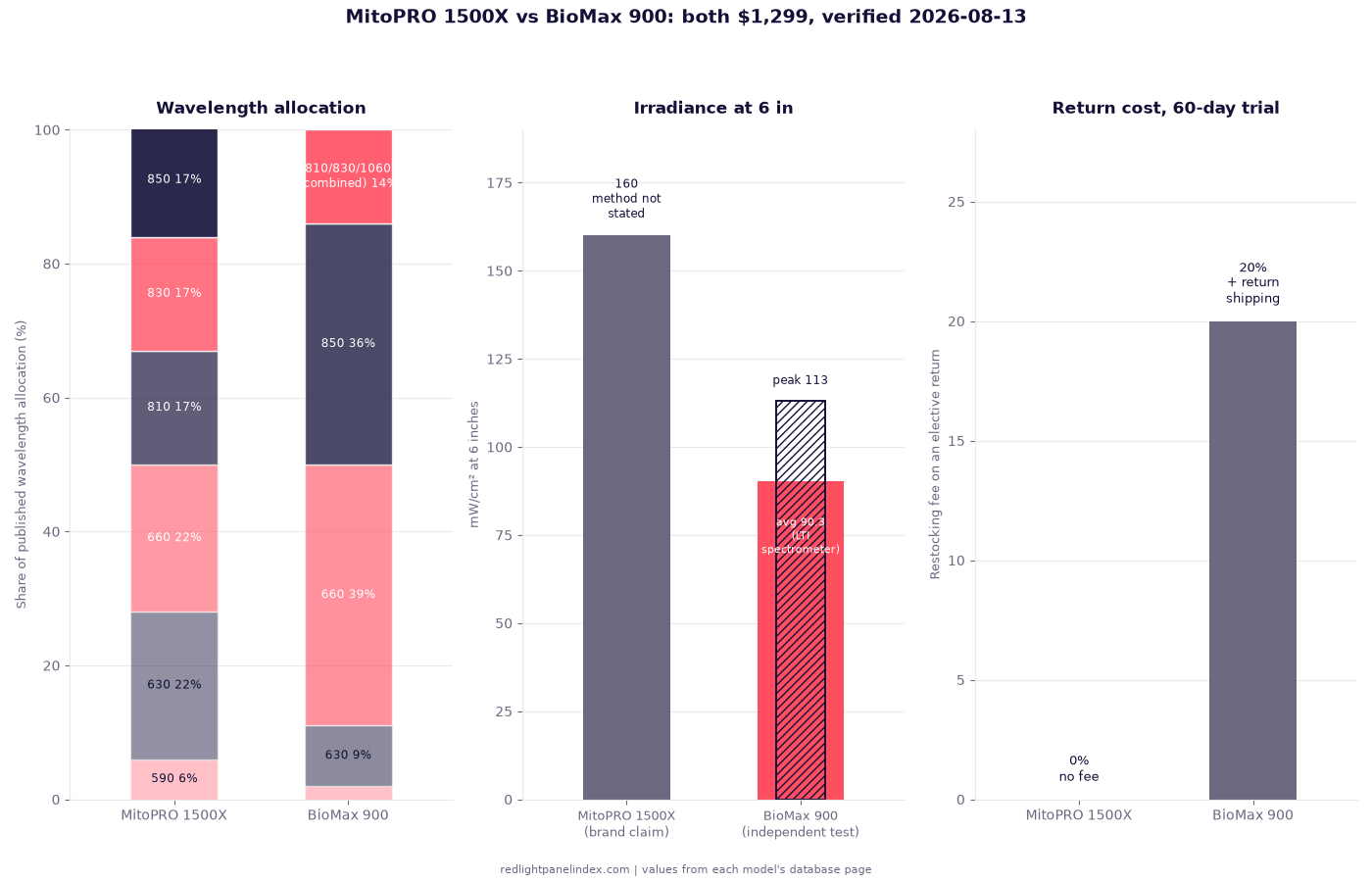
| Wavelength allocation | 6/22/22/17/17/17 percent (published) | ~2% 480, 9% 630, 39% 660, 36% 850, rest split across 810/830/1060 |
| Irradiance at 6in | 160 mW/cm2 claimed, method not stated | Peak 113, avg 90.3 (independent LTI spectrometer test); ~75 at 12in |
| Panel size | 10 x 43in | 36 x 12 x 3in |
| Modularity | Stand sold separately, ~$139 single or ~$349 multi-panel; manual, not motorized | Not published |
| Warranty | 3 years | 3 years |
| Trial window | 60 days, no restocking fee (return shipping is the customer's cost unless a paid protection add-on was bought) | 60 days, 20% restocking fee on elective returns plus return shipping |
Wavelength mix: seven bands against six, but read the split
The BioMax 900 lists a seventh wavelength, 1060nm, that the MitoPRO 1500X does not carry, and PlatinumLED's database page shows it also includes a small 480nm blue component alongside the more common red and near-infrared bands. But a wavelength count alone does not tell you where the output goes. The BioMax 900's own allocation numbers put 39 percent of its published output at 660nm and 36 percent at 850nm, meaning three quarters of the panel's stated power sits in just two bands; the 480nm, 810nm, 830nm and 1060nm wavelengths share whatever is left, and PlatinumLED does not break that remainder down further.
The MitoPRO 1500X instead spreads its output more evenly: 22 percent each at 630nm and 660nm, 17 percent each at 810nm, 830nm and 850nm, and 6 percent at 590nm. If you want a panel weighted toward the two most heavily studied bands (660nm and 850nm), the BioMax 900's concentration works in your favor; if you want more even coverage across the red and near-infrared range, including a slice at 590nm that neither panel's near-infrared bands touch, the MitoPRO 1500X's spread is the more even design of the two. Neither allocation is objectively better; it depends on whether you are treating a single condition with a well-studied wavelength or want broader spectrum exposure in one session.
Irradiance: a claimed number against a measured one
This is where the two panels actually separate. Mito's own database page states the MitoPRO 1500X puts out 160 mW/cm² at 6 inches, but does not name the instrument used to get that figure. PlatinumLED's page for the BioMax 900 does not lean on its own claim; it publishes an independent spectrometer test result instead, showing a peak of 113 mW/cm² and an average of 90.3 mW/cm² at 6 inches, dropping to roughly 75 mW/cm² at 12 inches.
An unlabeled claim and a labeled, independently measured figure are not the same kind of number, and they should not be compared as if they were. Brand-stated irradiance figures across the industry run roughly double the spectrometer-verified figure on average, so a reasonable working assumption is that the MitoPRO 1500X's real output at 6 inches is closer to 80 mW/cm² than to 160, putting it in the same rough range as the BioMax 900's measured 90.3 mW/cm² average rather than meaningfully ahead of it. That is an estimate, not a fact: the only way to know the 1500X's real output is a spectrometer reading of an actual unit, and neither Mito's page nor this comparison has one. Whatever panel you buy, use the dose calculator with a spectrometer-verified figure, your own measurement, or a conservative half-claim estimate, not the brand's raw number, to work out session length at your actual treatment distance.
Both database pages carry FDA status language worth reading before you trust either brand's marketing claims at face value: the MitoPRO 1500X's own listing states "FDA-registered Class II, not cleared," a distinction that matters because registration is an administrative filing, not a safety or efficacy review, while clearance requires the FDA to review a specific application. PlatinumLED's own marketing copy for the BioMax 900 goes further, describing the device in terms that imply a higher regulatory or professional standing than an FDA registration on its own establishes. Registration status alone does not mean a panel has been cleared for treating any specific condition; check the evidence pages for what published trials actually studied rather than relying on a device label.
Stand, modularity and physical footprint
The MitoPRO 1500X's stated panel dimensions, 10 by 43 inches, describe a tall, narrow unit meant to be mounted on a stand rather than used flat; Mito sells that stand separately, at roughly $139 for a single-panel version or $349 for a multi-panel stand that supports vertical or horizontal orientation and two-panel arrays. The stand is manual rather than motorized, so adjusting height or angle is a physical task each session, not a stored preset. Add the stand cost to the $1,299 panel price if you do not already own compatible mounting hardware, since a wall-mounted or handheld panel is a different use case than a floor-standing one.
The BioMax 900's database page lists dimensions of 36 by 12 by 3 inches and does not mention a modular or stand option, which suggests it is designed as a single fixed unit rather than part of an expandable system. If you expect to add panels later to build a multi-panel setup, that is a meaningful difference in long-term flexibility between the two, even though neither device's page settles the question definitively for the BioMax 900.
Warranty and returns: the real gap at this price
Both panels carry an identical 3-year warranty, so that spec is a wash. The trial terms are not. The MitoPRO 1500X's 60-day trial charges no restocking fee at all; you pay only return shipping unless you bought Mito's optional paid protection add-on at checkout, which would cover that cost too. The BioMax 900's 60-day trial charges a 20 percent restocking fee on an elective return, on top of return shipping paid by the customer. On a $1,299 panel, that fee alone is about $260, which is a meaningful amount of money to lose if the BioMax 900 does not work out for you and you decide to send it back for reasons other than a defect.
That gap matters more than it might first appear, because it changes the real cost of being wrong. A buyer who is confident about wanting either specific panel loses nothing from this comparison; a buyer who is still deciding whether red light therapy suits their routine, or whether this particular size and wavelength mix fits their use case, is taking on real financial risk by choosing the BioMax 900 and later changing their mind, in a way the MitoPRO 1500X's no-fee trial does not expose them to.
Verdict by use case
If you want the more heavily studied 660nm and 850nm wavelengths concentrated at higher published percentages, you are comfortable relying on an independently measured irradiance figure rather than a brand's own claim, and you are confident enough in your decision that a 20 percent restocking fee on a change of mind is an acceptable risk, the BioMax 900 is the stronger pick of the two on transparency alone, since its number comes from a named third-party spectrometer test rather than an unlabeled claim.
If you would rather have a no-fee 60-day trial while you find out whether the panel fits your routine, want a more even spread across five wavelengths plus a 590nm band neither panel otherwise shares, or plan to add panels to a stand-mounted, potentially multi-panel setup down the line, the MitoPRO 1500X is the safer buy at the same $1,299 price, with the caveat that its 160 mW/cm² figure is a brand claim without a named measurement method behind it. For a look at how a different price tier and pair of brands handle the same trade-offs, the Bestqool BQ40 vs Comfytemp K4037 comparison covers the budget end of the same irradiance-disclosure problem, and the Hooga HG300 vs PRO300 vs ULTRA360 comparison shows the same claimed-versus-measured gap playing out within a single brand's own tier ladder rather than between two competitors.