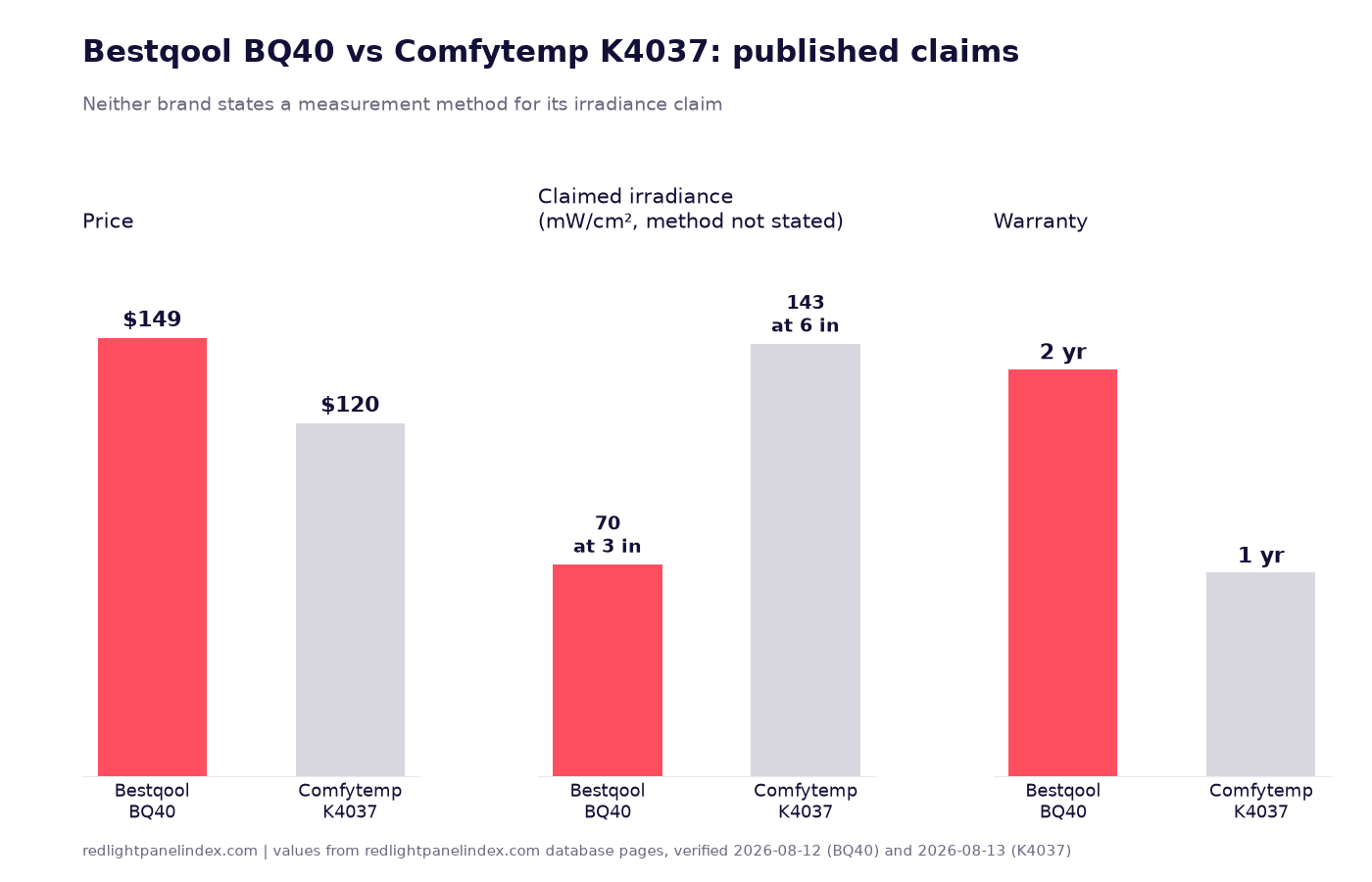
Bestqool and Comfytemp both sell entry-level red and near-infrared panels in the same rough price band, and the closest matched pair is the Bestqool BQ40 at $149 against the Comfytemp K4037 55W panel at $120. Neither brand publishes a measurement method behind its irradiance claim, so the real differences that decide this comparison are price, warranty length and how each brand handles returns.
Choosing a panel? Our ranking of the best red light therapy panels is computed from published, method-labeled specs across 188 devices. For a budget panel like either of these, the spec that matters most is what the warranty and return terms actually cover, since neither brand backs its irradiance number with a stated measurement method.
The two panels, side by side
| Spec | Bestqool BQ40 | Comfytemp K4037 |
|---|---|---|
| Price (verified) | $149 (2026-08-12) | $120 (2026-08-13) |
| Wavelengths | 660nm, 850nm | 660nm, 850nm |
| LED count | 40 | Not published |
| Claimed irradiance | 70 mW/cm² at 3 in, method not named | 143 mW/cm² at 6 in, method not named |
| Panel dimensions | 11.3 x 5.6 x 1.3 in | Coverage listed as "arm to 40 in" |
| Warranty | 2 years | 1 year |
| Trial window | 30 days, no restocking fee | 30 days, 15% restocking fee on non-defective returns |
What the specs actually tell you
Both panels use the same two-wavelength combination, 660nm red and 850nm near-infrared, which is the most common pairing in the budget tier and covers the wavelength range most photobiomodulation trials have used. Neither model adds the 630nm or 940nm wavelengths that appear further up the Bestqool lineup, so on wavelength mix alone the two panels are evenly matched; the differences that separate them are elsewhere in the spec sheet.
Neither brand names a measurement instrument behind its irradiance figure, so the 70 mW/cm² and 143 mW/cm² numbers are not directly comparable to each other or to a spectrometer-verified reading; they were taken at different distances (3 inches versus 6 inches) using unstated methods, and claimed irradiance figures across the industry run an average of about twice the spectrometer-verified figure, so treat both numbers as upper bounds rather than settled facts. A higher claimed number at a longer test distance is not automatically a stronger panel; distance affects the reading as much as the panel's actual output does, and a brand testing at 6 inches instead of 3 inches is describing a different measurement condition, not necessarily a brighter light. If you own either panel, the only way to know your actual dose is to measure it yourself or use a spectrometer-verified figure from a similar published panel as a rough anchor, then use the dose calculator to work out session length at your real treatment distance.
LED count is where the listings diverge in transparency rather than necessarily in hardware: Bestqool states 40 LEDs for the BQ40, while Comfytemp does not publish a count for the K4037 at all. A published LED count does not by itself tell you output, since chip type and per-LED wattage vary, but a brand's willingness to publish it is one data point when a spec sheet is otherwise thin.
Physically, the two panels are not really aimed at the same use case. The BQ40's stated dimensions (11.3 x 5.6 x 1.3 in) put it in the small, single-limb-or-face category. Comfytemp lists the K4037's coverage as "arm to 40 in," which reads as a wider treatment footprint, useful if the goal is a torso or multi-area session rather than a small joint or the face, though without an exact panel width to check against, that claim is harder to verify than a stated dimension.
Warranty and return terms are the real gap
This is where the two brands separate clearly. Bestqool backs the BQ40 with a 2-year warranty and a 30-day trial with no restocking fee on returns. Comfytemp gives the K4037 a 1-year warranty and a 30-day trial, but charges a 15% restocking fee on change-of-mind or non-defective returns within that window. On a $120 panel, a 15% restocking fee works out to $18, which meaningfully changes the economics of trying the device and returning it if it doesn't suit you. If you're fairly confident you'll keep the panel, that fee is irrelevant; if you're buying to test whether red light therapy works for you at all, the no-restocking-fee terms available elsewhere in the budget tier are worth weighing against Comfytemp's lower sticker price.
A 2-year warranty against a 1-year warranty is also a meaningful gap for an LED panel, since diode output can degrade over years of use and a warranty is the only recourse if a panel underperforms its claimed spec after the return window closes. Doubling the warranty period on a panel that costs $29 more works out to a small ongoing cost for a real increase in downside protection, which is part of why a straight price comparison undersells what the BQ40 is actually offering.
If you want to size up
Bestqool's lineup runs well past the BQ40: the BQ60 steps up to 60 LEDs at $189, and the Pro series (Pro100, Pro200, Pro300) adds 630nm and 940nm to the wavelength mix alongside more LEDs, running from $319 to $899. All of these carry the same 2-year warranty and no-restocking-fee 30-day trial as the BQ40. Comfytemp's K4037 does not have a directly comparable step-up model in the same database entry, so if wider coverage or a broader wavelength mix matters more than price, the Bestqool Pro line is the more built-out option to compare against panels from other brands rather than against Comfytemp itself. The same unlabeled-irradiance pattern shows up much further up the price ladder too; MitoPRO 1500X vs BioMax 900 compares two $1,299 flagships where one brand's claim is backed by an independent spectrometer test and the other's is not. Bestqool is not the only budget brand with a within-brand step-up question: Hooga's own HG300, PRO300 and ULTRA360 tiers run the same $199-to-$399 kind of ladder, and only the top tier there adds new wavelengths rather than just more claimed output.
The budget panel rankings list the BQ40 as a "cheapest credible panel" pick within the criteria the site tracks (method-labeled irradiance where available, buyer terms, wavelengths and price per delivered hardware); Comfytemp's K4037 was not included in that ranking. That is not the same as saying the K4037 is a poor panel, only that the site's published ranking has not evaluated it against the same field.
That page also notes a recurring pattern across the entire budget tier: method-unstated irradiance claims, thin warranties and weak return terms show up together often enough to be the category's defining trade-off, not an exception either brand invented. Bestqool and Comfytemp both share the method-unstated irradiance problem; where they differ is that Bestqool backs its panel with the stronger warranty and return terms of the two, which is the trade-off this comparison keeps coming back to.
Verdict by use case
If the lowest possible entry price is what matters most and you're comfortable with a 15% restocking fee should the panel not work out, the Comfytemp K4037's $120 price and wider stated coverage make it a reasonable low-cost starting point, particularly for torso or multi-area use where its listed footprint has an edge over the BQ40's smaller dimensions.
If you'd rather have a longer warranty and a no-penalty return window while you figure out whether red light therapy fits your routine, or you think you might want to step up to more LEDs and a wider wavelength mix later without switching brands, the Bestqool BQ40 and its Pro-series siblings are the safer buy at a $29 premium over the K4037. Neither company publishes a measurement method for its irradiance claim, so pick on the terms you can actually verify, price, warranty and return policy, rather than on the irradiance number alone.