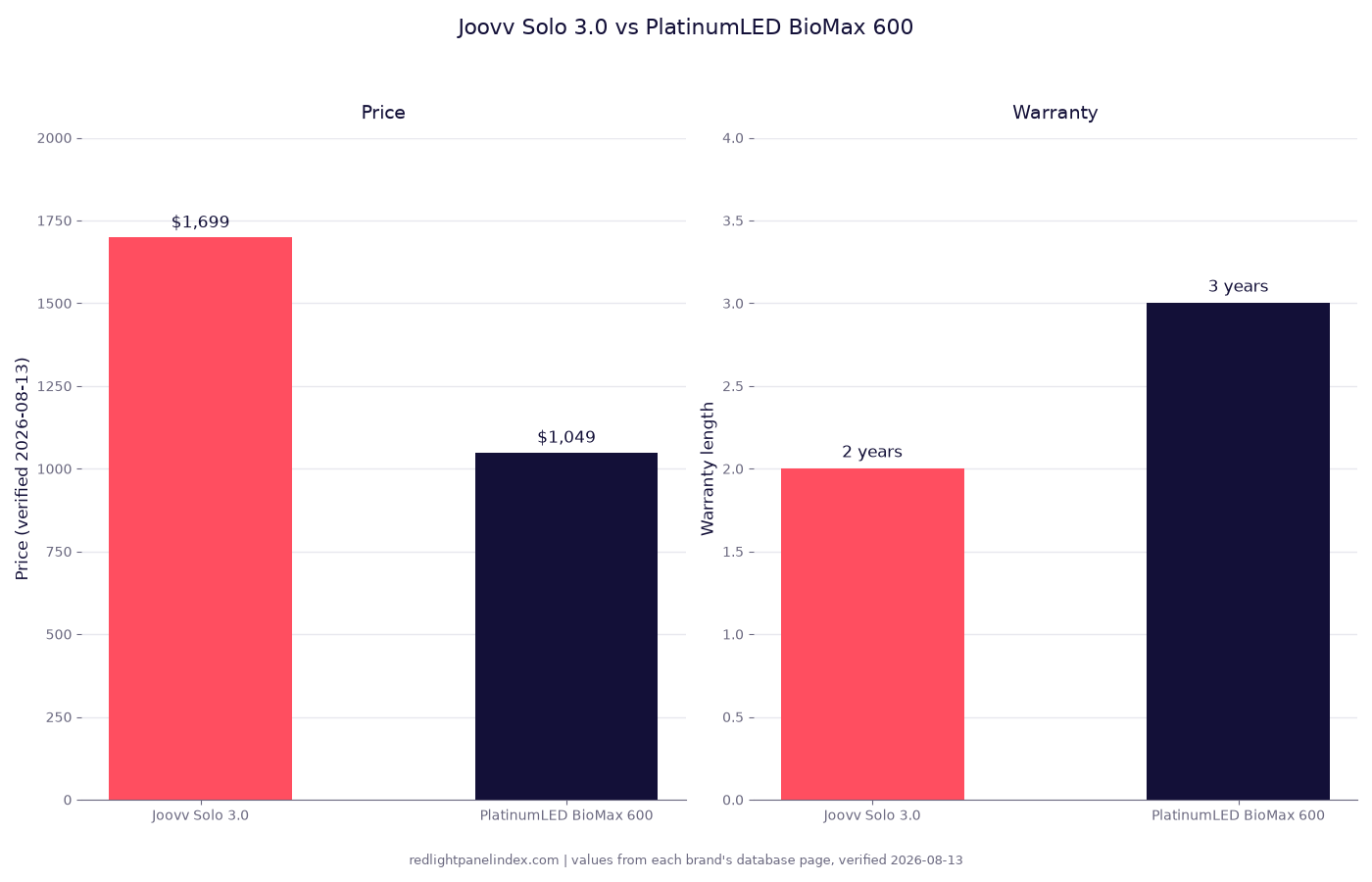
The Joovv Solo 3.0 at $1,699 and the PlatinumLED BioMax 600 at $1,049 (both verified 2026-08-13) are mid-size panels from the two oldest brands in this index's database, and they split on almost every spec that matters. Joovv covers fewer wavelengths but backs its irradiance claim with an independent measurement; PlatinumLED covers more wavelengths but publishes no method-stated irradiance figure at all for this specific model.
Choosing a panel? Our ranking of the best red light therapy panels is computed from published, method-labeled specs across 188 devices. For a matchup like this one, the spec that matters is whether the irradiance number behind the price is backed by a stated measurement method.
The two panels, side by side
The Joovv Solo 3.0 is a two-wavelength panel: 660nm and 850nm, in a 36 x 8.75 x 2.34 inch modular housing. Joovv's own marketing claims ">100 mW/cm2" without stating the measurement distance, which by this site's irradiance measurement guide is treated as a marketing figure rather than a verifiable spec until a method and distance are attached. Independent testing by Light Therapy Insiders measured the Solo 3.0 at roughly 72.4 mW/cm2 at the panel surface using a spectrometer, the more conservative and more comparable instrument type.
The PlatinumLED BioMax 600 covers seven wavelengths (480nm, 630nm, 660nm, 810nm, 830nm, 850nm and 1060nm) in a similarly sized 36 x 9 x 3 inch housing. Its own database page states plainly that PlatinumLED does not publish a method-stated irradiance figure at six inches for this model; the independently measured figures that exist for the BioMax line belong to the larger BioMax 900, not this one, so they cannot be applied to the 600 without assuming the two panels share identical LED density and driver output, which their different physical sizes make unlikely. On wavelength coverage alone, the BioMax 600 reaches further into both the near-infrared range with 1060nm and the visible range with 480nm than the Solo 3.0 does; on irradiance disclosure, the Solo 3.0 is the only one of the two with a number a buyer can actually check against an instrument and location.
Price and ownership terms
At $1,699 against $1,049, the Solo 3.0 costs $650 more than the BioMax 600. Joovv backs the Solo 3.0 with a 2-year warranty on its modular Gen 2.0/3.0 hardware and a 60-day trial window; for modular devices there is no flat restocking fee, but the original shipping cost is non-refundable and the customer pays return shipping, with the unit required back in its original packaging. PlatinumLED backs the BioMax 600 with a longer 3-year warranty and the same 60-day trial window, but its return terms are less favorable on an elective return: a 20% restocking fee applies, and the customer also pays return shipping. Neither brand's return policy is free; the BioMax 600 charges a percentage fee that Joovv's modular policy does not, while Joovv's non-refundable original shipping charge on a $1,699 panel can still be a meaningful amount in absolute dollars.
What the irradiance gap means for dosing
The measurement gap between the two panels is not just a labeling detail; it changes how confidently you can plan a session. With the Solo 3.0's spectrometer-measured 72.4 mW/cm2 at the surface, a buyer can enter that figure into this site's dose calculator along with their actual sitting distance and get a reasonable estimate of the dose delivered in J/cm2 per session. With the BioMax 600, there is no independently measured or method-stated irradiance figure to enter at all; a buyer would either have to rely on PlatinumLED's general "clinical-grade" language, which this site's irradiance guide treats as a marketing claim rather than a spec, or guess based on figures published for a different, larger panel in the same product line. That is the practical cost of the missing disclosure: it is harder to plan a specific dose and session length with the BioMax 600 than with the Solo 3.0, independent of how the two panels actually perform.
Wavelength mix in practice
The Solo 3.0's two wavelengths, 660nm and 850nm, sit in the range most commonly used across the red light therapy trial literature for skin-level and shallow-tissue applications, and 850nm reaches somewhat deeper into muscle and joint tissue than 660nm alone. What the Solo 3.0 does not offer is anything past 850nm; there is no 1060nm-class deep near-infrared band in its lineup. The BioMax 600's seven wavelengths add 480nm at the blue end, plus 630nm as a second red alongside 660nm, and 810nm and 830nm as a broader near-infrared band alongside 850nm, before topping out at 1060nm. For someone specifically interested in deeper tissue targets like larger joints, the BioMax 600's 1060nm band is a real point in its favor that the Solo 3.0 cannot match at any price in this product line. For someone who mainly wants a validated 660nm/850nm combination without paying for wavelengths they will not use, the Solo 3.0's narrower mix is not necessarily a weakness.
Where each brand competes
This site's PlatinumLED versus Joovv comparison covers the two brands at the catalog level, and the pattern in that page holds at the model level here too: PlatinumLED spreads its catalog across more wavelengths per panel and has moved toward publishing accredited lab reports on some models, while Joovv keeps a narrower two-wavelength lineup and states a single irradiance claim without a distance. Buyers who want deep near-infrared coverage in the 1060nm range, at this price point, will not find it in the Solo 3.0 at all. Buyers who want an irradiance number that has actually been checked by an independent lab against the panel's surface, rather than an unstated brand claim, will not get that from the BioMax 600.
| Spec | Joovv Solo 3.0 | PlatinumLED BioMax 600 |
|---|---|---|
| Price (verified 2026-08-13) | $1,699 | $1,049 |
| Wavelengths | 660nm, 850nm | 480nm, 630nm, 660nm, 810nm, 830nm, 850nm, 1060nm |
| Irradiance disclosure | Claimed >100 mW/cm2 (no distance stated); independently measured ~72.4 mW/cm2 at surface | No method-stated figure published for this model |
| Panel size | 36 x 8.75 x 2.34 in | 36 x 9 x 3 in |
| Warranty | 2 years | 3 years |
| Trial window | 60 days | 60 days |
| Return terms | No flat restocking fee (modular); original shipping non-refundable, customer pays return shipping | 20% restocking fee on elective returns; customer pays return shipping |
Verdict by use case
For someone who wants the widest wavelength spread in a mid-size panel, is specifically targeting deeper tissue with the 1060nm band, and is willing to accept a shorter-disclosure irradiance claim and a restocking fee on a change of mind, the BioMax 600's seven-wavelength mix and lower $1,049 price make it the more flexible buy. For someone who wants a spec they can independently verify before committing, and who is comfortable with a narrower 660nm/850nm mix, the Solo 3.0's third-party spectrometer figure and no-restocking-fee modular policy are the stronger case, even at $650 more. Neither panel wins outright on every criterion this index tracks; the choice comes down to whether wavelength breadth and warranty length matter more than a verified irradiance number, or the other way around, for the intended use.