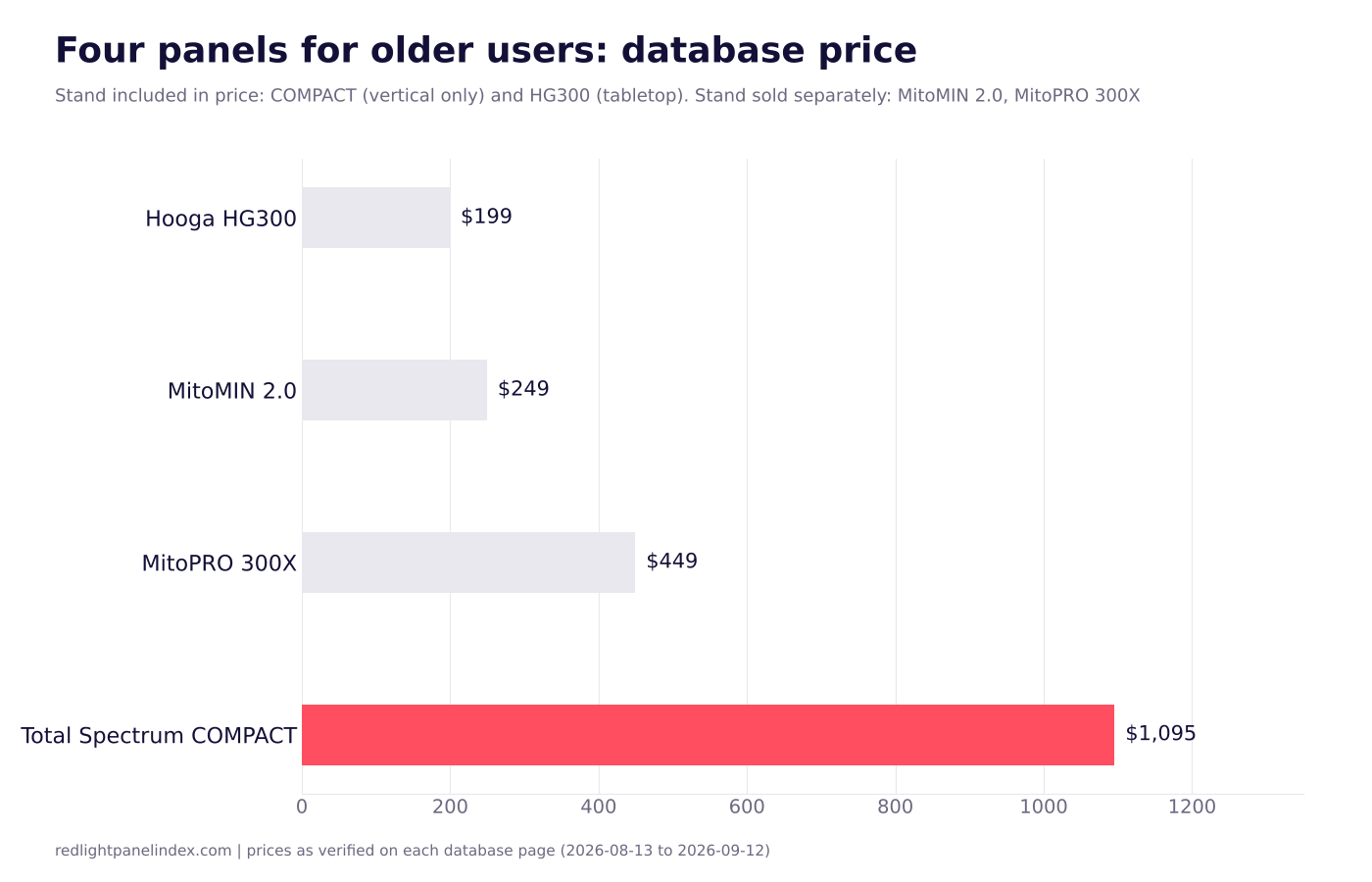
For older adults, the best red light panel is the one that is easy to start, easy to position without lifting and covered by a long, fee-free trial, and among the four panels compared here the RLT Home Total Spectrum COMPACT and the Hooga HG300 come closest on those database fields, at very different prices. The ranking below is computed from published fields, not from age-specific trials, because no panel has been tested in a trial built around older users.
Choosing a panel? Our ranking of the best red light therapy panels is computed from published, method-labeled specs across 188 devices. For older users, the spec that matters is how the panel is operated and positioned, because dose is easy to calculate once you can reach the controls and sit comfortably.
What the evidence covers for older users
Most of the trials behind home panels enrolled adults across a wide age range, so the evidence is relevant to older users but was rarely designed around them. Two bodies of work come closest.
Knee osteoarthritis. Our knee osteoarthritis evidence page is graded Moderate. A meta-analysis of 22 randomized placebo-controlled trials with 1,063 participants (PMID 31662383) reported that pain fell by 14.23 mm on a 100 mm visual analog scale versus placebo at the end of therapy. In trials within the World Association for Laser Therapy dose range the reduction was 18.71 mm, and the authors concluded that pain and disability improved at 4 to 8 J per treatment spot with 785 to 860nm light. Most of those trials used clinic lasers applied point by point, not home LED panels, which is the main reason for the Moderate grade. A separate placebo-controlled trial of light added to a therapeutic exercise program (PMID 31144070) found that light reduced pain on its own but added no measurable benefit to the exercise program for walking distance, mobility or strength. In practice that means light is best viewed as a possible add-on to movement, not a replacement for it. The broader joint pain evidence page covers the other joints.
Age-related vision. A small 2020 study of healthy volunteers aged 28 to 72 (PMID 32596723) reported that 670nm light had no impact in younger participants, but in people around 40 and older it produced significant improvements in blue color contrast sensitivity and rod thresholds. Our study review of the 670nm vision work covers its limits: small samples, one research group, narrow laboratory outcomes, healthy volunteers only and a clinical light source aimed at the eye rather than a consumer panel. This is early work and gives no basis for pointing a home panel at the eyes. Read the eye protection guide before any session that involves the face.
Ranking criteria
The ranking uses database fields only: operating controls, stand or mounting, size against a knee or shoulder, method-labeled irradiance, price with its verification date, warranty and trial terms. Seniors-specific fields are sparse, so where the database says "not stated" this page says so. See how rankings work for the general rules, which treat every brand the same way.
| Criterion | Why it matters for older users |
|---|---|
| Controls | Physical controls and no app dependence mean fewer steps to start a session |
| Stand or mounting | A stand included in the price avoids lifting a panel onto a wall or door |
| Size and orientation | A panel sized to sit over a knee or shoulder reduces repositioning |
| Near-infrared share | Joint trials used 785 to 860nm light, so a meaningful share in that band matters |
| Irradiance with method | A labeled figure lets you calculate session time with the dose calculator |
| Trial and return terms | A long trial without a restocking fee lowers the cost of trying a panel that turns out to be hard to use |
| Warranty and price | Warranty as stated by the brand; price with the date the database verified it |
The picks
Prices were verified on the dates shown on each database page. Confirm them on the brand's site before buying.
1. RLT Home Total Spectrum COMPACT
The Total Spectrum COMPACT is $1,095 (verified 2026-09-12) and measures 30.3 x 11.8 inches, a size the site's joint pain ranking describes as sized to sit directly over a knee or shoulder. A stand is included in the price, it has on-panel controls and no companion app or internet connection, and the database lists 9 modes without describing them. Button layout, timer and remote are not stated. It mounts in vertical orientation only, with no wall option stated. Its mix includes 810nm (19%), 830nm (14%), 850nm (9%) and 1064nm (14%), and its 99.0 mW/cm2 at 6 inches was measured with a spectrometer by Electropossible Ltd. The database notes that those lab tests were commissioned by the brand, so treat the figure as brand-commissioned, not as a fully independent result. Warranty is 3 years, with a 60-day trial and no restocking fee.
2. Hooga HG300
The Hooga HG300 is $199 (verified 2026-09-12) and is the smallest and lightest-footprint option here at 12.2 x 8.2 x 2.5 inches. It has a built-in timer, no condition presets, and a foldable tabletop stand included, which suits a seated user treating a knee or hand at the table. Output is 660 and 850nm. Its 73 mW/cm2 at 6 inches is brand-stated with no measurement method, and independent testing of a related Hooga model read roughly half of that brand's claim, so plan sessions with a conservative figure. Warranty is 3 years. The 60-day trial offers a return label whose cost is deducted from the refund, and open-box items are non-refundable. Its small size means treating a large joint may need more than one position.
3. MitoMIN 2.0
The MitoMIN 2.0 is $249 (verified 2026-08-13), measures 12 x 9 x 3 inches, and splits its output 50/50 between 660 and 850nm. Operation is by timer with no published preset modes, which keeps the interface simple. A stand is sold separately (about $139 for one panel). Its 115 mW/cm2 at 6 inches comes with both solar-meter and spectrometer figures disclosed, but the database says the labeling is internally inconsistent, so treat the method as unclear. Warranty is 3 years, with a 60-day trial and no restocking fee, though return shipping is the buyer's cost unless the paid returns add-on was purchased.
4. MitoPRO 300X
The MitoPRO 300X is $449 (verified 2026-08-13) and measures 9.5 x 14.5 inches. It publishes a six-band split: 590nm (6%), 630nm and 660nm (22% each), and 810, 830 and 850nm (17% each), so about half its output sits in the 810 to 850nm band. The stand is sold separately, and controls are not stated for this model. Its claimed 130 mW/cm2 at 6 inches does not clearly assign each number to a method, and an independent reading in the database is well below it. Warranty is 3 years, with a 60-day trial and no restocking fee.
How the four compare
| Panel | Price (verified) | Stand | Controls and app | Irradiance label | Trial terms |
|---|---|---|---|---|---|
| Total Spectrum COMPACT | $1,095 (2026-09-12) | Included, vertical only | On-panel, no app | 99.0 mW/cm2, spectrometer, brand-commissioned | 60 days, no restocking fee |
| Hooga HG300 | $199 (2026-09-12) | Foldable tabletop included | Timer, no presets | 73 mW/cm2, method not stated | 60 days, label cost deducted |
| MitoMIN 2.0 | $249 (2026-08-13) | Sold separately | Timer, no presets | 115 mW/cm2, method unclear | 60 days, buyer pays return shipping |
| MitoPRO 300X | $449 (2026-08-13) | Sold separately | Not stated | 130 mW/cm2, method unclear | 60 days, no restocking fee |
Which one for which situation
- You want the fewest steps and a stand in the box: the COMPACT, at a much higher price, is the only one here with an included stand, on-panel controls and no app.
- You want the lowest cost and will treat at a table: the HG300 with its included tabletop stand, accepting an unverified irradiance figure and a smaller area.
- You want a simple timer interface and a documented 660/850 mix: the MitoMIN 2.0, budgeting for a separate stand.
- You want broader wavelength coverage: the MitoPRO 300X, accepting a separate stand and unstated controls.
Whichever you choose, check the database page for controls before buying, because that field is often blank, and ask the brand directly about button layout if it matters to you.
Using a panel safely and practically
Set the distance once and mark it, so every session repeats. Use the dose calculator with a conservative irradiance, and follow the schedule in the how often guide. Wear eye protection when the panel faces the head. People taking photosensitizing medications should read the photosensitizing medications guide and ask a clinician first. Persistent joint pain, swelling or sudden changes in vision warrant a medical evaluation before any device.