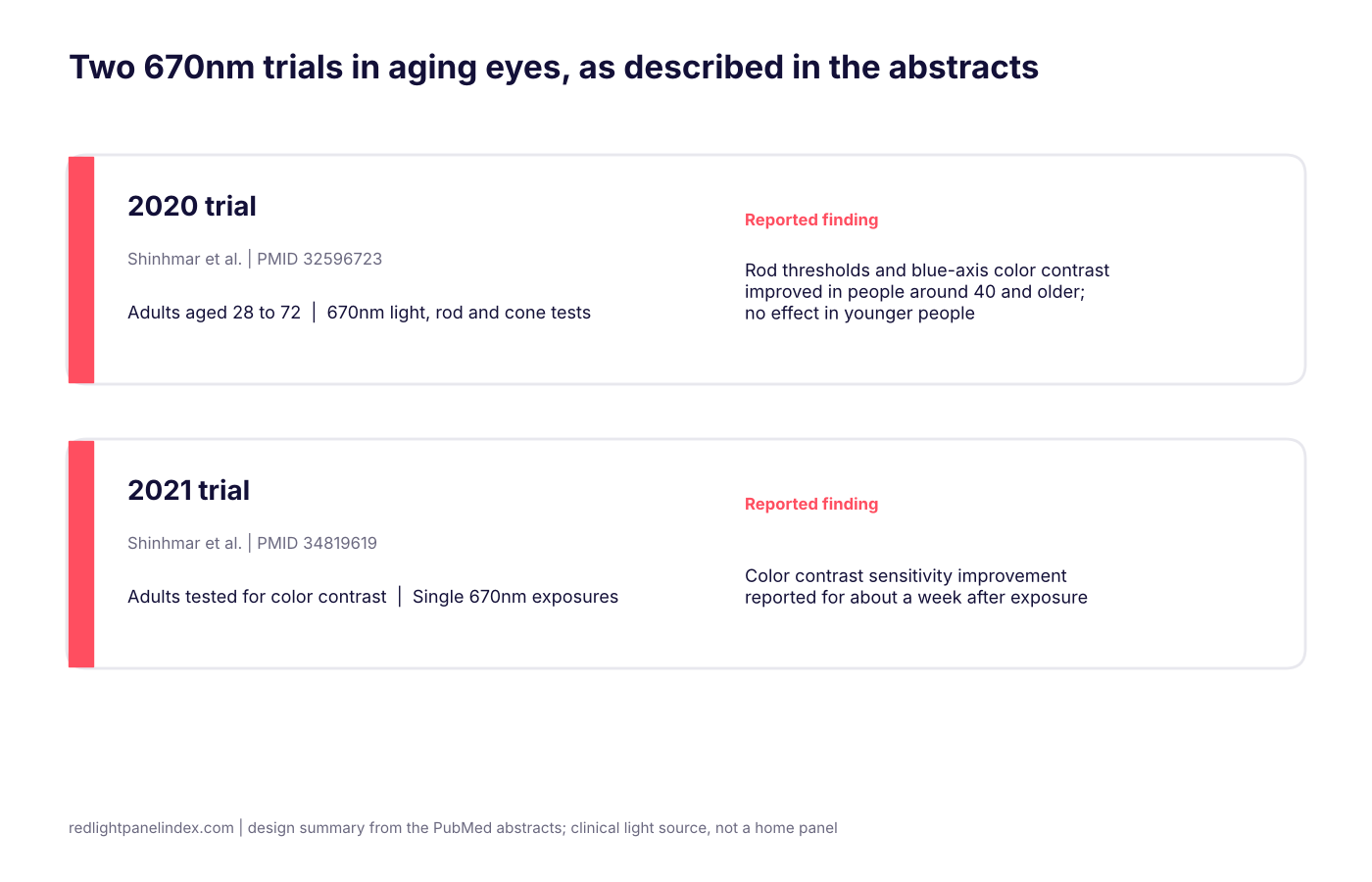
Two small trials from the same laboratory reported that 670nm light delivered to the eye improved some measures of visual function in adults around 40 and older, with no effect in younger participants (PMID 32596723), and that a single brief exposure was followed by better color contrast sensitivity for about a week (PMID 34819619). They are interesting early findings, they used controlled clinical light sources aimed at the eye, and they are not a reason to point a home panel at your face.
Choosing a panel? Our ranking of the best red light therapy panels is computed from published, method-labeled specs across 188 devices. For eye research like this, the spec that matters is how much 670nm-range output a panel has, and for safety the answer is that panels are not designed to be aimed at eyes.
What the studies asked
The authors, led by Shinhmar and including Glen Jeffery's group at University College London, started from a mitochondrial argument. Retinal photoreceptors have very high energy demands, mitochondrial function is reported to decline with age, and longer wavelengths between roughly 650 and 1,000nm have been reported to improve mitochondrial complex activity, membrane potential and ATP production. The site's explainer on cytochrome c oxidase covers that proposed mechanism and why it is still a hypothesis. The 2020 paper, "Optically Improved Mitochondrial Function Redeems Aged Human Visual Decline," asked whether 670nm light would improve rod and cone function in people of different ages. The 2021 paper, "Weeklong improved colour contrasts sensitivity after single 670 nm exposures associated with enhanced mitochondrial function," asked how a single exposure would affect color contrast and how long any change lasted.
Who was studied
The 2020 abstract describes participants aged 28 to 72 and reports that rod and cone performance declined significantly after about 40 years of age (PMID 32596723). The site's eye health evidence page summarizes the 2021 group as adults aged 37 to 70. Both are small samples of healthy volunteers recruited for visual testing, not patients with eye disease. The exact group sizes were not available to this review from the abstract text it could read, so none are given here.
Device and parameters as stated
Both studies used 670nm light. The abstracts and the summary on the eye health page describe a controlled clinical light source rather than a consumer panel, with the 2021 work using a single exposure of about three minutes and a lower total energy than earlier work. Irradiance and dose values were not available to this review from the text it could read, so no figures are quoted. That gap is itself instructive: without the delivered dose, a reader cannot reproduce the exposure with another device. The site's dose calculator can convert irradiance and time into energy density for any panel, but it cannot tell you what dose reached a retina.
What was measured and found
2020 trial. Rod and cone performance was tested across the age range. The abstract reports that 670nm light had no impact in younger individuals, while in people around 40 years and older it produced significant improvements in color contrast sensitivity along the blue (tritan) visual axis. Rod thresholds also improved significantly in those over 40 (PMID 32596723).
2021 trial. The study looked at color contrast sensitivity after single exposures and reported an improvement that lasted about a week, associated in the authors' interpretation with enhanced mitochondrial function (PMID 34819619). A claim of a "weeklong" improvement is a statement about one outcome in a small group, not about general vision or eye disease.
The pattern across the two is consistent: effects were reported in older participants and not in younger ones, which fits the argument that the benefit depends on an age-related deficit to correct. It is also what you would expect if the findings were noise, which is why independent replication matters.
Limitations
- Small samples. Small studies can show significant differences and still overstate them. The sham-controlled trials explainer describes why controls and replication matter.
- One research group. Both papers come from the same laboratory. Agreement between them is encouraging but is not independent confirmation.
- Narrow outcomes. Color contrast and rod thresholds are lab measures. Neither is the same as seeing better in daily life.
- Unknown durability beyond the follow-up. A week of improvement is not evidence of a lasting change, and the abstracts do not show what happens with repeated use over months.
- Mechanism is inferred. The mitochondrial explanation is the authors' interpretation, and the broader field still debates how light acts.
- Healthy volunteers. Nothing here addresses macular degeneration or any other disease.
Questions the trials leave open
Several questions that a buyer would naturally ask have no answer in these abstracts. Would repeated sessions extend the benefit past a week, or fade? Does the effect depend on the age-related deficit, so that it disappears once vision is already normal? Would a different wavelength near 670nm do the same? Would an independent group, using a sham exposure for comparison, see the same result? Until those are tested, the findings are best held as a hypothesis worth pursuing, in the same way the site treats other early-stage areas on its evidence hubs.
What this means for a home panel
The honest gap between the trials and a panel is large. The trial light was a controlled 670nm source delivered to the eye for a measured time. A home panel emits a mix of wavelengths across a wide area, with output stated for skin distances, not for the eye, and the eye is far more sensitive to light than skin. The site's eye protection guide explains why facing a running panel with open eyes is advised against, and the safety and side effects page covers the general cautions.
If you want to understand the wavelength involved, the 660nm explainer covers the nearest common panel band; 670nm is not the same as 660nm, and a panel that lists 660nm does not replicate these trials. Anyone with an eye condition or a history of eye surgery should talk to an ophthalmologist before trying any light device near the eyes. The grade the site gives this area, Limited, reflects small trials with clinical devices rather than home use.