Limited: four small clinical trials report improved visual function in aging eyes and in dry age-related macular degeneration using 670nm or 780nm light delivered by controlled clinical devices at low, precisely measured doses, not by the broad LED panels this site tracks, and none of the four tested a home panel on the eyes at all (PMID 32596723, PMID 34819619, PMID 37972955, PMID 18588438).
Choosing a panel? Our ranking of the best red light therapy panels is computed from published, method-labeled specs across 188 devices. For eye health specifically, the spec that matters is not on any panel's data sheet: none of the trials below used a flat LED panel, so there is no published dose to look up and replicate at home.
Eye safety comes before any of this research. Every trial reviewed here used a device built to deliver a small, controlled, precisely measured dose directly into the eye under study conditions, at power levels far below what a home LED panel emits at working distance. That is not an argument for looking into a panel's LEDs, aiming a panel at closed or open eyes, or treating this page as instructions for a home eye protocol. This site's eye protection guide states the baseline rule plainly: do not look directly at the LEDs of a running panel at any distance, and wear the goggles a brand supplies for any face session.
The four trials behind this grade
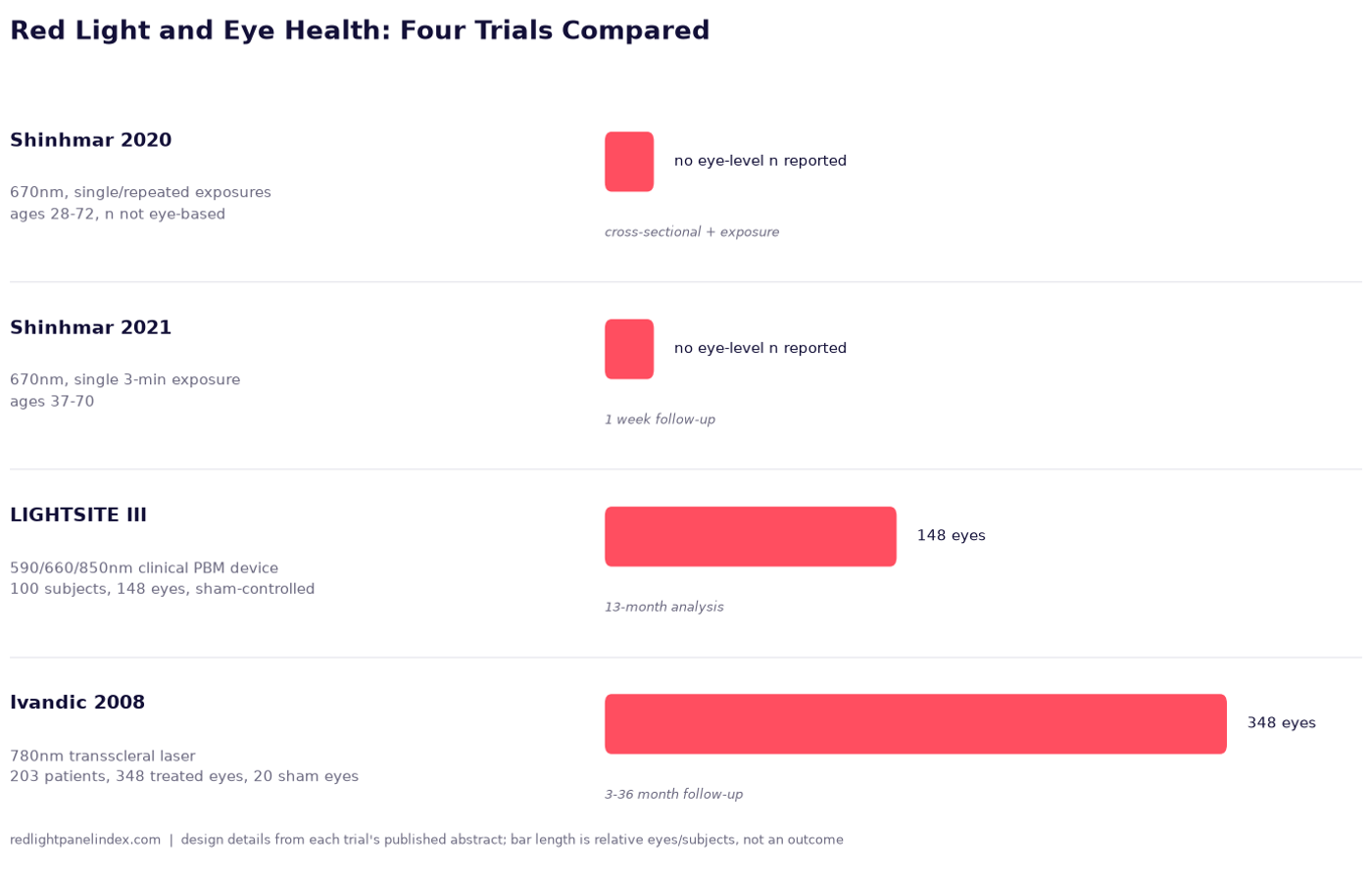
Shinhmar et al. 2020, aging vision (PMID 32596723). Published in The Journals of Gerontology, this study tested 670nm light exposure in adults aged 28 to 72 and found that rod and cone visual performance declined significantly after about age 40. The 670nm exposure produced no measurable change in participants younger than 40 but produced a significant improvement in rod thresholds and in blue-yellow (tritan-axis) colour contrast sensitivity in participants over 40, the two measures most sensitive to the mitochondrial decline the researchers linked to a roughly 70 percent drop in retinal ATP output over a lifetime. The study frames longer wavelengths, in the 650 to 1,000nm range, as a way to support mitochondrial function in the retina's most energy-demanding cells.
Shinhmar et al. 2021, single-exposure follow-up (PMID 34819619). Published in Scientific Reports by the same research group, this study tested a single 3-minute 670nm exposure delivered in the morning to adults aged 37 to 70. The abstract reports that this brief, one-time exposure, at a much lower total energy than the repeated exposures used in earlier work, was enough to significantly improve cone-mediated colour contrast detection for a full week afterward, to levels the authors compared with younger subjects. The mechanism proposed is the same as the 2020 study: long-wavelength light reducing the viscosity of water around the mitochondrial enzyme that produces ATP, improving its efficiency in aging photoreceptors.
LIGHTSITE III, dry age-related macular degeneration (PMID 37972955). This randomized, sham-controlled trial, published in Retina, tested a clinical multiwavelength photobiomodulation device (the Lumithera Valeda system, combining 590nm, 660nm and 850nm light) against a sham procedure in 100 subjects with nonexudative ("dry") AMD, covering 148 treated and sham eyes. Treatment was delivered in courses of nine sessions over three to five weeks. At the trial's 13-month primary analysis, the treated group showed a statistically significant difference from sham on visual acuity and showed fewer new cases of geographic atrophy, a marker of AMD progression, than the sham group.
Ivandic and Ivandic 2008, AMD case series (PMID 18588438). This is the oldest and largest study in this group, published in Photomedicine and Laser Surgery, and it used a different device entirely: a 780nm semiconductor laser delivered transsclerally (through the white of the eye, not through the pupil) at 7.5 mW and 292 Hz, for four sessions of 40 seconds each across two weeks, a total dose of 1.2 J/cm2. Across 203 patients with 348 treated eyes, spanning both dry and wet forms of AMD, the authors reported significant improvement in visual acuity in 95 percent of eyes with cataracts and 97 percent of eyes without cataracts, compared with no change in a 20-eye sham group, with improvement tracked out to 3 to 36 months of follow-up. Because this trial used a transscleral laser rather than light aimed through the pupil at the retina, and predates the more tightly controlled trials above by over a decade, its very high response rates should be read alongside its age and its case-series design rather than treated as directly comparable to the newer sham-controlled work.
What was not studied
None of these four trials used a broad-panel LED device of the kind this site tracks; three used tightly focused clinical light sources built for a single research protocol, and the fourth used a transscleral laser. No trial tested whether sitting in front of a home panel, even with eyes closed, produces any effect on vision or retinal health, positive or negative, at the distances and durations this site's other guides recommend for skin, muscle or joint goals. The two Shinhmar trials studied color contrast and rod thresholds in adults with otherwise typical aging vision, not a diagnosed eye disease, so they say nothing about people with retinopathy, macular degeneration, or other retinal conditions. LIGHTSITE III and the Ivandic study both treated diagnosed AMD but used devices, doses and delivery methods (a clinical PBM unit and a transscleral laser, respectively) that have no published equivalent for a panel used at a normal sitting distance. None of the four papers reviewed here reports a study specifically designed to test whether repeated close-range LED panel exposure has any effect, protective or harmful, on the retina over time.
Using a panel around your eyes: what this evidence does and does not support
Nothing in these four trials describes a protocol you can replicate with a home LED panel, so there is no dose to plug into this site's dose calculator for an eye-health goal the way there is for a skin or joint goal. The wavelengths involved sit close to the 660nm this site's wavelength explainer covers for skin and tissue use, but proximity in wavelength does not mean the eye responds to a panel the way it responded to the specific, precisely dosed clinical devices in these trials; retinal tissue is far more sensitive to light exposure than skin, which is exactly why the devices above delivered such small, controlled doses under research supervision. The practical takeaway from this evidence register is narrower than "670nm is good for eyes": it is that a specific, low-dose, closely monitored light exposure has shown a measurable effect on visual function and on AMD progression markers in small trials, and that finding has not been tested, let alone confirmed, for a home panel used at typical treatment distances.
Cautions
This evidence is associated with improved visual function and reduced AMD progression markers in the specific trial populations and devices described above; it does not support a claim that red light therapy treats, cures, or heals an eye disease, and none of the four trials involved a device sold as a consumer wellness panel. Anyone with a diagnosed retinal condition, a history of retinal surgery, or an eye disease such as AMD should treat any light-based eye intervention as a matter for their ophthalmologist, not a home routine to start independently based on this page. For general panel use unrelated to the eyes specifically, this site's eye protection guide and safety and side effects page cover the standing precautions: never look directly at a running panel's LEDs, wear supplied goggles for face sessions or for any panel with a blue or violet channel, and take extra care for children, whose eyes transmit more light to the retina than an adult's.