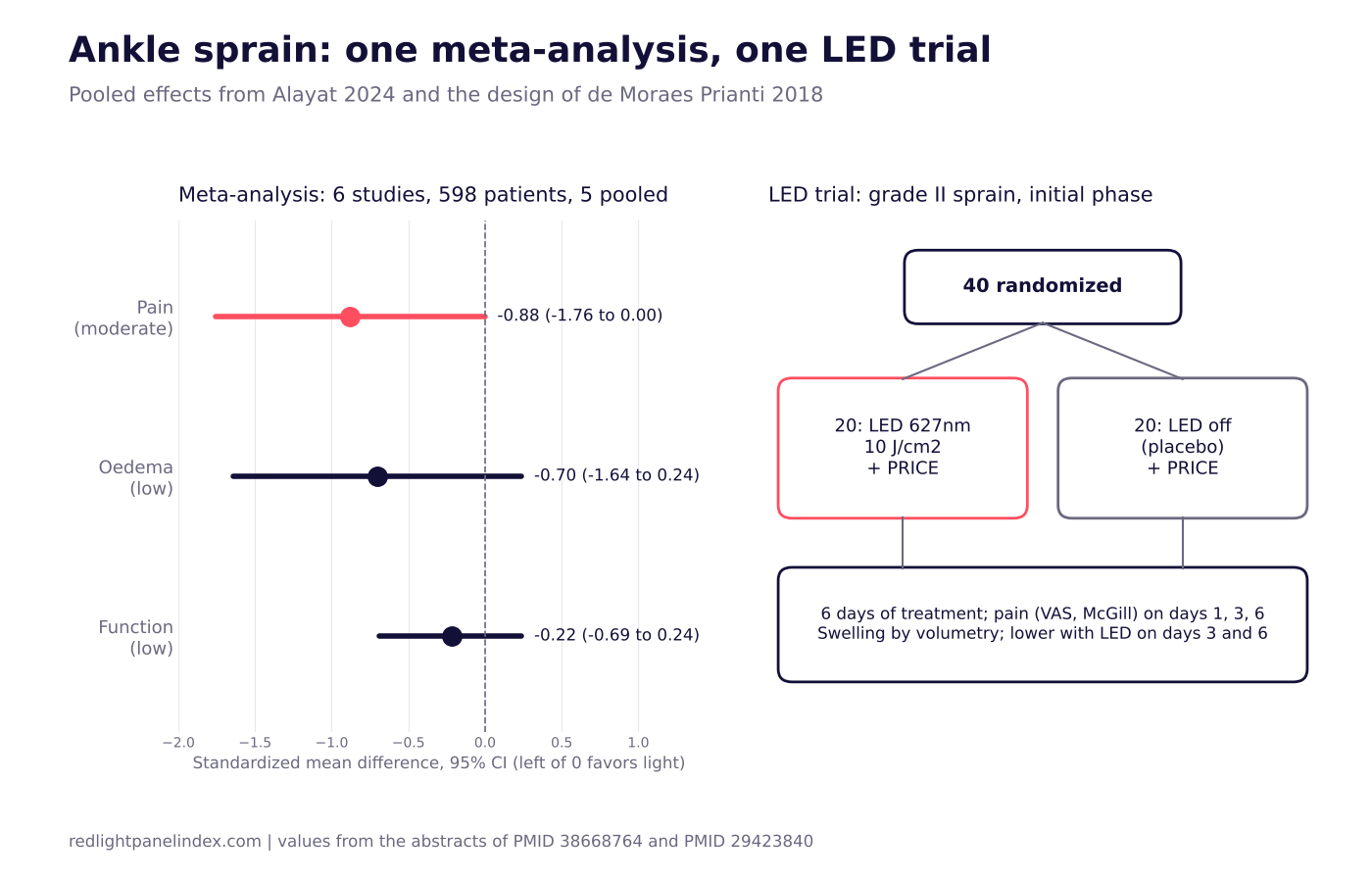
A 2024 systematic review and meta-analysis of six trials and 598 patients with ankle sprain reported that photobiomodulation reduced pain, with the authors rating that evidence moderate in quality, but found no significant effect on swelling or function, both rated low in quality (PMID 38668764). A 2018 placebo-controlled trial that used a 627nm LED in the first days after a grade II sprain reported less pain and less swelling than a switched-off device over six days (PMID 29423840). Together they point in one direction for pain and leave swelling and recovery of function unsettled.
Choosing a panel? Our ranking of the best red light therapy panels is computed from published, method-labeled specs across 188 devices. For an acute ankle injury, the spec that matters is method-labeled irradiance in the red band, because the one LED trial here dosed red light only.
Where this fits
The site's joint pain and arthritis evidence page is built on knee osteoarthritis and tendon trials and does not cover sprains. The inflammation evidence page grades light and inflammation as Limited and notes that swelling after an injury can have causes that need a clinician. An ankle sprain is neither a chronic joint condition nor a general inflammation claim. It is an acute ligament injury that usually improves over weeks on its own, so any treatment effect has to be measured against natural recovery and timed against the injury. Everything below comes from the two abstracts, read through database records. Where an abstract is silent, this page says so.
What the studies asked
The review. Alayat and colleagues, writing in Lasers in Medical Science, asked whether photobiomodulation therapy is effective for pain, swelling (oedema) and function in people with an ankle sprain. They searched MEDLINE, PubMed, EBSCO, Web of Science, Wiley Online Library, ScienceDirect, PEDro and Cochrane from inception to the end of 2023 for trials comparing light therapy with a control.
The LED trial. De Moraes Prianti and colleagues, in the same journal, asked a narrower question: does a red LED at 627nm, added to standard first aid, reduce pain and swelling in the initial phase of an ankle sprain?
Who was studied
The review included six studies with 598 patients in total, and five of them were pooled in the meta-analysis. The abstract does not give ages, sprain grades, how soon after injury treatment started, or the size of each trial. It rated study quality on the PEDro scale and judged two studies fair and four good. The abstract as read does not say whether the 2018 LED trial was one of the six.
The LED trial randomized 40 volunteers with a grade II inversion sprain into two groups of 20. A grade II sprain is a partial ligament tear, more than a mild stretch and less than a full rupture. The abstract does not report ages, sex or the exact time from injury to the first treatment beyond describing it as the initial phase.
Device and parameters as stated
The review. The abstract does not list the devices, wavelengths or doses used across the six trials. It does say the authors called for future trials with standardized irradiation parameters, which suggests the included trials varied in how light was delivered. The full text is behind a paywall and was not read for this page.
The LED trial.
- Light source: LED at 627 plus or minus 10nm, in the red band.
- Dose: 10 J/cm2.
- Control: the same LED device turned off.
- Background care: both groups received PRICE (protection, rest, ice, compression and elevation).
- Duration: treatment over six days.
- Assessments: pain on days 1, 3 and 6 with a visual analogue scale (VAS) and the McGill Pain Questionnaire; swelling by volumetry, which measures the foot and ankle's displaced water volume.
The abstract does not give the LED's power, the irradiance at the skin, the time per application, the area treated, the number of sessions within the six days or any follow-up after day 6. A dose in joules per square centimeter without an irradiance cannot be turned into a session length, so the trial cannot be fully reproduced from the abstract.
What was measured and found
The review. Pooled across the meta-analysis:
| Outcome | Standardized mean difference | 95% confidence interval | p | Certainty (GRADE) |
|---|---|---|---|---|
| Pain | -0.88 | -1.76 to -0.00 | 0.05 | Moderate |
| Oedema | -0.70 | -1.64 to 0.24 | 0.14 | Low |
| Function | -0.22 | -0.69 to 0.24 | 0.35 | Low |
The authors describe the pain effect as large, and their conclusion is that photobiomodulation is "quite effective" for ankle sprain. Read closely, the pain result sits right at the edge: the upper end of the confidence interval reaches zero and p is 0.05. Heterogeneity between studies was above 75 percent for pain and oedema, meaning the trials disagreed with each other far more than chance would explain. Swelling and function did not differ significantly from control.
The LED trial. The LED group reported less pain than the placebo group on both scales. The abstract gives the pain reductions as 85.79 percent against 55.73 percent on the VAS and 83.33 percent against 52.52 percent on the McGill questionnaire. Swelling fell more in the LED group on days 3 and 6, with p below 0.0001. The authors conclude that LED at this dose was effective for pain and oedema in the initial phase. Note that the placebo group improved substantially too, which is what natural recovery and PRICE care would predict in the first week.
Limitations
- A borderline pooled result. The review's pain effect has a confidence interval touching zero, and the heterogeneity is high, so the size of any real effect is uncertain.
- Swelling disagrees across sources. The single LED trial reported less swelling, while the pooled review did not find a significant effect. One small trial does not outweigh a pooled estimate.
- Unknown parameters. Neither abstract gives enough device detail to compare treatments across trials or with a home device.
- Small trial, short window. Forty people over six days, with no follow-up on return to activity or re-injury.
- Device-off placebo. A switched-off LED controls for the ritual of treatment, but the abstract does not say whether participants could tell the difference. The guide to reading sham-controlled trials explains why that matters most for self-reported pain.
- Acute timing. These results apply to the first days after a sprain, not to lingering ankle pain months later.
How this reads on the site's grading scale
The site's evidence grades explainer asks whether more than one controlled trial points the same way at doses a home panel can plausibly deliver. Here, a pooled review rates the pain evidence moderate and the swelling and function evidence low, and the one LED trial with a stated wavelength used a dose a panel could deliver in principle but did not report the irradiance needed to match it. This page reviews the studies and does not assign a condition grade, but on those terms the support for home panels in ankle sprain would not reach the site's Strong grade. The ankle sprain evidence page assigns that grade, Limited, and adds what was not studied and a session-length worked example.
What it means for a home panel
The LED trial is closer to a home panel than most injury trials, because it used an LED rather than a laser and a red wavelength many panels carry. The site's 630nm page notes that 114 of the 188 panels in the database list 630nm, and that red light at this wavelength is absorbed mostly in the upper layers of tissue. The ankle ligaments sit close to the surface, which makes the red band less of a mismatch than it would be for a hip or a spine.
The dose is the harder part. Session time equals the dose divided by irradiance, so reaching 10 J/cm2 takes 10,000 divided by the irradiance in mW/cm2, in seconds. A hypothetical panel delivering 50 mW/cm2 of red light at your distance would need about 200 seconds. Most panels publish one irradiance figure for all their bands combined, though, and the trial dosed red light alone, so only part of a panel's headline number counts toward a 627nm dose. Use the dose calculator with a method-labeled figure, and see the LED vs laser page for why clinic and home doses are not interchangeable.
If you try a panel on a fresh sprain, treat it as an addition to standard first aid, as both trial groups had, not a replacement. Have a severe sprain checked, since a fracture or a complete ligament tear can look similar in the first days. Check photosensitizing medications and stop if pain or swelling worsens. This page describes studies; it is not medical advice.