The evidence grade for light therapy in frozen shoulder is Limited for clinic high-intensity laser and Insufficient for home panels: the only controlled trial on the condition itself randomized 36 people and reported added pain relief from a high-intensity laser on top of exercise, but no added gain in disability or range of motion (PMID 32808147). The better-known shoulder laser trials were run in rotator cuff tendinitis, a different problem, and they are covered on the shoulder tendinopathy evidence page; this page deals only with adhesive capsulitis.
Choosing a panel? Our ranking of the best red light therapy panels is computed from published, method-labeled specs across 188 devices. For a deep joint like the shoulder, the spec that matters is method-labeled near-infrared irradiance at your real distance, though no panel reproduces the laser tested in frozen shoulder.
What frozen shoulder is
Frozen shoulder, or adhesive capsulitis, is a condition in which the capsule around the shoulder joint becomes inflamed, thickened and tight, so the shoulder grows painful and then stiff in every direction. It usually runs a long course, often over many months, and the defining problem for most people is lost movement, not only pain.
That is why it needs a page of its own. Tendon pain, which the tendinopathy evidence page grades Moderate for clinic laser, comes from an overloaded tendon that still lets the joint move. In frozen shoulder the restriction sits in the joint capsule itself. A treatment that eases tendon pain is not automatically a treatment that loosens a contracted capsule, and the trials below show that difference directly.
How this page grades the evidence
Grades on this site run Strong, Moderate, Limited and Insufficient, as set out in how this site grades evidence. Frozen shoulder gets a split grade:
- Limited, for clinic high-intensity laser. One small, double-blinded, sham-controlled randomized trial on adhesive capsulitis reported a pain benefit. One trial, roughly a dozen people per arm, and no stated device parameters in the abstract keep it at Limited.
- Insufficient, for home LED panels. No trial found for this page tested an LED panel, or any low-power red or near-infrared device, in frozen shoulder.
The grade does not borrow from the rotator cuff trials. They are reported below for contrast, because they are the trials a reader is most likely to meet when searching for laser and shoulder pain.
What the trials used
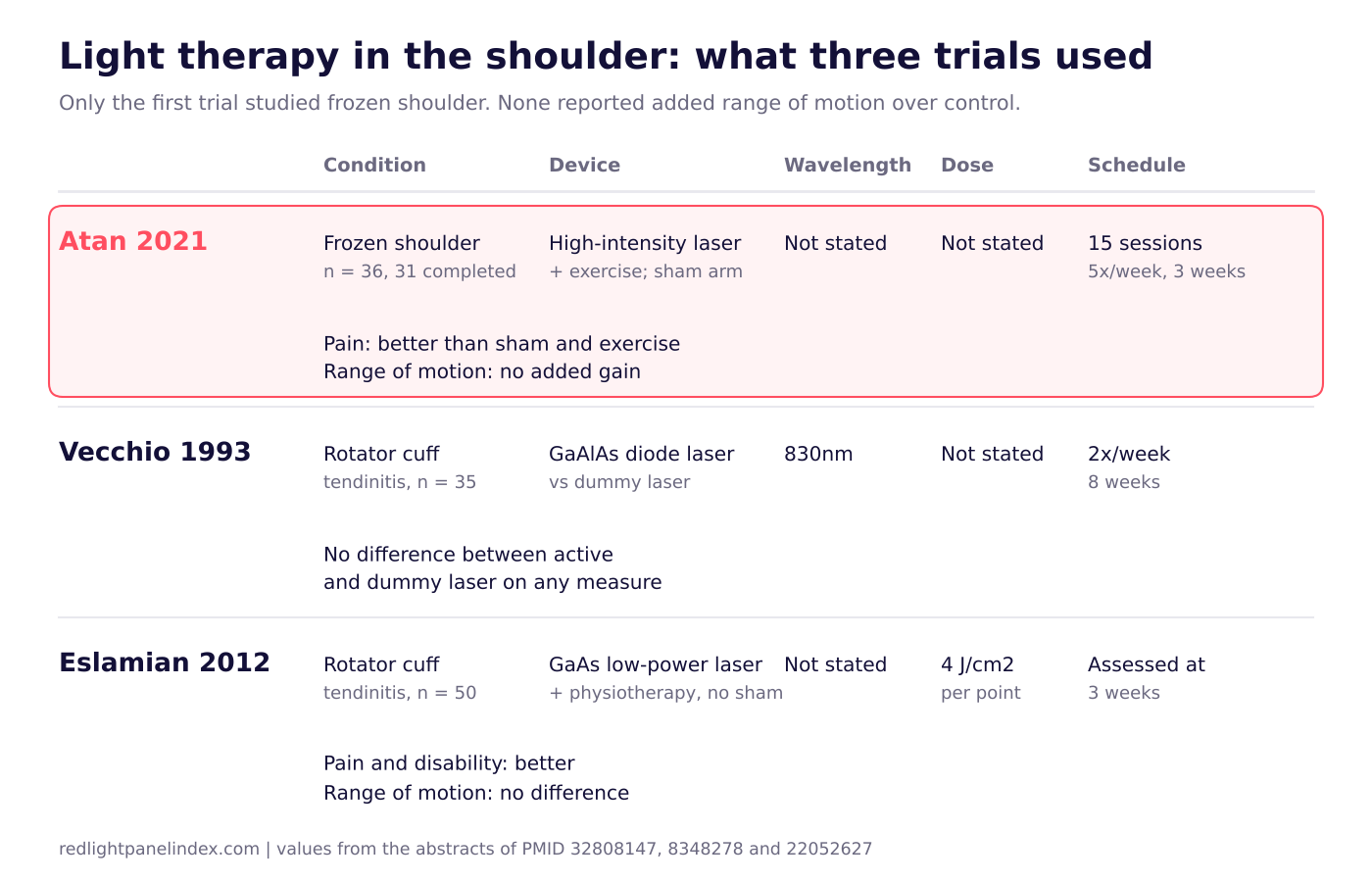
The table is built only from the three abstracts read for this page. Where an abstract does not give a figure, the cell says so.
| Trial | Condition | Device | Wavelength | Dose | Schedule | Added range of motion? |
|---|---|---|---|---|---|---|
| Atan 2021 (PMID 32808147) | Adhesive capsulitis, 36 randomized, 31 completed | High-intensity laser plus exercise, vs sham plus exercise, vs exercise | Not stated | Not stated | 5 times a week for 3 weeks, 15 sessions | No |
| Vecchio 1993 (PMID 8348278) | Rotator cuff tendinitis, 35 patients | 830nm GaAlAs diode laser vs dummy laser | 830nm | Not stated | Twice weekly for 8 weeks | No difference on any measure |
| Eslamian 2012 (PMID 22052627) | Rotator cuff tendinitis, 50 patients (25 per group) | Gallium-arsenide low-power laser plus physiotherapy vs physiotherapy | Not stated | 4 J/cm2 per point, up to ten painful points | 5 minutes in total; assessed at 3 weeks | No |
The studies
Atan 2021: the frozen shoulder trial
Atan and Bahar-Ozdemir randomized 36 patients with adhesive capsulitis to high-intensity laser therapy (HILT) plus exercise, sham laser plus exercise, or exercise alone, with 31 completing (PMID 32808147). All groups did 25 minutes of physiotherapist-supervised shoulder exercise, and outcomes were taken after treatment and at 12 weeks. The abstract reports that the HILT group did better on pain, the SPADI pain subscale and three SF-36 quality-of-life subscales, while disability and range of motion improved comparably in all three groups.
Put plainly, the stiffness side of the condition responded to exercise, and the laser did not add to it. The sham arm matters here: pain is self-reported and prone to placebo response, and a trial that beats both sham and exercise alone on pain is stronger than one with no sham at all. The guide to sham-controlled trials explains why. The full write-up, including what the abstract leaves out, is in the study review of the Atan high-intensity laser trial.
A high-intensity laser is a clinic device that delivers far more power than a low-level laser or an LED panel, and it warms the skin. The abstract gives no wavelength, power or energy, so the dose cannot be entered into the dose calculator or compared with a panel.
Vecchio 1993: a rotator cuff trial that found no difference
In a double-blind trial of 35 patients with rotator cuff tendinitis, an 830nm gallium-aluminum-arsenide diode laser was compared with a dummy laser, twice weekly for 8 weeks (PMID 8348278). Range of movement, painful arc, resisted movement and pain scores improved from baseline in both groups, with no difference between them, and the authors concluded the trial gave no evidence that the laser was effective for the condition. The abstract does not state the dose.
This trial is useful here as a warning about uncontrolled improvement. Both arms got better over 8 weeks. Without the dummy laser, that improvement could easily have been credited to the light.
Eslamian 2012: laser added to physiotherapy
Fifty patients with rotator cuff tendinitis were randomized to routine physiotherapy or physiotherapy plus a gallium-arsenide low-power laser at 4 J/cm2 on up to ten painful shoulder points (PMID 22052627). After three weeks, both groups had improved, and the laser group reported lower pain (3.1 vs 5 on the visual analogue scale, p = 0.029) and lower shoulder disability scores (4.4 vs 8.5, p = 0.031). Active abduction and external rotation did not differ between groups (p = 0.20 and p = 0.77). There was no sham arm, so some of the pain difference may reflect the extra attention of being treated.
The pattern across all three
Read side by side, the three abstracts point the same way. Where light reported an added effect, it was on pain or disability scores. In none of them did light add range of motion over the comparison group. For tendinitis, a pain change may be the main goal. For frozen shoulder, where lost movement is the core problem, it means the one direct trial did not touch the outcome most patients care about. The joint pain and arthritis hub shows the same add-on-to-exercise pattern in knee trials.
What was not studied
- Home LED panels. No trial here used an LED device of any kind, let alone a panel at a distance from the shoulder.
- Low-level laser in frozen shoulder. The only adhesive capsulitis trial used a high-intensity laser. The low-power lasers in the table were tested in a different condition.
- Stages of the condition. The frozen shoulder abstract does not say whether patients were in the painful early phase or the stiff later phase, so nothing here says when light might fit.
- Diabetes. Frozen shoulder is more common in people with diabetes, and the abstract does not report how many participants had it.
- Light alone. Every frozen shoulder participant exercised. No result here applies to light used instead of exercise or physiotherapy.
- Long-term outcomes. Follow-up ran to 12 weeks in the frozen shoulder trial, which is short for a condition that often lasts much longer.
- Injections, capsular release or manipulation. None of these were compared with light.
What a home panel can and cannot reproduce
A panel cannot reproduce the frozen shoulder trial. The device was a high-intensity clinic laser with undisclosed settings, and a panel differs in power, delivery and the warmth it produces. What a panel can do is deliver red and near-infrared light over the whole shoulder at a known dose, which you can compute.
- Dose. Multiply a method-labeled irradiance at your real distance by session time, using the dose calculator. The only stated dose in this literature is 4 J/cm2 per point from a laser in a tendinitis trial, and the WALT dosing page explains why per-point laser doses do not convert directly into panel minutes. Treat any panel protocol as an estimate.
- Wavelength. The shoulder capsule sits deep, under the deltoid and around the joint. Near-infrared travels further into tissue than red, as the penetration depth page explains, and the 830nm used in the Vecchio trial is covered on the 830nm wavelength page. Most panels pair red with 850nm near-infrared.
- Irradiance labels. A spectrometer figure and a solar meter figure for the same panel can differ about twofold, as the irradiance explainer shows, so compare like with like.
- Choosing a panel. The best panels for joint pain ranking applies the same method-labeled criteria to every brand.
What a panel cannot do, on this evidence, is restore movement. In the only frozen shoulder trial, movement came back with exercise, with or without the laser.
Cautions
- Frozen shoulder is diagnosed by examination. Shoulder stiffness after a fall, sudden weakness, a deformed joint, fever, or shoulder pain with chest pain or breathlessness needs prompt medical assessment, not a light session.
- Keep up the exercise or physiotherapy program. Every positive result on this page came from light added to exercise.
- People who are pregnant, have a history of skin cancer over the area, or take photosensitizing medication should speak with a clinician first.
- Use eye protection with bright near-infrared panels, since the band is invisible.
- Judge any change in pain over weeks, expect range of motion to come from movement work, and stop if pain worsens.