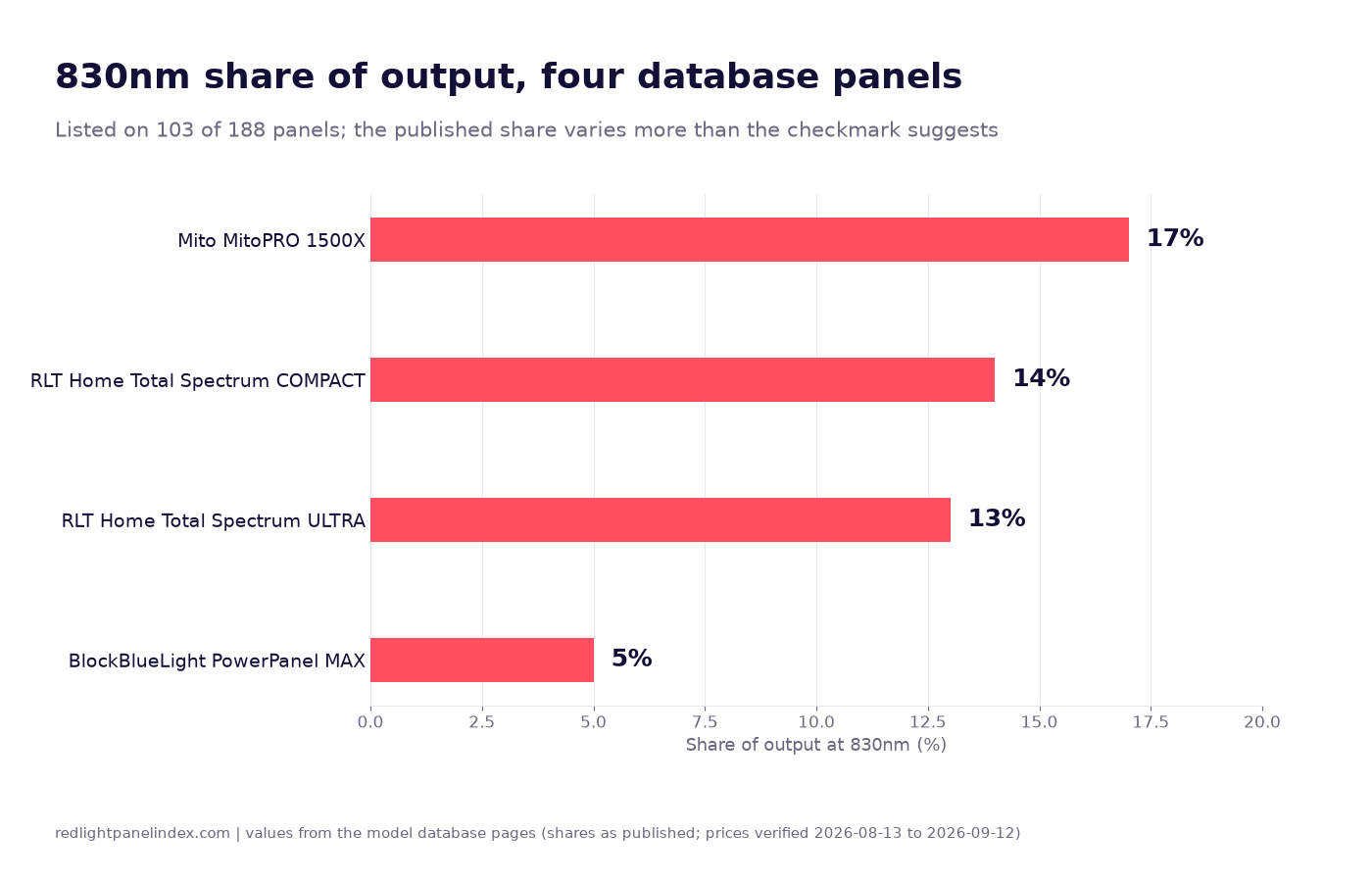
830nm is a near-infrared wavelength, invisible to the eye, that sits between the 810nm and 850nm bands and is the near-infrared partner most often paired with 633nm red in LED skin trials. It is listed on 103 of the 188 panels in this site's database, 55 percent, but the share of a panel's output it gets ranges from none to 17 percent on the panels that publish a breakdown.
Choosing a panel? Our ranking of the best red light therapy panels is computed from published, method-labeled specs across 188 devices. For 830nm, the spec that matters is the published share of output at that band, because a listed wavelength can mean a large fraction of the light or a token amount.
What 830nm is
Visible red runs from roughly 600 to 700nm, and near-infrared begins somewhere past that, a boundary the red versus near-infrared page explains. 830nm is squarely near-infrared, 20nm above 810nm and 20nm below 850nm. Like the red bands, it is absorbed by a mitochondrial enzyme, the first step in the process described on the photobiomodulation page. The site's wavelength guide summarizes it in four words, "pain, skin-depth crossover", and notes that the 633 plus 830 pairing recurs across positive skin trials.
The "crossover" label is the useful part. Visible red is absorbed close to the surface, while the longer near-infrared bands are the family associated with reaching deeper tissue, a point the penetration depth page treats with caution because depth figures are modeled ceilings, not what a home panel delivers. 830nm is the band that sits at the join: far enough into near-infrared to be associated with the dermis and below, yet it is the band skin researchers have repeatedly chosen to sit beside red.
The skin trials that used 830nm
Two of the studies behind this site's skin and anti-aging evidence page used 830nm directly.
A split-face trial. A prospective, randomized, placebo-controlled, double-blinded, split-face study compared LED treatment settings for photorejuvenation in 76 patients with facial wrinkles: 830nm alone, 633nm alone, the two combined, or a sham light, twice a week for four weeks (PMID 17566756). The combined red and infrared light improved wrinkles significantly more than the control and more than red alone, while red alone reduced melanin more. That result is why 830nm gets its reputation as a useful add-on to red, but the trial tested a specific clinical LED device, not a wall panel, and it does not say what share of a panel's output the near-infrared band needs. Our study review of the 2007 split-face LED trial walks through its design and what the abstract does and does not report.
Psoriasis, in nine patients. Nine people with chronic psoriasis, most of it resistant to conventional treatment, were treated with LED arrays delivering continuous-wave 830nm and 633nm in two 20-minute sessions over 4 or 5 weeks, with 48 hours between sessions, at 60 J/cm² for 830nm and 126 J/cm² for 633nm (PMID 19764893). Clearance rates at the end of follow-up ranged from 60 to 100 percent. The authors described it as preliminary and called for a controlled, double-blind study in a larger group. With no control arm and nine participants, it shows that a protocol was feasible and that the patients reported high satisfaction, not that 830nm cleared psoriasis. Anyone with psoriasis should treat it as a question for a dermatologist.
A related controlled trial, with a caveat. The 2014 trial from Wunsch and Matuschka, reviewed on the site's skin rejuvenation study page, used red-only light (611 to 650nm) or polychromatic light (570 to 850nm) twice a week for 30 sessions and reported improved complexion, reduced roughness and increased collagen density in treated groups, with no advantage for the polychromatic light over red alone (PMID 24286286). It does not isolate 830nm, and its result is a reminder that adding near-infrared did not outperform red in that design.
Taken together: the sham-controlled evidence for 830nm in skin comes from a pairing with red, the psoriasis data is a nine-person series, and the one controlled trial that included near-infrared in a broad band did not show it adding anything. 830nm has a respectable trial history as a partner to 633nm, not a demonstrated benefit on its own.
How much 830nm the database panels carry
A wavelength on a spec sheet is a yes or no, and a share of output is a number. The panels below publish both:
| Model | 830nm share | Other bands |
|---|---|---|
| Mito Red Light MitoPRO 1500X | 17% | 590 (6%), 630 and 660 (22% each), 810 and 850 (17% each) |
| RLT Home Total Spectrum COMPACT | 14% | 630 and 660 at 19% each, seven bands in all |
| RLT Home Total Spectrum ULTRA | 13% | 480, 630, 660, 810, 850 and 1064nm |
| BlockBlueLight PowerPanel MAX | 5% | 660 and 850 at 40% each, 630 at 10%, 810 at 5% |
The Hooga ULTRA750 skips 830nm and spends that output on 810 and 850nm. A panel without 830nm is not missing a category of light so much as choosing how to spread its output across neighbors, which is the point the 810nm page makes from the other side. Prices on these pages carry their own verification dates: $1,299 for the MitoPRO 1500X (verified 2026-08-13), $1,095 for the COMPACT, $2,895 for the Total Spectrum ULTRA and $1,100 for the PowerPanel MAX (all verified 2026-09-12). Treat them as snapshots.
Worked example: how much 830nm is that
Take the Total Spectrum ULTRA. Its page lists 119.28 mW/cm² at 6 inches, measured by an independent lab with a spectrometer, and 13 percent of output at 830nm. Multiplying gives roughly 15.5 mW/cm² at 830nm. That is an estimate built from a share and a total, not a direct measurement of 830nm irradiance, and the irradiance explainer shows why the method label on the total matters.
Now compare it with the psoriasis trial's 830nm dose of 60 J/cm². Delivered over a 20-minute session, that dose implies about 50 mW/cm², which is simple arithmetic on the paper's own figures. At about 15.5 mW/cm², reaching 60 J/cm² would take roughly 65 minutes. The point is not to chase that number, since the trial used a clinical LED array and a specific population, but to show that a panel's 830nm share, not its total wattage, sets how long a session at 830nm would need to be to match a published dose. The dose calculator does this conversion for any irradiance, distance and time, and the dosing guide explains why more minutes is not automatically better.
830nm for joints and pain
The wavelength guide groups 810 and 830nm as the near-infrared bands that matter for joints and deep tissue, and the joint pain evidence page names 810, 830 and 1064nm-class bands as the ones to look for at meaningful density. The evidence behind that advice is laser and LED trial work graded on that page, and it is not specific to 830nm. The pain label comes from laser and LED trial work in that near-infrared range, and one pooled analysis of laser therapy, the Lancet meta-analysis, is covered on the site's neck pain evidence page, which also explains why its pooled result cannot be assigned to a single wavelength.
How to compare two panels on 830nm
- Check that the page publishes a percentage for 830nm, not just the wavelength. If it does not, you can only say the band is present.
- Check the irradiance method label. A spectrometer figure is a measurement; a bare manufacturer claim is not.
- Multiply cautiously. A share applied to a total gives an estimate that inherits any uncertainty in the total.
- Ask what the 830nm is for. If the goal is skin, the trials paired it with 633nm, so check the red share too. If the goal is deeper tissue, compare it against the 810nm versus 850nm shares.
- Use the dose calculator with the distance you will actually sit.
What to take from this
- 830nm is a real research wavelength, and 55 percent of database panels list it.
- Its skin evidence comes from pairing with 633nm red, in a sham-controlled split-face trial and a small uncontrolled psoriasis series.
- Published shares range from 5 to 17 percent on the panels above, so compare numbers, not checkmarks.
- Nothing here shows 830nm working alone, and a panel with it is not a clinical LED array.
Filter the panel database by wavelength to see which models include 830nm and how much of their output it gets, and read the 630nm page for the red half of the pairing.