The evidence grade for red light therapy and hypothyroidism is Limited: a single randomized, placebo-controlled trial of 43 people with autoimmune hypothyroidism reported that people who received an 830 nm laser over the thyroid later needed a lower levothyroxine dose, and a follow-up by the same research group reported a similar direction six years on, but no independent group has repeated it. The trial used a focused diode laser held against the neck, not a panel, so it says little about what a home device would do.
Choosing a panel? Our ranking of the best red light therapy panels is computed from published, method-labeled specs across 188 devices. For thyroid research, the spec that matters is how much 830 nm light a panel actually delivers at the skin, which is far below what the trial laser delivered.
This page is a summary of published research, not medical advice. Thyroid hormone replacement is a prescribed treatment. Never lower, stop or skip levothyroxine because of anything on this page; any change in dose is a decision for your physician, guided by blood tests.
Why the grade is Limited
This index grades each condition on the number, size and independence of controlled trials. How the grades work is explained separately. For the thyroid the picture is:
- One randomized, placebo-controlled trial on the main question (PMID 22718472).
- A long-term follow-up of the same patients, run by the same group (PMID 30532779).
- A companion analysis of the same trial looking at blood flow in the gland on ultrasound (PMID 23316383).
- No independent replication that we found, and no trial of a panel or any LED device.
All three papers describe one cohort of 43 patients at one center. Three papers on one trial are not three trials. That is the main reason this page sits at Limited rather than Moderate.
What the main trial reported
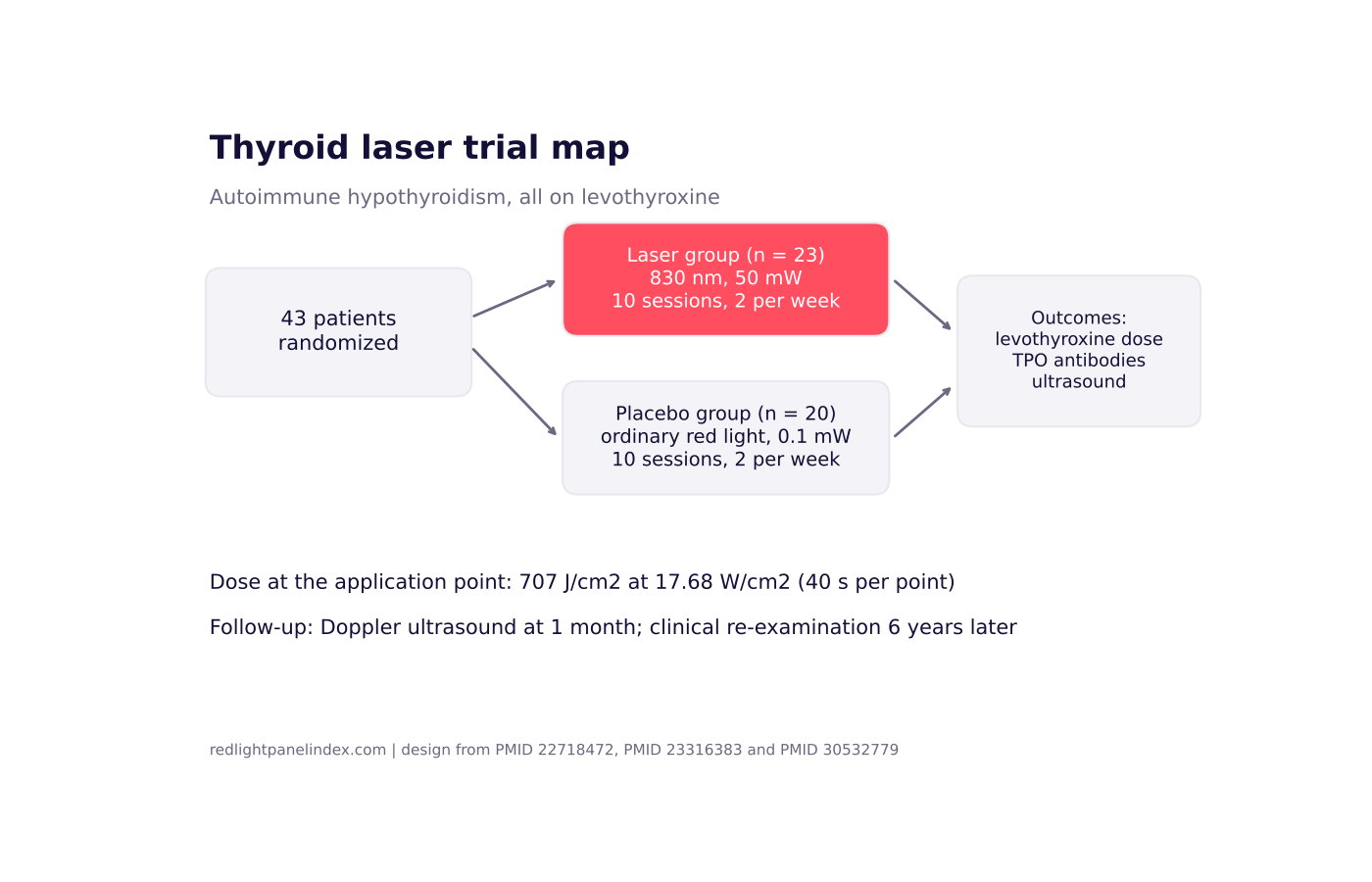
The trial enrolled adults with hypothyroidism caused by chronic autoimmune thyroiditis (Hashimoto's disease) who were already taking levothyroxine. Forty-three patients were randomly assigned to 10 laser sessions (23 people) or 10 placebo sessions (20 people). The laser was a continuous-wave 830 nm diode at 50 mW, applied in contact with the skin over the thyroid, twice a week for five weeks. The placebo arm used the same equipment with an ordinary red light that the authors described as indistinguishable from the laser beam.
The main outcome was the levothyroxine dose needed to keep thyroid blood tests in the normal range after the medication was withdrawn under medical supervision. The reported mean doses were 38.59 micrograms a day in the laser group and 106.88 micrograms a day in the placebo group, a difference reported as statistically significant (PMID 22718472). The same paper reported lower thyroid peroxidase antibodies in the laser group and greater echogenicity (a brighter ultrasound texture of the gland), with no difference in thyroglobulin antibodies.
Two points deserve emphasis. First, withdrawing thyroid hormone to measure a dose is an intervention that was done inside a supervised trial. It is not something to try at home. Second, a lower required dose is a laboratory-guided outcome, not a symptom score, so the trial does not tell you whether people felt better.
What the follow-up and the ultrasound paper added
The six-year follow-up (PMID 30532779) re-examined 43 patients: 25 in the laser group and 18 in the placebo group, because two former placebo patients later received the laser. The authors reported that the laser group still needed less levothyroxine, 94.50 micrograms a day against 141.72 micrograms a day, with a reported p value of 0.003. Antibody levels and TSH did not differ significantly between groups at that point, and nodule rates were similar. The authors described the effect as possibly transient and suggested that repeat sessions might be needed. They also noted the small sample limits the safety analysis.
The ultrasound analysis (PMID 23316383) looked at thyroid blood flow one month after treatment. It reported that normal vascular patterns were more frequent in the laser group, with a parenchymal score of 1.87 against 2.30 in the placebo group (p = 0.033). The authors themselves called the meaning of some of the Doppler findings uncertain, and the follow-up was only one month.
For how placebo arms are built and why they matter in light studies, see the guide to sham-controlled trials. This trial had a plausible sham, which is a strength. The weaknesses are the single center, the small size and the fact that the research group that developed the protocol ran it.
What was not studied
Many questions people ask have no controlled data behind them:
- Panels and LED devices. No trial we found used a home panel over the thyroid.
- Other thyroid conditions. Hyperthyroidism, Graves' disease, thyroid nodules and thyroid cancer were not the subject of this evidence.
- Symptoms. Fatigue, weight and mood were not the primary outcomes.
- Safety in people with nodules. The follow-up excluded people with nodules at baseline.
- Long-term maintenance. There is no data on how often sessions would need repeating, beyond the authors' suggestion.
- Combined use with medication changes. Any dose change in the trial happened under medical supervision.
Why a home panel is not the trial device
The trial laser put 50 mW into a small spot for 40 seconds per application point. The authors report a fluence of 707 J/cm2 and an irradiance of 17.68 W/cm2 at the point of contact. A home panel spreads light over a large area. Using the 830 nm output estimate on our 830 nm wavelength page, one popular multi-wavelength panel delivers roughly 15.5 mW/cm2 of 830 nm light at six inches. That estimate is not a measurement, but it makes the gap plain: the trial irradiance is on the order of a thousand times higher.
Dose is irradiance multiplied by time. At about 15.5 mW/cm2, reaching 707 J/cm2 would take roughly 12 to 13 hours of continuous exposure at that spot, which is not a realistic session. This calculation only compares numbers. It does not mean either approach is equivalent or that a longer panel session would reproduce the result. A focused laser and a diffuse LED panel also differ in beam geometry, contact and how light enters the tissue. See LED versus laser for that difference, and irradiance and how it is measured for the numbers.
You can check any dose figure yourself with the dose calculator, and the wavelength guide explains where 830 nm sits among the bands panels offer.
Practical points
- If you have thyroid disease, talk to your physician before using any light device near the neck. The thyroid sits just under the skin at the front of the neck, so light directed there is a deliberate choice, not an accident.
- Do not change a thyroid medication dose because of this research. The trial adjusted doses with blood tests and clinical supervision.
- If you use a panel for another reason, such as joints or skin, keep it away from the eyes and follow the usual cautions in our safety review.
- If a seller claims a panel supports thyroid function, ask which trial it relies on. The only controlled trial on this page used a laser, not a panel.
Cautions
The evidence is one research group, one center and 43 patients. Results from such a small group can fail to hold up when others repeat the work. The reported effects were on a laboratory-guided outcome, and the authors themselves said effects may fade. Nothing here shows that red light therapy corrects an underactive thyroid, and the data do not support using a panel in place of prescribed medication.
Bottom line
One placebo-controlled trial reported that an 830 nm laser over the thyroid was associated with a lower levothyroxine requirement in autoimmune hypothyroidism, and a follow-up by the same group reported a similar direction. That is interesting early evidence, not an established therapy, and it was not tested with the kind of device people keep at home. Until an independent trial appears, treat the thyroid as an open research question and leave medication decisions to your physician. For the trial in detail, see our study review of the Hofling hypothyroidism trial.