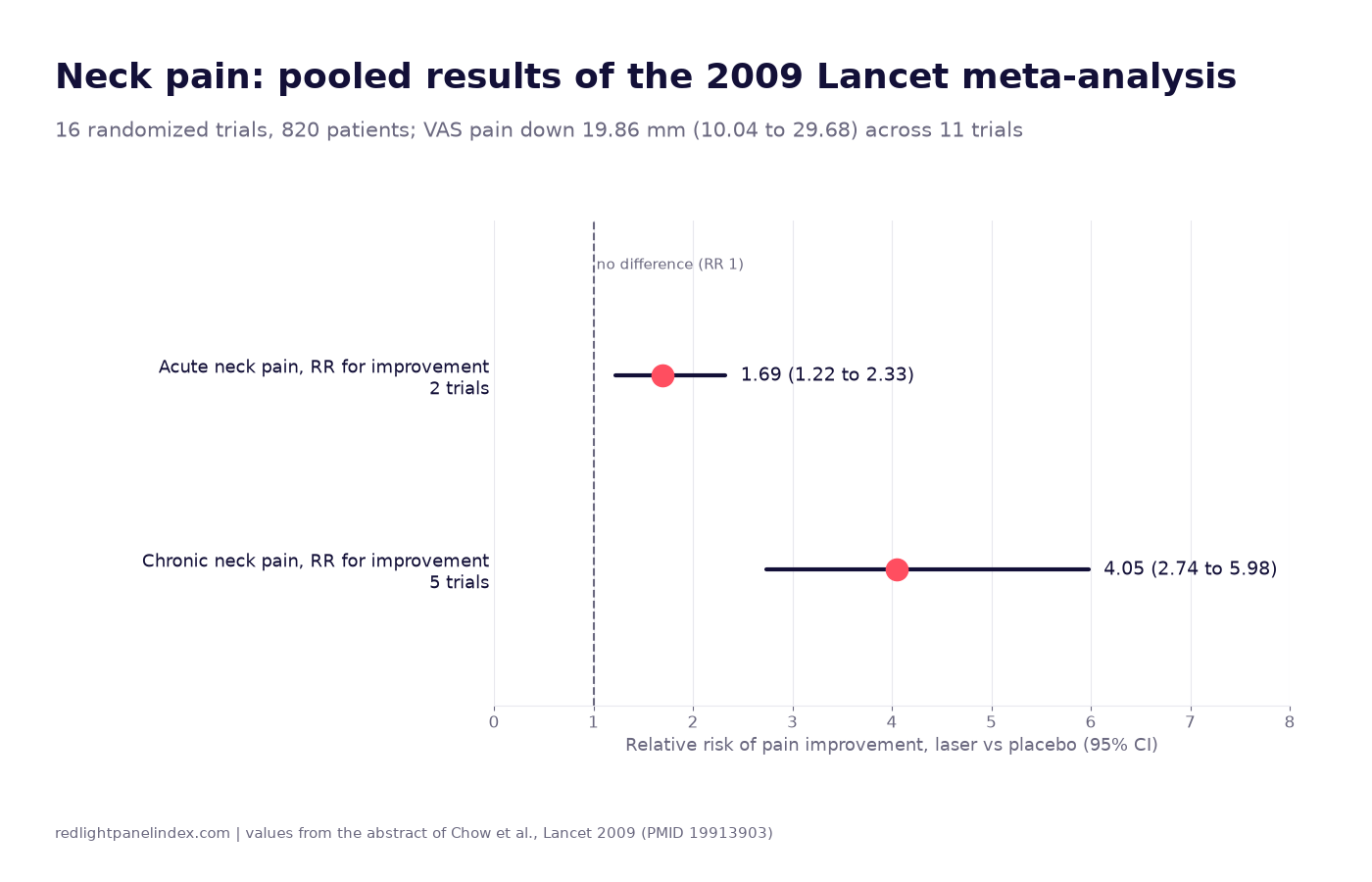
Moderate: one systematic review and meta-analysis of randomized trials, published in The Lancet in 2009, pooled 16 trials and 820 patients and reported that low-level laser therapy reduced neck pain compared with placebo, but every trial used a laser aimed at painful sites, none used a home LED panel, and the evidence rests on that single pooled paper (PMID 19913903).
Choosing a panel? Our ranking of the best red light therapy panels is computed from published, method-labeled specs across 188 devices. For neck pain, the spec that matters is the energy delivered to the treated area, which comes from irradiance and session time, not the panel's wattage or its number of LEDs.
The grade and why
The Moderate grade reflects a well-regarded source with real limits. The meta-analysis pooled randomized, placebo or active-controlled trials, which is a strong design, and its pain results were reported for both acute and chronic neck pain, with short-term relief that persisted at follow-up. What holds it back from Strong is that it is one pooled paper rather than several independent lines of evidence, that its trials used lasers rather than the LED panels sold for home use, and that the abstract does not specify a single wavelength or dose that applies across the pooled trials. The site's evidence grades explainer sets out how these levels are assigned, and the same pattern of laser trials with a hardware gap appears on the joint pain evidence page.
The study: what the Lancet meta-analysis asked and found
A paper-level walkthrough of its design, numbers and limits is in our study review of the Lancet meta-analysis.
Neck pain is common and costly, and the authors noted that drug treatment for it has limited evidence of efficacy and side effects. Low-level laser therapy (LLLT) is a non-invasive approach in which non-thermal laser light is applied to sites of pain. They searched for trials comparing LLLT of any wavelength with placebo or with an active control in acute or chronic neck pain, and defined the primary outcome as pain intensity, pooled as the mean difference in change on a 100 mm visual analogue scale (PMID 19913903).
They identified 16 randomized controlled trials with a total of 820 patients. The reported results were:
- Acute neck pain: two trials gave a relative risk of 1.69 (95% CI 1.22 to 2.33) for pain improvement with laser versus placebo.
- Chronic neck pain, categorical outcome: five trials gave a relative risk of 4.05 (95% CI 2.74 to 5.98).
- Pain intensity: eleven trials reporting visual analogue scale changes found pain reduced by 19.86 mm (95% CI 10.04 to 29.68) on the 100 mm scale.
- Follow-up: seven trials followed patients for 1 to 22 weeks after treatment finished, and the short-term relief persisted, with a reduction of 22.07 mm (95% CI 17.42 to 26.72).
- Side effects: mild, and not different from placebo.
The authors concluded that LLLT reduces pain immediately after treatment in acute neck pain and up to 22 weeks after completion of treatment in chronic neck pain. The paper reports no funding.
What these numbers do and do not say
A relative risk of 4.05 means that in the five chronic-pain trials reporting categorical data, patients given laser were about four times as likely to be counted as improved as patients given placebo, with a wide confidence interval from 2.74 to 5.98. A reduction of 19.86 mm on a 100 mm scale is the pooled average change across eleven trials, and the interval around it is wide too, from 10.04 to 29.68. Both are group averages across trials of different design, and neither tells an individual what to expect. The abstract also does not report how many of the 820 patients had acute versus chronic pain, so the two results should not be added together.
The review is also best read alongside the site's other pooled laser papers, which show a similar structure: back pain from a 15-trial meta-analysis with a dose split, and fibromyalgia from a point-laser RCT, a 9-trial meta-analysis and a whole-body LED bed trial. In each, a pooled laser result is real, and the gap to a home panel is the hardware.
What was not studied
- No home LED panel. The abstract describes laser irradiation applied to sites of pain. A wall panel lights a large area from a distance at much lower intensity per point, a difference the LED versus laser page lays out.
- No single wavelength. The authors searched for LLLT of any wavelength, and the abstract does not break the results out by wavelength. Nothing in it shows that one band, including the 830nm near-infrared band covered on the 830nm page, produced the pooled result.
- No single dose. The abstract gives no joules-per-point or session schedule that applies across the 16 trials, so no dose can be lifted from it and treated as the tested regimen. The pain results should not be read as a prescription.
- Long-term outcomes. Follow-up in the seven trials that reported it ran 1 to 22 weeks after treatment. Whether relief lasts for a year is not addressed in the abstract.
- Causes of neck pain. The abstract describes acute and chronic neck pain generally and does not break down results by underlying cause.
- Trials after 2009. The paper reports on trials identified up to its search date. Later trials are not part of it, and this page does not claim to have reviewed them.
Practical section: using this with a home panel
The honest reading is that the trials show a laser applied to painful points reduced neck pain compared with placebo, and that a panel is a different tool. If you are considering one for the neck, three practical points follow.
Think in energy, not wattage. A session's dose is irradiance multiplied by time, expressed in joules per square centimeter. The dose calculator converts a panel's published irradiance, your working distance and your minutes into that figure, and the dosing guide explains why more time under a panel is not automatically better. Remember that the figure you start from should carry a method label, as the irradiance explainer describes, because manufacturer claims and spectrometer measurements often differ.
Look at the near-infrared share. Pain research is usually associated with near-infrared wavelengths, and the wavelength guide groups 810 and 830nm as the bands for joints and deep tissue. Check the published percentage for those bands on a database model page rather than assuming a listed wavelength means a large share. The penetration depth page explains why depth figures are modeled ceilings.
Match coverage to the area. Neck pain often involves the muscles across the back of the neck and the tops of the shoulders, an area a large panel can cover at a working distance of several inches while a small device would need repositioning. That is a practical observation about coverage, not something the Lancet paper tested.
Cautions
- Pain that is new, severe, follows an injury, or comes with numbness, weakness or fever needs medical evaluation first. A light panel is not a substitute for diagnosis, and this page does not suggest otherwise.
- Protect your eyes. A panel aimed at the neck can still put bright light near the face. The eye protection guide covers goggles and positioning.
- Check medications. Some drugs make skin more sensitive to light, a point the photosensitizing medications guide covers.
- Side effects in the pooled trials were mild and not different from placebo, but those were supervised laser sessions, and the safety and side effects page covers what is known about home use.
- Wording matters. The paper reports pain reduction in pooled trials. It does not show that light cures neck pain or its cause.
What to take from this
- The Lancet meta-analysis of 16 trials and 820 patients is the main evidence here, graded Moderate.
- It reported improvement in acute and chronic neck pain with laser versus placebo, and persistence for up to 22 weeks in chronic pain.
- It tested lasers of any wavelength, not home LED panels, and gives no single dose to copy.
- If you try a panel, work from the dose calculator and published near-infrared shares, and see a clinician about pain that is new or severe.
For the wider pain literature, start from the joint pain evidence page and the fibromyalgia study review.