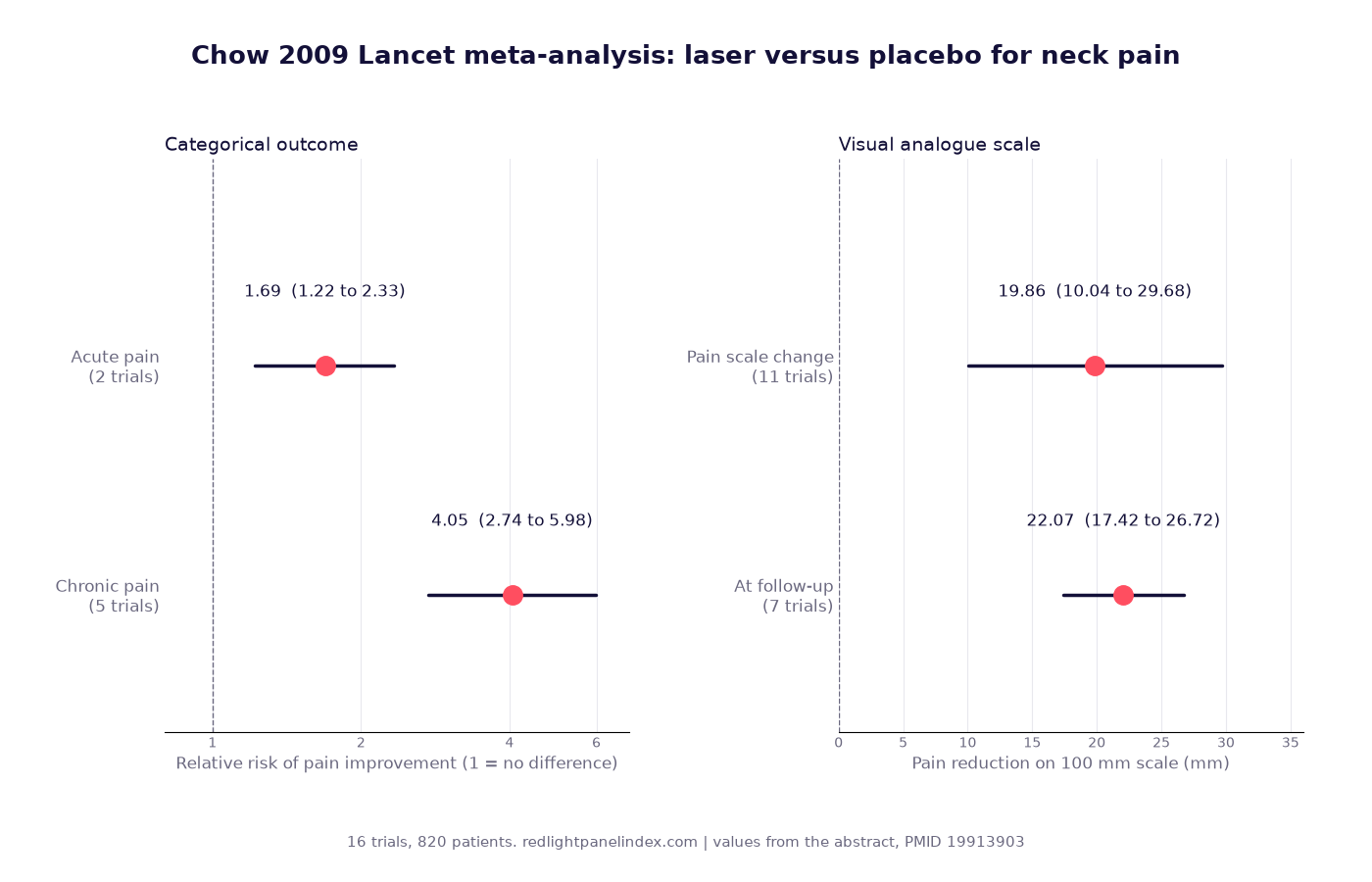
In 2009 Chow, Johnson, Lopes-Martins and Bjordal published a systematic review and meta-analysis in The Lancet that pooled 16 randomized, placebo or active-controlled trials of low-level laser therapy (LLLT) in 820 patients with neck pain, and reported that laser reduced pain immediately after treatment in acute neck pain and for up to 22 weeks after treatment in chronic neck pain (PMID 19913903). It is a pooled analysis of laser trials, not a test of a home LED panel.
Choosing a panel? Our ranking of the best red light therapy panels is computed from published, method-labeled specs across 188 devices. For neck pain, the spec that matters is the irradiance at your working distance, because that sets how many minutes a session needs to deliver a given dose.
What the study asked
Neck pain is common and costly, and the authors noted that drug treatment for it has limited evidence of efficacy and carries side effects. LLLT is a non-invasive approach in which non-thermal laser light is applied to the sites of pain. The question was whether randomized trials, taken together, show that LLLT reduces neck pain compared with placebo or with an active comparison treatment.
This site's neck pain evidence page grades the topic as a whole. This review goes into one paper in more detail: the design, the numbers the abstract reports, and where the gaps to a wall-mounted panel sit. The same laser-first pattern appears on the joint pain evidence page and in the site's back pain evidence summary.
Who was studied
The review identified 16 randomized controlled trials with a total of 820 patients. The patients had acute or chronic neck pain, and the analysis reported the two groups separately where the data allowed. The abstract does not give a breakdown of how many of the 820 patients had acute pain versus chronic pain, so the two results below should not be added together or read as one population.
Because this is a meta-analysis, the people studied are the participants of the individual trials, not a single recruited cohort. Age, sex and cause of neck pain are not given in the abstract.
Device and parameters as stated
The intervention was low-level laser therapy: non-thermal laser irradiation applied to sites of pain. The abstract does not report one wavelength, one irradiance or one dose for the pooled trials, and it does not give a number of sessions that applies across them. That matters for anyone trying to translate the result, because no dose can be lifted from the abstract and treated as the tested regimen.
What the abstract does establish is the category of device. Every pooled trial used laser light delivered to painful sites. A panel is a different kind of tool: a large LED array lighting a wide area from a distance. The LED versus laser page lays out why intensity per point and coverage differ, and the irradiance explainer shows how to read the figures a panel's maker publishes.
What was measured and found
The paper reported its results in several forms:
- Acute neck pain: two trials gave a relative risk of 1.69 (95% CI 1.22 to 2.33) for pain improvement with laser versus placebo.
- Chronic neck pain, categorical outcome: five trials gave a relative risk of 4.05 (95% CI 2.74 to 5.98).
- Pain intensity: eleven trials reporting changes on a visual analogue scale found pain reduced by 19.86 mm (95% CI 10.04 to 29.68) on a 100 mm scale.
- Follow-up: seven trials followed patients for 1 to 22 weeks after treatment ended, and relief persisted, with a reduction of 22.07 mm (95% CI 17.42 to 26.72).
- Side effects: mild, and not different from placebo.
A relative risk of 4.05 means that in the five chronic-pain trials reporting categorical data, patients given laser were about four times as likely to be counted as improved as patients given placebo. The interval around it, 2.74 to 5.98, is wide. The acute-pain result rests on only two trials. A reduction of 19.86 mm on a 100 mm scale is a pooled average across trials of different design, and the interval from 10.04 to 29.68 mm shows how much those trials differed. None of these numbers tells an individual what to expect.
Limitations
- Pooling different trials. The 16 trials differed in design, so a pooled average blends different devices, schedules and patients. The abstract does not break results out by wavelength or dose.
- Few trials for some outcomes. Two trials fed the acute result and five fed the chronic categorical result. Small counts make the estimates less stable than the headline suggests.
- Placebo handling. The analysis includes placebo and active-control trials, and how well each trial concealed the allocation affects how much weight its result deserves. The site's sham-controlled trials explainer describes why that matters in light-based research.
- Search date. The paper covers trials found up to its search date in 2009. Later trials are not part of it, and this page does not claim to have reviewed them.
- Follow-up length. Follow-up ran 1 to 22 weeks in the seven trials that reported it. Whether relief lasts a year is not addressed in the abstract.
What this means for a home panel
The honest reading is that this analysis supports laser applied to painful sites in neck pain, and says nothing direct about a panel. Three practical points follow if you are weighing one for the neck.
Think in energy, not wattage. A session's dose is irradiance multiplied by time, expressed in joules per square centimeter, as the joules per square centimeter page explains. Enter a panel's published irradiance, your distance and your minutes into the dose calculator to see the figure. The abstract gives no dose to aim for, so the calculator tells you what a panel delivers, not whether it matches the trials.
Do not assume a wavelength. The abstract does not tie the pooled result to one band. The 830nm near-infrared band, covered on the 830nm page, is often discussed for deeper tissue, but nothing in this paper shows that it produced the pooled result.
Weigh the grade. One pooled paper is a single line of evidence, however well published. The evidence grades explainer shows why a result like this stays below the top grade when no trial used the consumer device. For comparison, the fibromyalgia evidence page and its trial and meta-analysis review show a similar pattern of laser results with a hardware gap.
Neck pain that is severe, follows an injury, or comes with numbness or weakness needs a clinician, not a light panel.