Two related papers, a small 2014 placebo-controlled trial and a larger 2019 meta-analysis pooling nine such trials, both used a laser moved point by point across specific tender spots on the body, not a panel illuminating a broad area at once, and both found symptom improvement over placebo, though the meta-analysis found no added benefit when the laser was layered on top of a structured exercise program.
Choosing a panel? Our ranking of the best red light therapy panels is computed from published, method-labeled specs across 188 devices. For fibromyalgia specifically, the number that transfers least cleanly from these trials to a panel is joules per tender point versus a panel's irradiance over an area.
What the studies asked
Ruaro and colleagues' 2014 trial asked a narrow, well-controlled question: does active laser treatment at specific tender points produce more symptom relief than an identical-looking sham laser in fibromyalgia patients (PMID 24801056). Yeh and colleagues' 2019 paper asked a broader question across the accumulated literature: pooling every randomized controlled trial of low-level laser therapy (LLLT) for fibromyalgia published before August 2018, what does the combined evidence show for pain, fatigue, stiffness, mood and tender point count, and does adding laser to an exercise program help beyond exercise alone (PMID 31151332)?
Who was studied
The 2014 trial was small: 20 people with fibromyalgia, randomized 10 to an active laser group and 10 to a placebo group. The 2019 meta-analysis is the aggregate of a much larger literature: 9 randomized controlled trials meeting its selection criteria, covering 325 fibromyalgia patients in total, some of whose trials tested laser alone against placebo and at least one of which tested combined laser and LED phototherapy alongside a standardized exercise program.
Device and parameters as stated
The 2014 RCT used a GaAlAs laser at 670nm, delivering 4 J/cm2 to 18 tender points per session, three times a week for four weeks, a dose reported per treatment point rather than as irradiance over an area, the convention this site's LED versus laser explainer describes as typical of point-and-move laser devices rather than broad-illumination LED panels. The 2019 meta-analysis does not report one pooled wavelength, dose or session count, since it combines nine differently designed trials; its abstract instead flags that the laser types, energy sources and exposure times varied enough between the included trials to introduce real heterogeneity into the pooled estimate. One notable sub-analysis within it did use combined LLLT and LED phototherapy rather than laser alone, though the abstract does not give that sub-analysis's own wavelength or dose figures separately from the pooled total.
What was measured and what was found
In the 2014 RCT, tender point counts fell significantly in both the active and placebo groups (active p < 0.0001, placebo p = 0.0001), a result the authors themselves treat as inconclusive on its own, since a placebo response on tender-point counts is common in this literature. What separated the two groups were the standardized symptom scores: the Fibromyalgia Impact Questionnaire (FIQ) improved significantly more with active laser than placebo (p = 0.0003), as did the McGill Pain Questionnaire (p = 0.0078) and a visual analog pain scale (p = 0.0020).
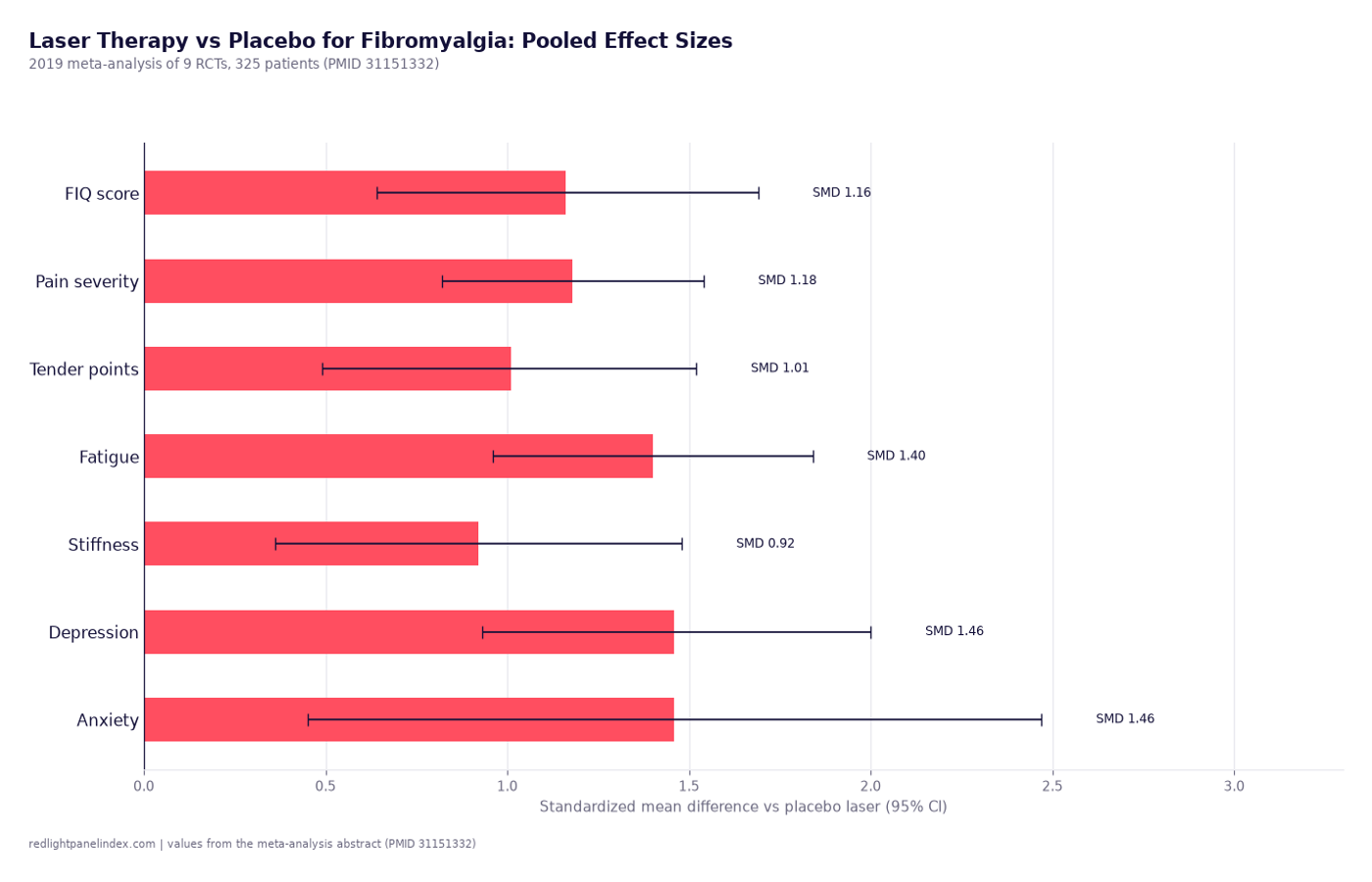
The 2019 meta-analysis pooled its nine trials using standardized mean difference (SMD), finding laser therapy significantly outperformed placebo laser on FIQ score (SMD 1.16, 95% CI 0.64 to 1.69), pain severity (SMD 1.18, 95% CI 0.82 to 1.54), tender point count (SMD 1.01, 95% CI 0.49 to 1.52), fatigue (SMD 1.40, 95% CI 0.96 to 1.84), stiffness (SMD 0.92, 95% CI 0.36 to 1.48), depression (SMD 1.46, 95% CI 0.93 to 2.00) and anxiety (SMD 1.46, 95% CI 0.45 to 2.47), every one of those confidence intervals excluding zero. Two further findings sit inside that headline result. When laser was added to a standardized exercise program, the review found no extra advantage over the exercise program alone, meaning the laser-versus-placebo comparisons above, not the laser-plus-exercise ones, are the more informative figures for someone without a supervised exercise protocol running alongside their light sessions. Separately, the one trial in the pool that used combined LLLT and LED phototherapy plus exercise did report additional benefit over exercise alone for pain severity, tender point count and fatigue, a narrower and more specific finding than the pooled headline number, coming from a single trial rather than the full nine.
Limitations
The 2014 RCT is small, 10 patients per arm, for a condition with substantial symptom variability between individuals, and it tested one specific device and dosing protocol rather than a range. The 2019 meta-analysis carries the limitations its own authors flagged: low-to-middle methodological quality across the included trials, unclear allocation concealment in several, one study using a per-protocol analysis with 20 percent loss to follow-up, and meaningful differences in laser type, energy dose and exposure time between the pooled trials, all of which widen the true uncertainty behind the reported confidence intervals. Neither paper reports the current 2026 dataset of consumer LED panels; both are laser-literature reviews describing point-applied clinical devices, not the broad-area home panels this site tracks.
What this means for a home panel
The clearest gap for a home-panel user is geometry and dose convention: the trials above deliver a fixed number of joules to a small, specific tender point using a device moved by a clinician, while a panel illuminates a broad area at once and its output is measured as irradiance in mW/cm2 rather than joules per point. That means the 4 J/cm2 per point figure from the 2014 RCT cannot be typed directly into a panel session-length calculation without deciding what "one point" corresponds to on a broad-beam device; the dose calculator works from a panel's own irradiance and a chosen distance, not from a laser's per-point energy figure. What does carry over is the general pattern, not the exact protocol: laser therapy aimed at specific painful points was associated with meaningful symptom relief beyond placebo in both the small trial and the pooled literature, and combining light therapy with a structured exercise program did not clearly beat exercise alone in most of the pooled evidence, so a panel session is more reasonably framed as one part of a broader pain-management routine than a substitute for it. This site's fibromyalgia evidence page covers these same two papers alongside a third, more recent whole-body LED bed trial, and grades the overall evidence for the condition. The pattern of point-applied laser benefit for widespread pain also shows up in chronic low back pain, where a 2016 meta-analysis found a similar dose-dependent effect using medical lasers rather than home panels, and more broadly across joint pain conditions this site tracks separately.