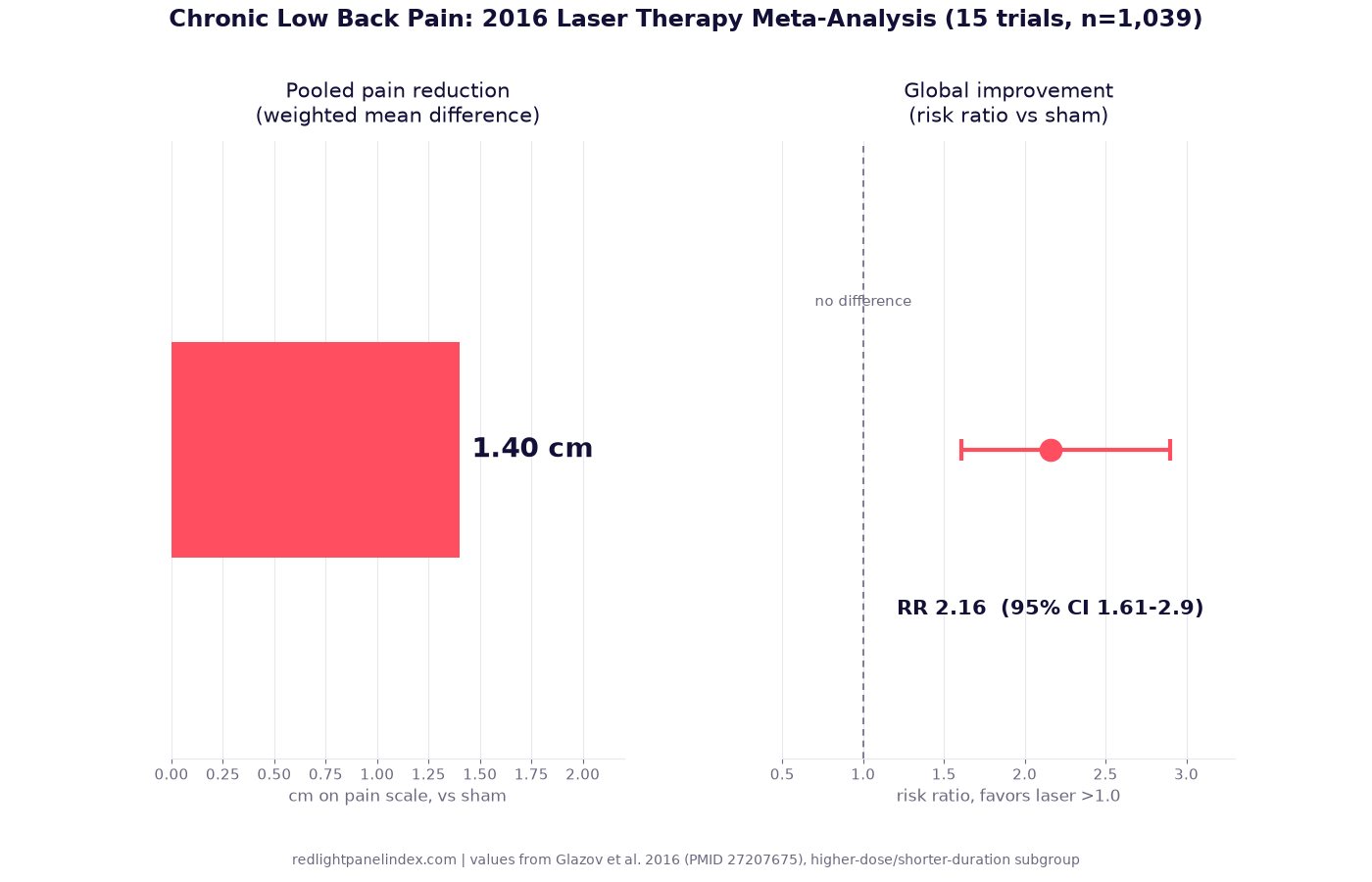
A 2016 meta-analysis pooled 15 randomized, sham-controlled trials and 1,039 participants with chronic non-specific low back pain and found a short-term pain reduction of up to 1.40cm on a pain scale, but the benefit only showed up clearly in trials that used a higher laser dose and treated people whose pain had lasted under 30 months (PMID 27207675). It is the same review behind the grade on this site's back pain evidence page; this article works through the pooled numbers and the dose and duration split the authors examined.
Choosing a panel? Our ranking of the best red light therapy panels is computed from published, method-labeled specs across 188 devices. For a chronic back pain protocol, the spec that matters is dose per point, in joules, not the panel's total wattage.
What the study asked
Low-level laser therapy (LLLT) had been tested for chronic low back pain in dozens of small trials with mixed conclusions, and the authors set out to update the evidence with a systematic search and meta-analysis, restricted to trials that used a sham control and blinded outcome assessment, the design features that keep a pain trial from overstating its own effect. The question was not just whether LLLT worked on average, but whether the studies that used a higher dose, or treated people with more recent pain, showed a different result than the ones that did not.
Who was studied
The meta-analysis pooled 15 randomized controlled trials with a combined 1,039 adult participants with chronic non-specific low back pain, meaning pain without a specific identified structural cause such as a fracture or disc herniation confirmed on imaging. The abstract does not give a single combined age or sex breakdown across the pooled trials, since that level of detail sits in each individual trial rather than the summary the meta-analysis reports.
Device and parameters as stated
The abstract describes the intervention only as low-level laser treatment, including laser acupuncture, applied under sham-controlled, blinded conditions; it does not give one wavelength, irradiance or session count that applies across all 15 pooled trials, since each included study used its own laser device and protocol. The one dose figure the authors do report is the subgroup split that mattered for the result: trials delivering at least 3 joules per treatment point showed a benefit, while lower-dose trials did not separate as clearly from sham. That per-point dosing convention, common in laser trials that treat discrete points along the spine rather than a whole area at once, does not translate directly to a home panel's output, which the dosing guide and dose calculator both work from area-based irradiance and session time rather than a fixed joule target per point.
What was measured and what was found
The authors pooled results across pain, patient-rated global improvement, disability and range of motion, with adverse effects tracked as a safety outcome. The two headline pooled results reported in the abstract are:
- Pain: a weighted mean difference of up to 1.40cm in favor of laser treatment, at immediate and short-term follow-up, on the pain scales the pooled trials used.
- Global improvement: a risk ratio of 2.16 (95% CI 1.61 to 2.90) favoring laser treatment, meaning participants who received active laser were more than twice as likely to report meaningful improvement compared with sham.
Both results held specifically in the subgroup of trials using a dose of at least 3 joules per point and treating participants whose pain had lasted under 30 months; the abstract does not report separate pooled numbers for the lower-dose or longer-duration subgroups beyond noting that the clear benefit was tied to those two conditions. The authors rated the overall quality of evidence as moderate under the GRADE framework, and their conclusion is that this supports a clinically important short-term benefit specifically within that higher-dose, shorter-duration subgroup, not a blanket effect across every trial pooled.
Limitations
- The dose and duration finding is a subgroup result, not the headline pooled figure across all 15 trials. Subgroup analyses carry less statistical power than the primary pooled result and can be more sensitive to which trials happen to land in which group.
- No single wavelength, irradiance or session protocol. Because the review pools 15 different laser trials rather than testing one protocol, a reader cannot take one dose, wavelength or session count from this paper and treat it as the tested regimen.
- Point-based dosing, not area-based. The joules-per-point convention describes energy delivered to a small treated spot with a laser, a different measurement than the area irradiance and session-time figures this site's dose calculator works from for a panel.
- Short-term follow-up. The abstract's pain and improvement findings are reported at immediate and short-term follow-up; it does not describe whether the benefit persists at 6 or 12 months.
- Laser, not LED. Every trial pooled used a laser device rather than an LED panel; whether the same dose-response pattern applies to LED-sourced light delivered over a larger area is not addressed by this review.
What this means for a home panel
The back pain evidence page already grades this literature Moderate, and this review is the main source behind that grade. The practical takeaway from the dose-and-duration subgroup is that dose matters more than most other variables studied: trials that delivered less energy per treated point, or that recruited participants with pain lasting well over two years, did not show the same separation from sham. A home panel cannot replicate a laser's point-focused delivery, but the underlying idea that adequate dose is a precondition for a response, not a bonus, carries over. Use the dose calculator with your panel's own measured irradiance and working distance to check how long a session needs to run to approach a therapeutic joule count over the treated area, rather than assuming any amount of time under the panel is equivalent. As with the whole-body PBM bed trial for fibromyalgia, the honest gap here is hardware: a clinical laser aimed at discrete spinal points is not the same delivery method as a panel illuminating a broader area of the lower back from a working distance, and this review does not test that substitution directly. The fibromyalgia evidence page collects that bed trial next to a point-laser RCT and a pooled meta-analysis, the same three-source pattern this back pain review fits into for readers comparing pain conditions.