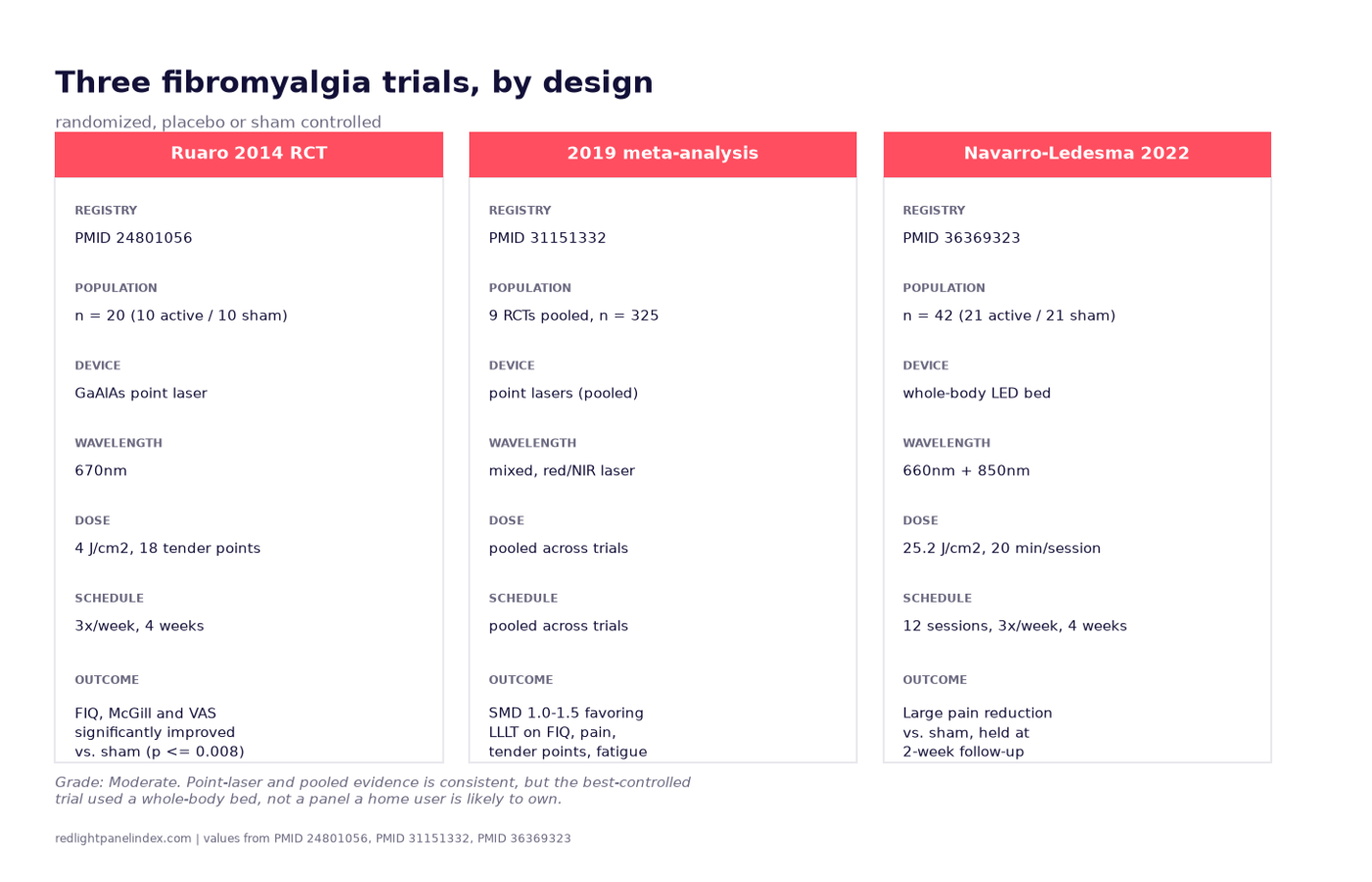
Moderate: a placebo-controlled point-laser trial, a 2019 meta-analysis of nine RCTs, and a triple-blinded whole-body LED bed trial all report significant improvement in fibromyalgia symptoms with photobiomodulation, but the best-controlled of the three used a clinic bed, not a device sold for home use, and none of the three tested a wall-mounted panel directly.
Choosing a panel? Our ranking of the best red light therapy panels is computed from published, method-labeled specs across 188 devices. For a whole-body condition like fibromyalgia, the spec that matters is how much of the body a device actually covers at once, not just its wavelength list.
Fibromyalgia is defined by widespread pain across the body rather than a single joint or region, which changes what a home device can realistically be expected to do about it: point lasers and small panels have been tested at localized tender points, and only one trial has tried treating the whole body at once. This page covers what was tested, on whom, and what a reader should not assume carries over to a panel.
The point-laser RCT
A 2014 placebo-controlled, randomized trial split 20 people with fibromyalgia into an active laser group (n = 10) and a placebo group (n = 10) (PMID 24801056). The active group was treated with a GaAlAs laser at 670nm, delivering 4 J/cm2 to 18 tender points per session, three times a week for 4 weeks. Both groups were assessed before and after treatment with the Fibromyalgia Impact Questionnaire (FIQ), the McGill Pain Questionnaire, and a visual analog scale (VAS) for pain.
The number of tender points fell significantly in both groups (active p < 0.0001, placebo p = 0.0001), which the trial's own numbers make clear is not, by itself, evidence the laser worked; a placebo response on tender-point counts is common in this literature. What separated the groups was the standardized symptom scores: FIQ improved significantly more with active laser than placebo (p = 0.0003), as did the McGill Pain Questionnaire (p = 0.0078) and the VAS (p = 0.0020). The authors concluded the laser provided real symptom relief beyond the sham response, though the trial's own size, 10 people per arm, is small for a condition with as much individual variability as fibromyalgia.
The 2019 meta-analysis
A systematic review and meta-analysis pooled 9 randomized controlled trials and 325 fibromyalgia patients treated with low-level laser therapy or a placebo laser, with or without an accompanying exercise program (PMID 31151332). Using standardized mean difference (SMD) to combine results across trials with different laser types and protocols, the pooled analysis found LLLT produced significantly greater improvement than placebo on the FIQ (SMD 1.16), pain severity (SMD 1.18), tender point count (SMD 1.01), fatigue (SMD 1.40), stiffness (SMD 0.92), depression (SMD 1.46), and anxiety (SMD 1.46), all with 95% confidence intervals that excluded zero.
Two caveats sit inside that pooled result and matter for a reader deciding what to expect. First, when LLLT was added to a standardized exercise program and compared with exercise alone, the review found no extra advantage from adding the laser, meaning the laser-alone-versus-placebo comparisons above are the more informative ones for a home user without a structured supervised program. Second, the review authors flagged low-to-middle methodological quality across the included trials, unclear allocation processes in several, and meaningful differences in laser type, energy dose, and exposure time between studies, all of which widen the uncertainty around any single pooled number even where the confidence interval looks tight.
The whole-body bed trial
The most tightly controlled fibromyalgia trial in this index used a different device class entirely: a triple-blinded, placebo-controlled RCT of a whole-body 660nm and 850nm LED bed, the NovoTHOR XL, in 42 women with fibromyalgia (PMID 36369323). Over 12 sessions across 4 weeks, each 20 minutes and delivering 25.2 J/cm2, the active bed produced a large reduction in pain compared with a matched sham bed, an effect (Cohen's d = 2.06 immediately after treatment) that grew slightly larger by a 2-week follow-up (d = 2.87). Quality of life, physical activity, and kinesiophobia all improved significantly from the active bed as well; pain catastrophizing was the one measure that did not separate the two groups.
This is the strongest single design of the three, real placebo arm, blinding on both the participant and assessor side, and a still-present effect two weeks out, but it is also the hardest to translate to anything a reader is likely to own. A bed that surrounds the body from multiple angles for a fixed 20 minutes is not the same exposure geometry as a panel that illuminates one side of the body from a working distance, and the review of that trial goes through the gap in more detail.
What was not studied
None of the three sources tested a flat panel, of the kind ranked on this site, directly against fibromyalgia symptoms. The point-laser trials used handheld or point-applied lasers aimed at specific tender points, not broad-area illumination. The whole-body bed is a clinic device with a different geometry, output, and total power than anything marketed for home use. No trial in this register has followed participants for more than a few weeks past the end of treatment, so how long any benefit lasts with continued at-home use, or whether it fades after stopping, is not addressed by this literature. And no trial has isolated wavelength as a variable; 655-670nm point lasers and a 660/850nm bed both showed effects, but nothing here says whether 660nm, 670nm, 850nm, or a mix matters more than total dose or coverage area.
A practical starting point
Fibromyalgia is a whole-body condition, so a panel large enough to cover more of the torso and limbs per session, rather than a small localized device, is the closer match to what the bed trial tested, even though it will not reproduce that trial's from-all-sides geometry. Our full-body panel rankings cover the devices sized to illuminate an adult lying down. To approximate a trial's per-session dose, use a device's own method-verified irradiance in the dose calculator and work out session length for a target like the bed trial's 25.2 J/cm2, treating front and back of the body as separate sessions since a single panel only illuminates one side at a time.
Fibromyalgia shares some literature with joint pain and arthritis, and with chronic low back pain, where a 2016 meta-analysis of point-applied lasers found a similar pattern: real benefit above a dose threshold, using medical lasers rather than home LED panels. None of these conditions should be assumed to respond identically just because the underlying mechanism, photobiomodulation, is shared; each has its own trial base and its own gaps.
Cautions
None of the trials above reported serious adverse events, and the point-laser and whole-body bed trials both reported no adverse events at all. That is a safety signal specific to the devices and doses tested, not a blanket guarantee for every wavelength, dose, or session length a panel might deliver. Fibromyalgia symptoms fluctuate on their own, and a placebo response was clearly present even in the best-controlled trials here, so anyone trying a panel for fibromyalgia should track symptoms over weeks rather than judge a single session, and should not expect a home panel to reproduce results measured with a bed or laser device it does not resemble. Photobiomodulation was associated with symptom improvement across all three sources; none of it should be read as a claim that light therapy treats or cures fibromyalgia.