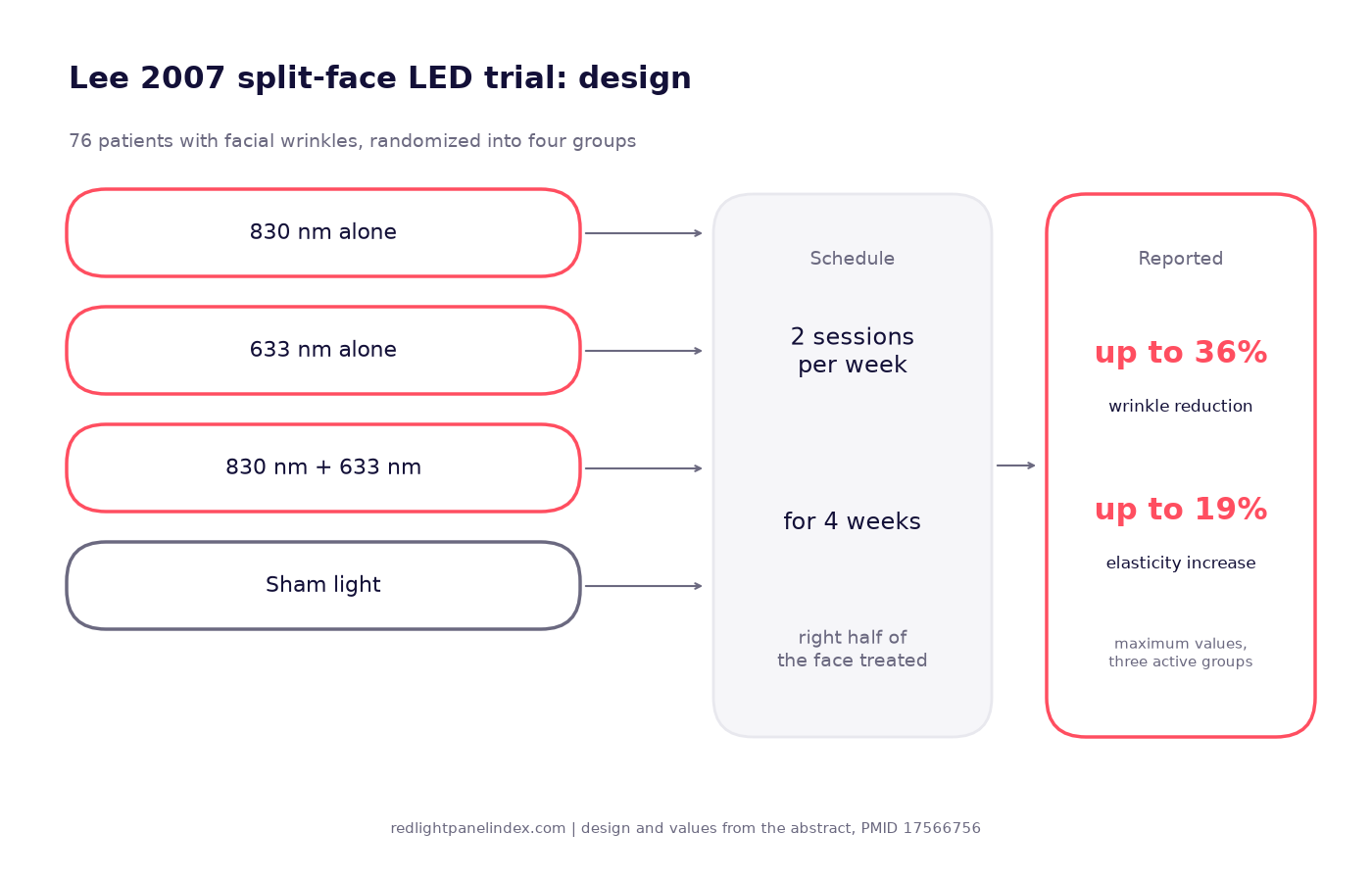
A 2007 prospective, randomized, placebo-controlled, double-blinded, split-face trial in 76 patients with facial wrinkles compared 830nm LED light alone, 633nm alone, the two combined and a sham light, given twice a week for four weeks, and reported significant wrinkle reductions (maximum 36%) and skin elasticity gains (maximum 19%) in the three active groups, with more collagen and elastic fibers on histology (PMID 17566756). It is a clinical LED trial, not a test of a wall panel.
Choosing a panel? Our ranking of the best red light therapy panels is computed from published, method-labeled specs across 188 devices. For facial skin, the spec that matters is the published share of output at red and 830nm, since this trial tested those two bands alone and together.
What the study asked
The trial, led by Lee and Park, asked whether LED phototherapy improves the signs of photoaging, and whether the choice of wavelength setting matters. It compared three treatment settings against a sham: near-infrared 830nm alone, red 633nm alone, and the two together. The title lists the outcomes it set out to measure: clinical, profilometric, histologic, ultrastructural and biochemical.
That breadth makes it one of the most cited skin papers in the field. This site's 830nm page and 630nm page both draw on it, and the skin and anti-aging evidence page places it alongside larger trials.
Who was studied
Seventy-six patients with facial wrinkles were randomly divided into four groups. The light was applied to the right half of each patient's face, which is the split-face element: the untreated side gives each person a comparison. The abstract summarized here does not give age, sex or skin type, and it does not give the number of patients in each of the four groups, so those details are left out rather than guessed.
Device and parameters as stated
The devices were quasimonochromatic LED sources. The four arms were:
- 830nm alone
- 633nm alone
- 830nm and 633nm combined
- a sham treatment light
Treatment was twice a week for four weeks, eight sessions in all. The abstract summary does not give irradiance, energy density or distance, so no dose in J/cm2 is stated here. That is a real gap if you want to replicate the trial on a panel, and the reason to treat the schedule, not the dose, as the one concrete detail. Lining up 633nm and 830nm against a panel's published output is covered on the irradiance explainer.
What was measured and found
Objective measurements showed significant reductions of wrinkles (maximum 36%) and increases in skin elasticity (maximum 19%) compared with baseline on the treated face in the three active groups. The "maximum" matters: those are the best values reported across the groups, not an average that every patient or every arm achieved.
Histology showed a marked increase in collagen and elastic fibers in all treatment groups. Electron microscopy showed highly activated fibroblasts surrounded by abundant elastic and collagen fibers. The treatment was well tolerated, with no adverse effects reported, and the authors concluded that 830nm and 633nm LED phototherapy is an effective approach to skin rejuvenation.
On the question of which setting was best, this site's 830nm page summarizes the trial as showing the red and near-infrared combination improving wrinkles more than the control and more than red alone, while red alone reduced melanin more. That comparison between arms is the part to check against the full paper before leaning on it, since the abstract's headline numbers are about change from baseline.
How to read a split-face design
In a split-face trial each patient acts as their own comparison, which removes differences in age, sun exposure and skin type between people. That is a strength for a small trial. It also has a quirk: light and any resulting biological signals could in principle reach the untreated side, and the sham arm only helps if patients and assessors truly could not tell which light was real. The trial was described as double-blinded, which addresses that, but the abstract does not describe how the blinding was tested. Treat the design as a good one for isolating the light from expectation, and the effect sizes as specific to this device and this population.
Limitations
- Short course. Four weeks of twice-weekly sessions is brief. Larger skin trials in the index run for months, as the Wunsch trial review shows with its fifteen-week schedule.
- Dose not stated. Without irradiance and energy density in the abstract, the result cannot be mapped to a panel session.
- Maximum values. The 36% and 19% figures are the top of the range, not typical outcomes.
- Clinical device. The LEDs were a clinical setup, applied to one half of the face, not a wall panel lighting the whole face and body from a distance.
- Group sizes. With 76 patients in four arms, each comparison rests on a small group, and the abstract does not give the split.
- Follow-up. The abstract does not report how long the changes lasted after the four weeks.
The dermatology systematic review puts single trials like this one in the wider context of LED studies and how they were graded.
What this means for a home panel
Two things transfer: the wavelength pairing and the schedule. If you want a panel that covers both bands the trial tested, check the published share at red and 830nm rather than the number of LEDs. On the 830nm page, the MitoPRO 1500X lists 17% of output at 830nm (database page) and the Total Spectrum COMPACT lists 14% (database page). Those are published shares, not a claim that either matches the trial's devices.
What does not transfer is the dose. Use the dose calculator to turn a panel's published irradiance and your distance into joules per square centimeter, and treat the result as information about the panel, since this trial's abstract gives no target. The results timeline guide explains why most skin trials run far longer than four weeks. For a different red-light skin question, the Papageorgiou acne review covers a trial that paired red with blue.
The practical takeaway is modest: this trial is a credible, sham-controlled reason to value red plus 830nm in a panel for facial skin, and a poor reason to expect a specific percentage change from any home device.