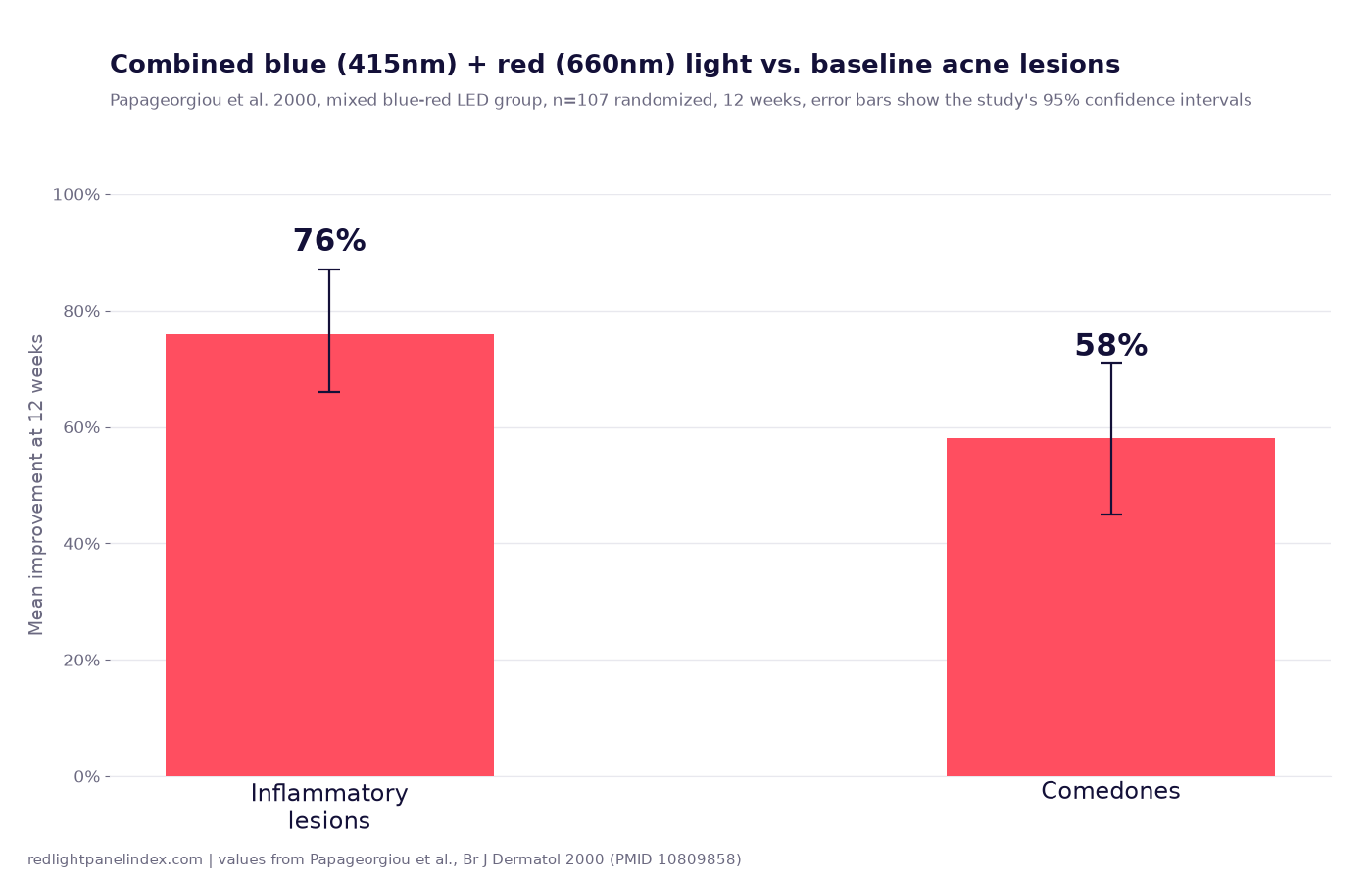
A 2000 randomized trial that still anchors the acne evidence on this site tested blue (415nm) light alone against a combined blue-and-red (415 and 660nm) light, cool white light, and 5% benzoyl peroxide cream, and found the combined blue-red group produced the largest reduction in both inflammatory lesions and comedones after 12 weeks (PMID 10809858). It is the trial that established why the acne case for light therapy rests on a blue channel working alongside red, not on red by itself.
Choosing a panel? Our ranking of the best red light therapy panels is computed from published, method-labeled specs across 188 devices. For this trial specifically, the spec that matters is whether a panel has a blue channel at all, since that is the wavelength the combination arm added on top of red.
What the study asked
By 2000, blue light's antibacterial action against Propionibacterium acnes was already established, but the question this trial set out to answer was narrower and more practical: does adding a red component to blue light improve on blue alone, and if so, by how much, measured against the two treatments a dermatology patient would actually be offered at the time, white light and topical benzoyl peroxide. The four-arm design let the researchers isolate the effect of adding red to blue rather than simply showing that light of some kind beats no treatment. That framing matters for how the result should be read today: this was never designed as a test of red light alone against a no-treatment control, so it cannot answer what a red-only panel would do on its own, only what red adds when layered on top of blue.
Who was studied
The trial enrolled 107 patients with mild to moderate acne vulgaris, randomized into four groups: blue light alone, mixed blue-and-red light, cool white light, or 5% benzoyl peroxide cream. The published abstract does not report the age range, sex distribution or skin phototype of the cohort, so the population beyond "mild to moderate acne vulgaris" is not specified further here. Comparisons between the three light arms were made in an observer-blinded fashion; blinding could not be achieved for the benzoyl peroxide arm, since a topical cream is visibly different from a handheld light source.
Device and parameters as stated
Patients in the three phototherapy groups used portable light sources and irradiated the treated skin daily for 15 minutes over 12 weeks, with assessments made every 4 weeks. The abstract does not name the device, state an irradiance figure in mW/cm2, or give a dose in J/cm2; it reports only the wavelengths (415nm for the blue component, 660nm for the red component in the combined arm), the daily 15-minute exposure, and the 12-week course. That gap means this site's dose calculator cannot convert the trial's protocol into a session length for a home panel the way it can for a trial that reports irradiance directly; the daily-15-minutes pattern is the only session-length detail this paper gives.
The chart above plots the two outcomes reported for the combined blue-red group, the only arm with numeric figures stated in the abstract; the paper describes the other three arms only in relative terms (better or worse than the combined group at specific weeks), without giving their own percentage improvements.
What was measured and what was found
After 12 weeks, the combined blue-and-red group had a mean 76 percent reduction in inflammatory lesions (95 percent confidence interval 66 to 87), significantly better than blue light alone at weeks 4 and 8 (though not distinguishable from blue alone by week 12), better than benzoyl peroxide at weeks 8 and 12, and better than white light at every assessment. Comedones improved by a mean 58 percent (95 percent confidence interval 45 to 71) in the combined group, numerically ahead of the other three arms, though the authors reported that this particular difference did not reach statistical significance. The authors attributed the added benefit of the red component to an anti-inflammatory action layered on top of blue light's antibacterial effect, rather than red contributing more antibacterial power of its own.
Limitations
The abstract gives no irradiance or dose in mW/cm2 or J/cm2, no device brand, and no skin phototype breakdown, which limits how precisely a home routine can reproduce the protocol beyond matching the daily 15-minute, 12-week pattern. It also does not report how many patients in each arm completed all 12 weeks, so the figures above describe the group that was analyzed rather than confirming there was no dropout to account for. The inflammatory-lesion advantage over blue alone narrowed by week 12, so the strongest version of the "adding red helps" finding is at the 4- and 8-week marks, not necessarily sustained to 12 weeks. The comedone improvement, while numerically the largest of the four arms, was not statistically significant, so it is a weaker finding than the inflammatory-lesion result and should not be read as an equally established effect. Blinding was not possible for the benzoyl peroxide comparison, which limits how directly that specific arm-to-arm comparison can be trusted against the light-only arms. And because this is a single trial from 2000 using a purpose-built acne device, it does not by itself establish what a modern red-and-near-infrared panel without a blue channel would do; this site's evidence page for acne reads this trial alongside a second, later trial and a broader systematic review to reach its overall Limited grade.
What this means for a home panel
The device this trial tested was a dedicated blue-plus-red acne light, not the red-and-near-infrared panels most common in this site's database; this site's wavelength guide covers what the 415nm and 660nm bands are each understood to do and why a general-purpose panel is usually built around a different pair of wavelengths chosen for depth of penetration rather than surface antibacterial action. A buyer working from this trial specifically should check for a stated blue channel before assuming a red-only panel will reproduce it; a red component alone, even at 660nm, is applying only the anti-inflammatory half of what this trial's combined arm tested, not the antibacterial half attributed to blue. Two other skin trials on this site used red or red-plus-near-infrared light without a blue component at all: the Wunsch and Matuschka trial on collagen and roughness, and the Mota periocular wrinkle trial, both closer matches for what a red-only panel is actually built to do than the acne trial reviewed here.