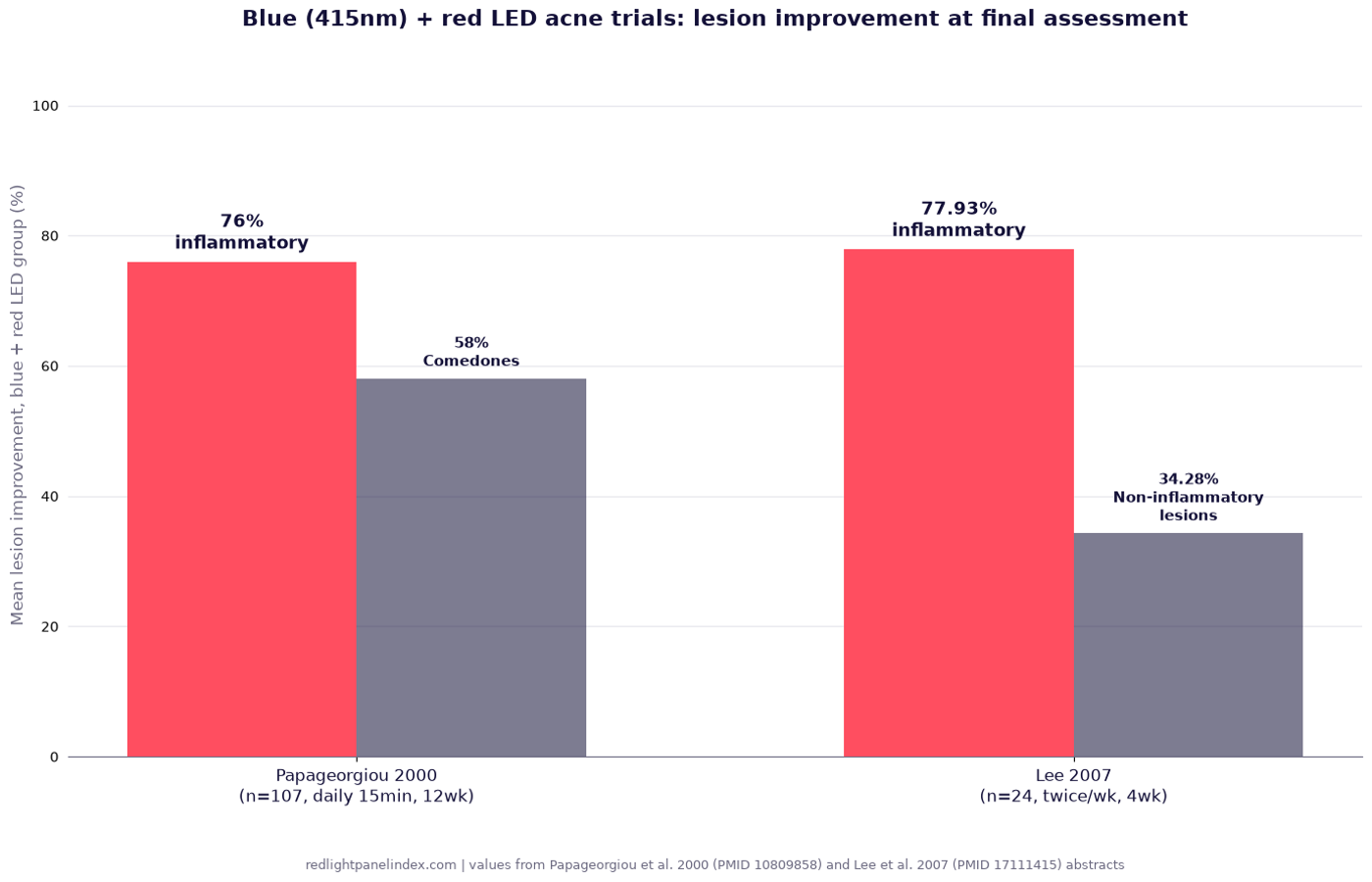
The evidence grade for acne is Limited: two randomized trials found that combining blue (415nm) and red (660nm or 633nm) LED light reduced inflammatory acne lesions more than blue light alone, benzoyl peroxide or white light, but neither trial tested red light on its own, and most panels sold for home use are red-and-near-infrared only, without the blue wavelength these trials found necessary for the antibacterial part of the effect.
Choosing a panel? Our ranking of the best red light therapy panels is computed from published, method-labeled specs across 188 devices. For acne, the spec that matters is whether a panel includes a blue channel at all, since that is the wavelength band the acne trials below actually tested alongside red.
The two trials below are the primary evidence this grade rests on. A separate systematic review of LED dermatology trials, covering acne among other conditions, gives some additional context on how that evidence has been weighed by reviewers, but it did not add a new acne trial of its own.
What the trials report
Papageorgiou and colleagues randomized 107 patients with mild to moderate acne vulgaris into four groups: blue light alone (415nm), mixed blue-and-red light (415 and 660nm), cool white light, or 5% benzoyl peroxide cream (PMID 10809858); this site's full study review covers the trial's design and limitations in more depth. Patients in the light groups used portable light sources and irradiated the treated skin daily for 15 minutes; the trial ran 12 weeks with assessments every 4 weeks, and comparisons between the three light arms were observer-blinded. After 12 weeks, the mixed blue-and-red group had a mean 76 percent reduction in inflammatory lesions (95 percent confidence interval 66 to 87), significantly better than blue light alone at weeks 4 and 8, better than benzoyl peroxide at weeks 8 and 12, and better than white light at every assessment. Comedones improved by a mean 58 percent (95 percent confidence interval 45 to 71) in the mixed-light group, numerically ahead of the other three arms though the authors reported this difference did not reach statistical significance. The authors attributed the added benefit of the red component to an anti-inflammatory action layered on top of blue light's antibacterial effect against P. acnes.
Lee and colleagues treated 24 patients with mild to moderately severe facial acne, all with skin phototype IV, using a device alternating blue (415nm) and red (633nm) LED light twice a week for 4 weeks, with follow-up assessments continuing through 8 weeks after the last session (PMID 17111415). Lesion counts and standardized grading were recorded before treatment, after the 2nd, 4th and 6th sessions, and at 2, 4 and 8 weeks afterward. The final mean improvements were 77.93 percent for inflammatory lesions and 34.28 percent for non-inflammatory lesions, and the authors reported no significant adverse events; several patients also spontaneously noted brighter skin tone and improved texture, which instrument readings linked to a reduction in measured melanin.
A separate systematic review of 31 randomized controlled trials using LEDs across dermatologic conditions, searched through September 2017, assigned acne vulgaris a grade of recommendation B, in the same tier as herpes simplex and zoster and acute wound healing, based on the trials available to the reviewers at that time (PMID 29356026). A grade of B reflects reasonable trial-based support rather than the strongest tier the review's scale allowed, and the review's own comment on the broader LED literature, small sample sizes, inconsistent blinding, and varied treatment parameters across studies, applies to the acne trials as much as to the other conditions it covered.
What was not studied
Neither randomized trial tested red light in isolation against a no-treatment or placebo control; the closest comparator arms were blue light alone, white light, and benzoyl peroxide, so the specific claim that red light by itself improves acne does not have a matching arm in either trial. Both trials used dedicated combination LED devices designed for facial acne treatment rather than the broader whole-body or multi-panel devices this site otherwise tracks, so a home user's full-body red-and-near-infrared panel is a different device profile than the one that produced these results, not only in wavelength coverage but in form factor and treatment distance. Skin type diversity was limited: the Lee trial enrolled only phototype IV patients, and the Papageorgiou trial does not report a phototype breakdown in its abstract. Neither trial reported irradiance or dose in joules per square centimeter, so there is no dose figure from this pair of trials to carry over into a session-length calculation the way trials in some other conditions on this site allow.
Using a panel for acne, with those gaps in mind
Reproducing what these trials actually tested requires a device that emits both a blue component around 415nm and a red component around 630 to 660nm; this site's wavelength guide covers what each band is understood to do and why a general-purpose red-and-near-infrared panel, the most common configuration in this site's database, is built around a different pair of wavelengths chosen for depth of penetration rather than surface antibacterial action. If a device you are considering does list a blue channel, that is the spec to check against these trials rather than total irradiance or wattage. Because neither trial reported a J/cm2 dose, the dose calculator cannot convert these particular protocols into a target number the way it can for a trial that reports irradiance and time directly; the daily-15-minutes and twice-weekly session patterns above are the closest transferable detail, not a joules figure.
The rationale both trial teams gave for combining the two colors is worth carrying over even without a matching device: blue light in the 400 to 420nm range is thought to work by exciting porphyrins produced by P. acnes bacteria, a photodynamic reaction that damages the bacteria, while the red component was added on the theory that it contributes a separate anti-inflammatory action on top of that antibacterial effect rather than adding more antibacterial power of its own. That division of labor is the reason a red-only panel is a weaker match for this evidence than it might look at first glance: the trials attribute a meaningful share of the benefit to the wavelength a red-and-near-infrared panel does not produce. A home user with only a red or near-infrared panel is applying the anti-inflammatory half of a two-part mechanism the original trials tested together, not the whole protocol, and no trial in this register isolates how much of the 76 or 77.93 percent figures above the red component alone would have delivered.
Cautions
Nothing here indicates that light therapy cures or replaces treatment for moderate to severe acne, and both trials studied mild to moderately severe cases specifically; a dermatologist is the right resource for anything more severe or for acne that involves cysts or scarring risk. Several drugs commonly prescribed for acne, including tetracycline-class antibiotics and retinoids, are themselves flagged as photosensitizing; this site's guide to photosensitizing medications covers those drug classes and why that caution is worth a conversation with a prescriber if you are combining a light-based routine with an acne prescription. A device with a genuine blue channel also raises a different consideration than a red-only panel: blue and violet wavelengths are the band this site's eye protection guide treats with more caution, so following the manufacturer's eye protection guidance matters more here than it does for a red-and-near-infrared-only device. Anyone treating acne alongside an anti-aging routine on the same skin should also read this site's skin anti-aging evidence page, which covers the separate, better-supported case for red and near-infrared light on collagen and fine lines and notes where a blue channel fits into that picture rather than the acne one.