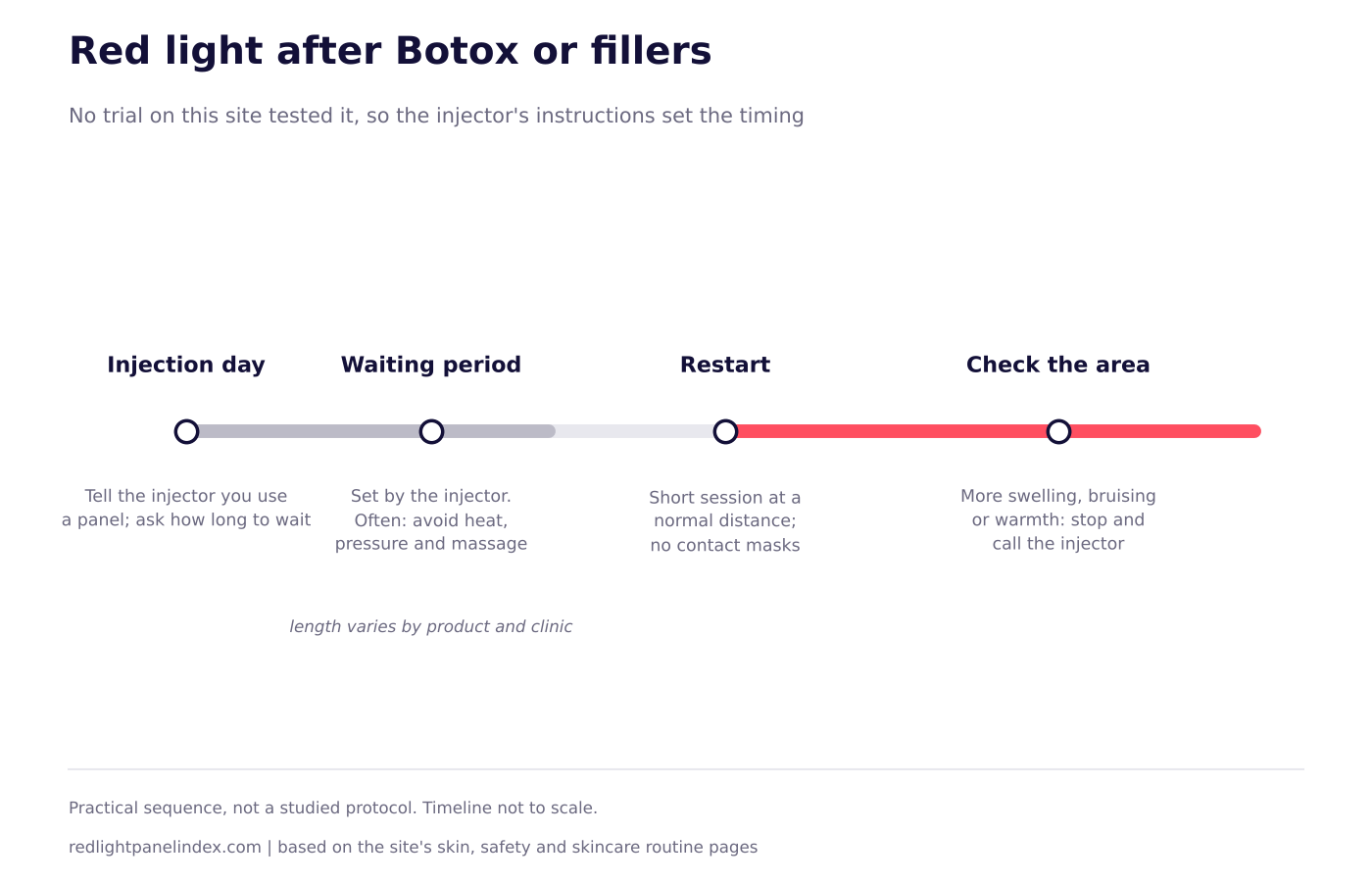
Nobody knows for certain whether a red light session soon after Botox or a dermal filler changes the result, because no trial in this site's register has tested a home panel after neurotoxin or filler injections, in either direction. The practical answer is to follow the waiting period your injector gives you, then restart with a short session at a normal distance and watch the treated area, since the person who did the injection knows the product, the dose and the sites.
Choosing a panel? Our ranking of the best red light therapy panels is computed from published, method-labeled specs across 188 devices. For face sessions around cosmetic treatments, the spec that matters is a stated working distance, because a panel used at a distance never needs to press on treated skin.
What the evidence covers, and what it does not
This site's skin and anti-aging evidence page grades red light for skin texture and wrinkles as Strong, based on controlled trials of multi-week courses, most consistently with 633nm and 830nm. None of those trials is about injections. The page does not discuss neurotoxins, fillers or how light interacts with either, and the trials it reviews did not report whether participants had recent injections.
The safety and side effects page is graded Limited, and it does not cover injectables or cosmetic procedures either. Its general findings still apply: no serious adverse events turned up in the trials this site has reviewed, but that reassurance comes mostly from efficacy studies rather than studies designed to look for harm.
So there are three separate things a reader might want to know, and the honest status of each is:
| Question | What this site can say |
|---|---|
| Does a panel session reduce or shorten a neurotoxin's effect? | Not studied in any trial on this site |
| Does a panel session affect how a filler settles or lasts? | Not studied in any trial on this site |
| Does red light help bruising or swelling after injections? | Not studied in any trial on this site |
Some clinics offer an LED session after injections. That is a clinic's choice; this site has no trial showing whether it helps or harms, and it is not a reason to run a home panel against your injector's instructions.
Why injectors give waiting periods
Aftercare sheets for neurotoxins and fillers commonly ask patients to avoid heat, pressure on the treated area, facial massage and strenuous exercise for a short period after treatment. The exact length varies by product, clinic and treatment site, which is exactly why this guide does not give one. The reasoning behind those instructions is general rather than specific to light:
- Product placement. A neurotoxin is injected into specific muscles, and a filler is placed at a chosen depth. Injectors try to avoid anything that could rub, press or move the treated area while the product settles.
- Swelling and bruising. Fresh injection sites can swell and bruise. Heat and increased blood flow are things most aftercare advice tries to keep down at first.
- Skin that has just been punctured. Small entry points are a reason to keep the area clean and avoid anything that touches or irritates it.
A red light panel is not a heat lamp, but it is not completely heat-free. Most of the warmth you feel comes from the panel's electronics and LEDs rather than from the light's effect on tissue, a distinction the thermal versus photochemical page explains. At close range that warmth is noticeable on the face, and red and near-infrared light are associated with increased local blood flow (PMID 24049929). Neither point shows harm after injections. They are simply the reasons a cautious injector might include light devices in the same "wait a little" bucket as saunas and hot yoga.
The practical steps
- Ask before your appointment. Tell your injector you use a red light panel at home, which wavelengths it emits and how often you use it, and ask how long to wait. Panels that also run 810 to 850nm near-infrared are worth naming, because injectors may treat near-infrared and red differently.
- Follow their window. If they give you a specific waiting period, use it. If they say they have no instruction about light, a reasonable precaution is to wait until any swelling, redness or tenderness has settled.
- Restart at a distance, not in contact. Use the panel at its normal working distance. Avoid LED masks or wands that press on the treated skin during the waiting period, since pressure, not light, is what aftercare sheets most often rule out. The guide to distance from a panel covers how distance changes what reaches the skin.
- Start short. Use the low end of your usual session for the first few sessions. The dose calculator turns your panel's irradiance at your distance into a dose, and the session length guide covers the reasoning. More light is not always better, a point the safety page makes about the dose-response curve.
- Check the treated area. If you notice more swelling, new bruising, unusual warmth or any change in how the treatment looks after a session, stop and contact your injector.
- Keep the rest of the routine the same. Clean, bare skin first and products afterward, as in where red light fits in a skincare routine. Protect your eyes for any face session; the eye protection guide explains why close-range face use is the case that matters most.
The exceptions
Some situations call for more caution than the general steps above.
- Complications after injection. Any sign of a problem at an injection site, such as increasing pain, blanching, spreading redness or a change in skin color, needs your injector or a clinician, not a light session. Do not use a panel on an area that is being assessed or treated for a complication.
- Filler dissolving or other follow-up procedures. If you are booked for a follow-up, ask again; the timing advice for the original treatment may not carry over.
- Other procedures on the same day. Chemical peels, laser resurfacing, microneedling and similar treatments leave skin more reactive, and clinics often bundle them with injections. Ask about each one separately; our guide to red light after microneedling or chemical peels covers the waiting period for those two.
- Photosensitizing medication. If you take a retinoid or another drug associated with light sensitivity, the photosensitizing medications guide applies on top of the injector's advice.
- Pregnancy. No trial in this site's register tested panel use during pregnancy, and cosmetic injections raise their own questions; see the pregnancy safety guide.
Should you change your panel for this?
No. Nothing about an injection makes one panel better than another, and the site has no evidence that a particular wavelength is safer after treatment. If you are choosing a panel for face use generally, the best panels for skin and anti-aging ranking compares models on published, method-labeled specs, and the 630nm vs 660nm comparison covers the red bands the skin trials used.
What was not studied
- Neurotoxin plus red light. No trial on this site tested whether a panel session changes the onset, strength or duration of a neurotoxin.
- Filler plus red light. No trial tested whether light or its warmth affects how a filler settles or how long it lasts.
- Bruising and swelling. No trial on this site tested red light for injection bruising or swelling.
- Timing. No study compared resuming sessions at different points after injection.
- Home panels. The skin trials on this site used clinical devices, so even the skin results do not describe a home panel used around injections.
Cautions
The person who injected you knows the product, the dose and the sites, and their instructions come first. If they say to avoid light devices for a period, do that. Treat red light as an addition to your skincare, not a way to change or extend an injectable result, which no evidence on this site supports. This is general wellness information, not medical advice.