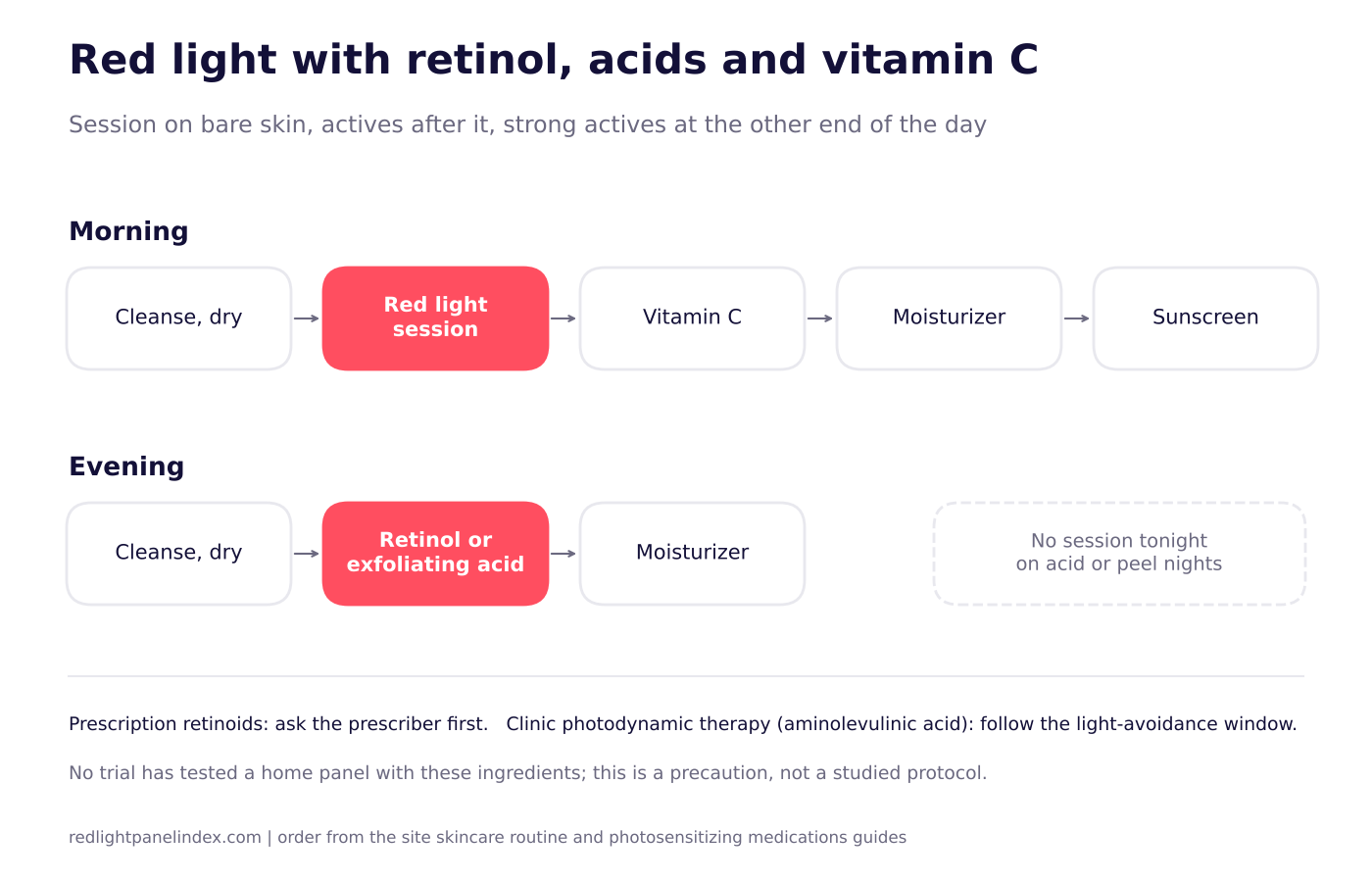
Run your red light session on clean, bare skin and apply actives afterward: vitamin C can go on right after a morning session, while retinol, prescription retinoids and exfoliating acids are best kept to the other end of the day so the light and the active do not stack irritation on the same skin barrier. No trial has tested a home panel together with retinol, acids or vitamin C in either order, so this is a precaution built from how each ingredient affects skin, not a studied protocol.
Choosing a panel? Our ranking of the best red light therapy panels is computed from published, method-labeled specs across 188 devices. For a routine with skincare actives, the spec that matters is the wavelength mix, including whether the panel adds a blue channel you can switch off.
Start from the routine order
The general order, cleanse, session, then serums, moisturizer and sunscreen, is covered in where red light fits in a skincare routine. The short reason is that anything on the skin can sit between the panel and the cells that absorb the light. This guide adds the ingredient-specific part: which actives go right after a session, which belong at a different time, and which deserve a question to a clinician first.
Ingredient by ingredient
| Ingredient | Photosensitizing? | Where it fits | Main concern |
|---|---|---|---|
| Vitamin C (ascorbic acid serums) | Not on the photosensitizing lists | Right after a morning session, under moisturizer and SPF | Stinging on reactive skin |
| Retinol and other over-the-counter retinoids | Linked to sun sensitivity through a thinner outer layer | Evening, away from the session | Dryness, peeling, redness |
| Prescription retinoids (tretinoin, isotretinoin) | On the medication lists | Ask the prescriber first | Same, often stronger |
| Exfoliating acids (glycolic, lactic, salicylic) | Raise sun sensitivity, mainly to UV | Evening, away from the session | Stinging, a more reactive barrier |
| Hydrating "acids" (hyaluronic acid) | No | Anytime after the session | None specific |
| Aminolevulinic acid in clinic photodynamic therapy | Yes, by design | Follow the clinic's light-avoidance window | Light activates it |
Vitamin C
Vitamin C serums are antioxidants, commonly used in the morning under sunscreen, and they are not among the photosensitizing drug classes this site's photosensitizing medications guide lists. That makes vitamin C the easiest active to pair with a morning session: cleanse, run the session, then apply vitamin C, moisturizer and SPF. The skin anti-aging evidence page notes that combining light with retinol or vitamin C is generally considered fine because the light is non-abrasive, while advising that actives be introduced on their own schedule and watched for irritation. Low-pH ascorbic acid serums can sting; if skin is pink and warm right after a session, waiting a few minutes before applying costs nothing.
Retinol and retinoids
Retinoids work differently from the other photosensitizing drugs. As the medications guide explains, a retinoid thins and speeds the turnover of the outer skin layer, so the extra sensitivity comes from having less barrier, not from the drug reacting to light. The documented reactions are about ultraviolet exposure, which a red and near-infrared panel does not emit. The practical concern is irritation: a retinoid already causes dryness and redness in many users, and a session adds mild warmth on the same skin.
- Keep retinol to the evening and the session to the morning, or the reverse, so the two are not back to back.
- Introduce a new retinoid and a new panel routine weeks apart, so if irritation appears you know which one caused it.
- For tretinoin, isotretinoin or any prescription retinoid, ask the prescriber before regular sessions.
Exfoliating acids
Glycolic and lactic acid (alpha hydroxy acids) and salicylic acid (a beta hydroxy acid) remove surface cells. Alpha hydroxy acids are known to increase sensitivity to UV light, and freshly exfoliated skin is more reactive in general. As with retinoids, the evidence on sensitivity is about sunlight, not red or near-infrared light, so the reason to separate acids from a session is irritation, not a known light reaction. On nights you use an acid or a peel pad, skip that evening's session or run it earlier in the day. After a professional chemical peel, follow the practitioner's aftercare, which may say to pause any light device for a period; the guide to red light after microneedling or chemical peels covers when and how to restart.
The acid that is a real exception
Aminolevulinic acid is not a skincare acid. It is a prescription photosensitizer applied in clinics for photodynamic therapy, and it is activated on purpose by light, including red light. After a photodynamic therapy treatment, follow the clinic's instructions on avoiding light and do not use a home panel on the treated area until they say you can. This is the one combination on this page where the concern is a known light reaction rather than general irritation.
Practical steps
- Cleanse and dry first, then run the session on bare skin. Wear the goggles the panel supplies for face sessions; see the eye protection guide.
- Morning: session, then vitamin C, moisturizer and sunscreen. Red light does not replace daily SPF, which matters more when you use retinoids or acids.
- Evening: retinol, prescription retinoid or exfoliating acid, with no session right before or after.
- Start conservative. Use the short end of the facial protocol on the skin anti-aging page (3 to 7 sessions a week, 10 to 20 minutes, 6 to 12 inches) and the dose calculator to turn your panel's irradiance at your distance into a dose. The dosing guide explains why the lower end of a range is a sensible place to begin.
- Check your skin after the first week. Redness that lasts, stinging, peeling or anything that looks like a sunburn is a reason to pause the active, the sessions or both, and to speak to a dermatologist.
If you have no time preference, the morning vs evening guide covers what is known about session timing, which is not much.
Exceptions and edge cases
- Panels with a blue channel. Some panels add a 480nm blue band. Blue light is closer to the range where some photosensitizers absorb, as the 480nm blue light page and the wavelength guide explain. If you use a photosensitizing medication or have just had photodynamic therapy, a red and near-infrared only mode is the conservative choice where the panel offers one.
- Acne routines. Acne regimens often combine retinoids, benzoyl peroxide and acids. The acne evidence page covers what the light trials used; the same spacing logic applies.
- Botanical extracts. Some citrus and bergamot oils are phototoxic under UV light. If a product lists them, apply it after the session rather than before.
- Injectables and procedures. Fillers, neurotoxins and laser treatments have their own aftercare; see red light after Botox or fillers.
- Sensitive or treated skin. If you are being treated for rosacea, eczema or another diagnosed condition, treat light as an adjunct and plan the routine with your dermatologist. The safety and side effects page covers what is and is not known about adverse effects.
What has not been studied
- No trial this site tracks combined retinol, retinoids, exfoliating acids or vitamin C with a red or near-infrared panel.
- No study compared applying an active before a session with applying it after.
- No study measured whether a session changes how a topical product is absorbed, in either direction.
Everything above is a reasonable precaution drawn from what each ingredient does to skin and from the UV photosensitivity literature, not a tested protocol. It is general wellness information, not medical advice.