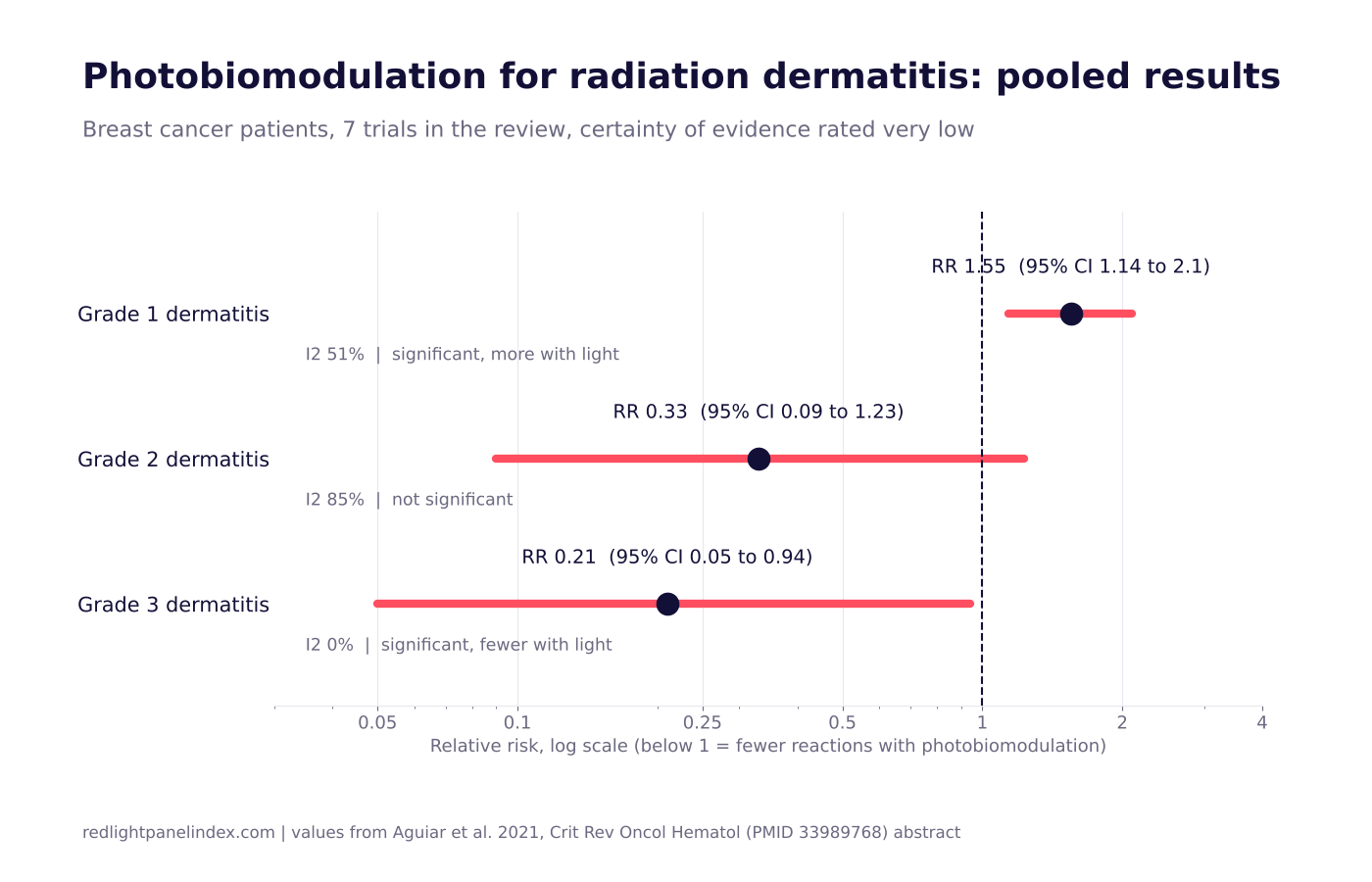
A 2021 systematic review and meta-analysis by Aguiar and colleagues pooled seven clinical trials of photobiomodulation for radiation dermatitis and concluded that the certainty of evidence that it prevents the condition is very low (PMID 33989768). In breast cancer patients the pooled data showed fewer grade 3 reactions with light, a statistically significant result, no significant difference for grade 2, and more grade 1 reactions in the light groups than in the controls. It is a mixed, low-certainty picture built entirely from clinic protocols, and it does not support using a home panel on irradiated skin.
Choosing a panel? Our ranking of the best red light therapy panels is computed from published, method-labeled specs across 188 devices. For radiation dermatitis, the spec that matters is not on any panel, because every pooled trial used a protocol run by a clinical team; for general skin use, check wavelength and irradiance with a named measurement method.
What the study asked
Radiation dermatitis is the skin reaction inside a radiotherapy field: redness and dryness at the mild end, peeling and moist breakdown at the severe end. Clinicians grade it on a scale where grade 1 is the mildest visible reaction and grades 2 and 3 are the reactions that hurt, interrupt daily life and can force a pause in radiotherapy.
The Aguiar review set out to answer one question across all the trials it could find: is photobiomodulation therapy (PBMT) effective in preventing and treating radiation dermatitis? It is the pooled counterpart to the two individual trials this site has already reviewed in its study review of LED light to prevent radiation dermatitis: a 2010 double-blind LED trial in breast cancer that found no benefit (PMID 21070458) and the 2021 DERMISHEAD trial in head and neck cancer that reported fewer moderate to severe reactions (PMID 33711412).
Who was studied
This is a review, so the "participants" are trials. According to the abstract, the authors searched seven databases plus gray literature and included seven clinical trials. The pooled results the abstract reports are for breast cancer patients, the population where enough trials shared an outcome to combine them.
The abstract does not list the individual trials, the total number of patients, or how many trials fed each pooled estimate. Those details sit in the full paper, which is behind a paywall, so they are not reported here. The Fife breast cancer trial was published years before the review's search and fits its scope, but the abstract does not confirm which trials were included, and this page does not assume it.
Device and parameters as stated
The abstract gives no wavelengths, irradiance, energy density, session count or device type. It reports results for photobiomodulation therapy as a category.
That matters. "Photobiomodulation" in oncology usually means a clinician-applied protocol, often laser or a hospital LED unit, timed against the radiation schedule. A pooled estimate across such protocols is an average of different devices and doses, and nothing in the abstract lets a reader work out a dose to put into the dose calculator. Where the underlying trials used lasers or clinic units, their delivery differs from a home LED panel in power, beam area and how the dose is placed on the skin, and the pooled result should not be assumed to transfer to one.
What was measured and found
The review's outcome was the rate of radiation dermatitis by grade, combined across trials as a relative risk (RR). An RR below 1 means fewer reactions in the light group than in the control group; an RR above 1 means more. If the 95% confidence interval crosses 1, the result is not statistically significant.
For breast cancer patients the abstract reports:
| Outcome | Relative risk | 95% confidence interval | Heterogeneity (I2) | Reading |
|---|---|---|---|---|
| Grade 1 dermatitis | 1.55 | 1.14 to 2.10 | 51% | More grade 1 with light, significant |
| Grade 2 dermatitis | 0.33 | 0.09 to 1.23 | 85% | Fewer with light, not significant |
| Grade 3 dermatitis | 0.21 | 0.05 to 0.94 | 0% | Fewer with light, significant |
The authors' conclusion is two-sided. They state there is very low certainty evidence that PBMT is effective in preventing radiation dermatitis, but that it showed a significant effect in preventing grade 3 dermatitis in breast cancer patients, and they call for further randomized clinical trials.
Why more grade 1 can sit beside less grade 3
The grade 1 result looks like harm at first glance, but it is more likely bookkeeping. Every patient ends up in one grade. If light shifts some patients from grade 2 or 3 down to grade 1, the grade 1 column grows even though the overall picture improved. The abstract does not test that explanation directly, so read it as a likely reason, not a finding.
How a pooled result can differ from its biggest trial
The two trials this site reviewed separately pointed in opposite directions. A meta-analysis does not take a vote between them. It weights each trial by its size and precision, combines events across all of them, and can find a signal that no single small trial had the power to show, or wash out a positive trial that turns out to be an outlier.
Two features of this review show both effects at once. The grade 3 estimate has I2 of 0%, meaning the trials agreed with each other, but severe reactions are rare, so the interval is very wide: the true effect could be large or modest. The grade 2 estimate has I2 of 85%, meaning the trials disagreed sharply, and its interval runs from a strong benefit to a possible increase. A single negative trial like Fife's, with 33 analyzed patients, would be a small part of such a pool, and its null result is consistent with the very low certainty the authors assign. The sham-controlled trials explainer covers why trials of this size can miss a real effect or produce a chance one.
Limitations
- Very low certainty, in the authors' own words. That is the bottom rung of the usual certainty scale. It means further trials are likely to change the estimate.
- Few, small trials. Seven trials in total, and fewer contributing to each pooled estimate.
- High heterogeneity for grade 2. At 85%, the trials did not agree, which usually signals differences in device, dose, timing or patient group.
- Wide intervals. Even the significant grade 3 result spans a range from a large to a small effect.
- One cancer type for the pooled results. The figures are for breast cancer. Head and neck radiotherapy, the setting of the DERMISHEAD trial, is a different field, dose and skin.
- No parameters in the abstract. Without wavelengths and doses, there is no way to say which protocol, if any, drove the result.
- No risk of bias detail in the abstract. How blinding and allocation were handled in each trial is not summarized there.
Where this leaves the grade
On this site's evidence grading scale, a meta-analysis usually carries the most weight. Here it confirms what the two single trials suggested: the signal is real enough to keep studying, concentrated in the severe grades, and not settled. For clinician-delivered photobiomodulation during breast radiotherapy, that supports a Limited reading at most. For any home device, the evidence is Insufficient, because no pooled trial tested one.
That contrast is the same one the oral mucositis evidence page draws: strong support for specific clinical protocols in cancer care, and nothing that carries over to a panel bought for home use. The site's skin and anti-aging evidence rests on trials in healthy aging skin, and its grade should not be read across to irradiated skin either.
What it means for a home panel
- Do not self-treat irradiated skin during radiotherapy. The trials ran inside oncology programs, with light timed to the radiation schedule and alongside standard skincare. Skin in a radiation field is fragile, and an unplanned light, heat or pressure exposure is a decision for the radiotherapy team.
- Ask the oncology team if the idea interests you. Some radiotherapy departments offer photobiomodulation. That is the route this evidence describes.
- After treatment, the general cautions apply. For anyone with a cancer history considering a panel later, the safety and side effects page sets out what has and has not been studied, and the lymphedema evidence page covers a related question in breast cancer survivors.
- Do not read "grade 3 reduced" as a home claim. The figure comes from clinic protocols the abstract does not describe, pooled at very low certainty.
The short version: seven trials pooled, fewer severe reactions in breast cancer patients, more mild ones, very low certainty overall, and nothing that tells a home user what to do with a panel.