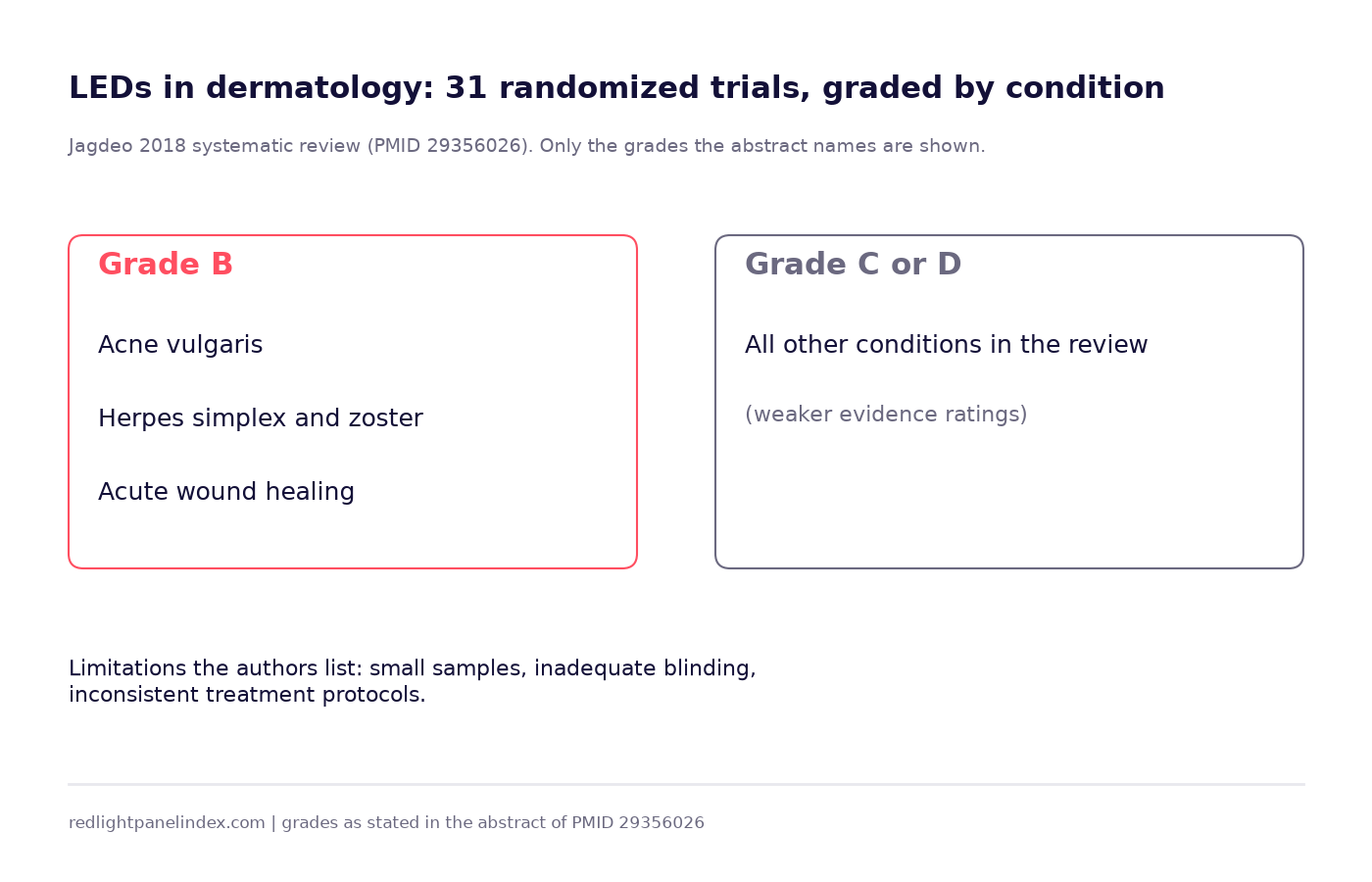
A 2018 systematic review of randomized controlled trials found 31 original trials of light-emitting diodes (LEDs) in dermatology and graded the evidence as strong (Grade B) for acne vulgaris, herpes simplex and zoster, and acute wound healing, with weaker ratings (Grade C or D) for the other conditions it covered (PMID 29356026). It is the broadest evidence map of LEDs for skin, and two shorter narrative reviews of the same technology add context (PMID 19150294, PMID 29552272).
Choosing a panel? Our ranking of the best red light therapy panels is computed from published, method-labeled specs across 188 devices. For skin, the spec that matters is wavelength, because the trials in this review used specific LED bands and a panel only matches them if its published peaks do.
What the review asked
The Jagdeo review set out to answer a broad question: for which skin conditions do randomized controlled trials of LEDs exist, and how strong is each body of evidence? Rather than testing one device, the authors gathered the published randomized trials, rated the evidence by condition, and commented on the quality of the literature as a whole (PMID 29356026).
The question matters for a home buyer because marketing often treats "LED skin benefits" as one claim. The review splits it into conditions and shows that the support is uneven.
Who was studied
The abstract reports that 31 original randomized controlled trials met the criteria for analysis. It does not report a pooled number of participants, and the abstract does not list ages or skin types, so those are not described here. Because the review covers many conditions, the populations differ from one condition to the next: acne trials, wound trials and viral lesion trials enrolled different people for different reasons.
The two companion papers are not trial summaries of this kind. The Barolet paper is a narrative review of how LED photobiomodulation developed in aesthetic and medical dermatology, including the cell-signaling pathways involved (PMID 19150294). The Ablon paper is a literature review centered on one LED device family using blue, red and infrared bands (PMID 29552272).
Device and parameters as stated
The Jagdeo abstract does not give wavelengths, irradiance, dose or session counts, because it summarizes 31 trials that used varied protocols. The authors themselves list inconsistent treatment protocols among the limitations. That means no single dose can be taken from this review.
The Ablon abstract does name bands for the device it discusses: 415nm (blue), 633nm (red) and 830nm (infrared). It describes that device as showing significant results across mild-to-moderate acne vulgaris, wound healing, psoriasis, Bowen's disease, basal cell carcinoma, actinic keratosis and cosmetic applications (PMID 29552272). That is a statement about one clinical device family, not about LEDs in general, and several of those conditions are ones a home panel is not designed to address.
To turn any trial dose into a session time for your own panel, use the dose calculator, and see what peak wavelength means for how a panel's published bands compare with the bands trials used.
What was measured and found
The headline result is the grading. The authors reported strong evidence (Grade B) for acne vulgaris, for herpes simplex and zoster, and for acute wound healing, and weaker evidence (Grade C or D) for the remaining conditions (PMID 29356026). The chart at the top of this page shows that split.
The authors described LEDs as an emerging modality to alter skin biology, noted few adverse events, affordability and encouraging clinical results, and recommended continued clinical use and further research. They also listed small sample sizes, inadequate blinding and inconsistent protocols as limitations.
Ablon's review states that phototherapy with LEDs is free of adverse events and displays an excellent safety profile, in contrast to photodynamic therapy with a photosensitizer, which may cause stinging and burning (PMID 29552272). That is a review author's conclusion about one device family, not a measured outcome from a trial.
How this maps to the site's skin grades
The review's grades and this site's grades answer different questions, which is why they do not always match.
- Acne. The review rated acne Grade B. This site's acne evidence page grades it Limited, because the two randomized trials it counts combined blue and red light and neither tested red light alone. The Papageorgiou study review covers one of them.
- Skin aging. The site's skin anti-aging page grades it Strong, based on controlled trials of wrinkle depth, texture and collagen density. The Mota periocular trial review shows what one such trial measured and left out.
- Other conditions. Herpes, wound healing and the clinical conditions in the Ablon paper are not on this site's consumer evidence hub, so the site does not assign them a grade. The grading explainer sets out how its four grades are defined.
The site's grades ask whether controlled trials exist at doses a home panel can plausibly deliver. A systematic review's grades ask how good the trial evidence is for a condition under clinic conditions. Both can be true at once.
Limitations
- The abstract is a summary of summaries. It gives grades, not effect sizes, so no percentage improvement can be drawn from it.
- Trial quality. The authors cite small samples, inadequate blinding and inconsistent protocols. The site's explainer on sham-controlled trials covers why blinding changes how much a result counts.
- Age of the evidence. The review dates from 2018, and later trials are not in it.
- Narrative reviews are not trials. The Barolet and Ablon papers describe and interpret a literature; neither produces new trial data.
- Device class. Many LED trials used clinic devices. Whether a home panel matches their irradiance and wavelengths depends on the panel's published specs.
What this means for a home panel
For skin, the review supports a narrow reading: randomized trials of LEDs exist, and the authors rated the evidence highest for acne, herpes simplex and zoster, and acute wounds. It does not say any home panel delivers those results.
Start from the wavelength and dose a trial reports, check them against a panel's published peaks and irradiance method, and use the dose calculator to get a session time. Where the source is a clinic device with no stated irradiance, treat the match as unknown. If you use photosensitizing medication, read the photosensitizing medications guide first, and do not use a panel on an active infection, wound or suspicious lesion without asking a clinician.
Bottom line
The Jagdeo review is the best available map of LED trials in dermatology, and it shows that evidence quality depends on the condition. It supports taking acne and skin-aging claims seriously, while leaving the dose question for a home panel open.