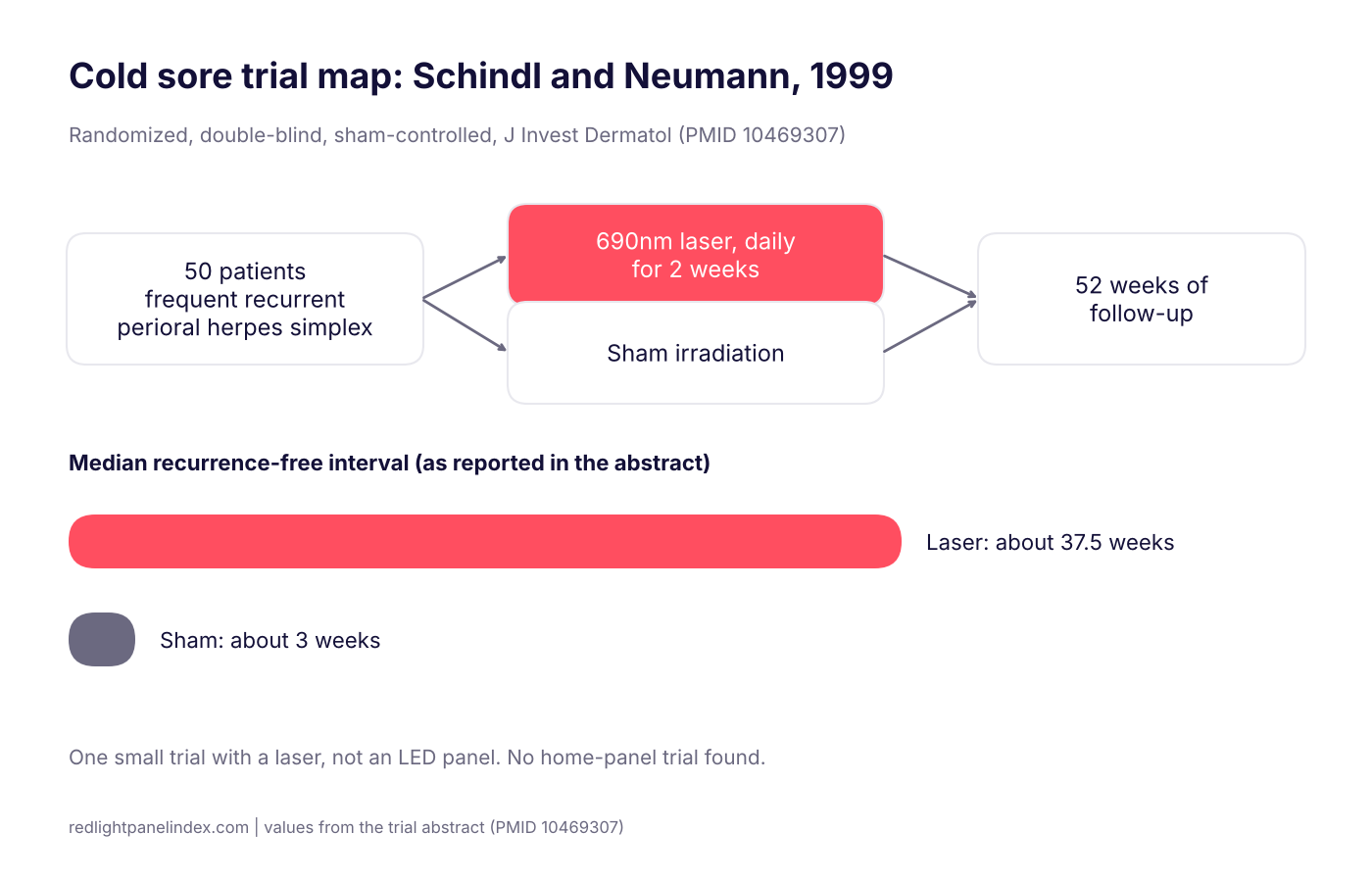
The evidence for red light on cold sores (recurrent herpes labialis) is graded Limited: one randomized, double-blind, sham-controlled trial from 1999 reported a much longer time to the next outbreak after a two-week laser course (PMID 10469307), but it used a laser rather than an LED panel, it was a single small trial, and no trial of a home panel was found.
Choosing a panel? Our ranking of the best red light therapy panels is computed from published, method-labeled specs across 188 devices. For cold sores, the spec that matters is the wavelength mix, because the one controlled trial used 690nm, a band between the common 660nm and 810 to 850nm bands.
How this page grades the evidence
This site uses four grades, Strong, Moderate, Limited and Insufficient, defined in how this site grades evidence. Limited means a small body of human evidence points in a favorable direction but is too thin, too narrow or too different from home use to support a confident claim. Cold sores earn that grade because there is a sham-controlled trial with a large reported difference, and because that trial cannot be carried over to a panel on a bedroom wall.
The one controlled trial: Schindl and Neumann, 1999
What it asked. The study, published in the Journal of Investigative Dermatology, asked whether a short course of low-intensity laser irradiation could lengthen the time between outbreaks in people with frequent recurrent herpes simplex on and around the lips (PMID 10469307).
Who was studied. According to the abstract, the trial enrolled 50 patients with frequent recurrent perioral herpes simplex. It was randomized and double-blind, with a placebo (sham) irradiation group.
Device and parameters as stated. The treatment was a 690nm low-intensity laser given daily for two weeks. Patients were then monitored for 52 weeks. The abstract does not give a home-style dose in the terms used on this site, so the dose calculator cannot be filled in from it. Distance, power density and energy per session are not something to infer.
What was measured and found. The outcome was the recurrence-free interval, the time until the next outbreak. The abstract reported a median recurrence-free interval of about 37.5 weeks in the laser group against 3 weeks in the sham group, a statistically significant difference. The authors concluded that the treatment was safe and noninvasive and might be an alternative to established therapies.
Why a single trial earns Limited and not more
- One trial. The same finding has not been shown again in a second randomized trial that this review could read, and a result that has not been replicated is held to a lower grade.
- Small sample. Fifty patients split across two groups leaves little room for chance. A large gap in a small trial is a reason to want a replication, not a reason to stop at one.
- A laser, not an LED panel. Lasers deliver a very narrow band and a collimated beam. A panel emits a broader band from many LEDs across a wide area. The LED versus laser page explains why that difference matters for reading trials, and the sham-controlled trials page explains why the sham arm in this study is what makes it informative.
- Clinic delivery. The light was applied in a study setting to a small area, not from a panel several inches away.
- Age of the evidence. The trial is from 1999. Later reviews of laser for herpes labialis have called for better designed trials with standardized parameters, which is the same limitation flagged in broader reviews of LEDs in skin disease.
What the broader skin reviews say
A 2018 systematic review of LEDs in dermatology graded herpes simplex and zoster in the same tier as acne and acute wound healing (PMID 29356026). Our study review of that paper explains how its letter grades differ from the ones used on this page. The review rated trial-level evidence across 31 randomized trials, and a high letter grade there does not mean a home panel has been tested on cold sores.
What was not studied
- A randomized, sham-controlled trial of an LED panel for cold sores.
- Red light at 630 to 660nm or near-infrared light at 810 to 850nm for cold sores. The one controlled trial used 690nm.
- Treating an outbreak that has already started, compared with trying to lengthen the gap between outbreaks.
- Comparison against standard antiviral treatment in the same trial.
- Effects in people with weakened immune systems, children, or people with frequent severe outbreaks.
- Whether the effect lasts beyond the 52 weeks of follow-up.
- Any trial that gives a distance, time per session and schedule for a panel at home.
A practical section for panel owners
Nothing in the evidence tells a home user what setting to use for cold sores. If you are weighing a panel for skin more broadly, the skin anti-aging evidence page and the photoaging page cover the skin trials that do exist for panels, and the eczema page shows how a condition with no red or near-infrared trial is handled.
Some practical points follow from the trial and from how panels work:
- Check the wavelength. The wavelengths guide explains the common bands. The 630nm vs 660nm page covers the red end. A panel with a 660nm and 850nm mix is not the same light as the 690nm laser in the trial.
- Irradiance depends on method. Any power figure on a spec sheet should be read with its measurement method in mind, as described on the irradiance page.
- Coverage is not the issue. The lip is a small area, so treatment area and coverage matters little here. That is another way a cold sore is a poor reason to choose a large panel.
- Use a calculator, not a guess. If you do test a panel on any skin area, the dose calculator turns a distance and time into energy per session, though it cannot tell you the right amount for this condition.
Cautions
- A cold sore is a viral infection. Light is not a substitute for medical care, and people with frequent, severe, spreading or eye-adjacent outbreaks should see a clinician.
- Protect your eyes during any facial session. See the eye protection guide.
- If you take medicines that make skin more sensitive to light, check the photosensitizing medications guide first.
- Sessions on active, open sores raise hygiene questions, such as sharing a device or touching a panel after touching a lesion. The trials summarized here do not address this.
- General safety information is on the safety and side effects page.
Bottom line
One sham-controlled laser trial reported a long recurrence-free interval, and that is why this page is graded Limited rather than Insufficient. It is not a trial of a panel, it has not been shown again in a second randomized trial found for this review, and it gives no home dose. A reader choosing a panel for general skin or recovery use should not choose it for cold sores on the strength of this evidence.