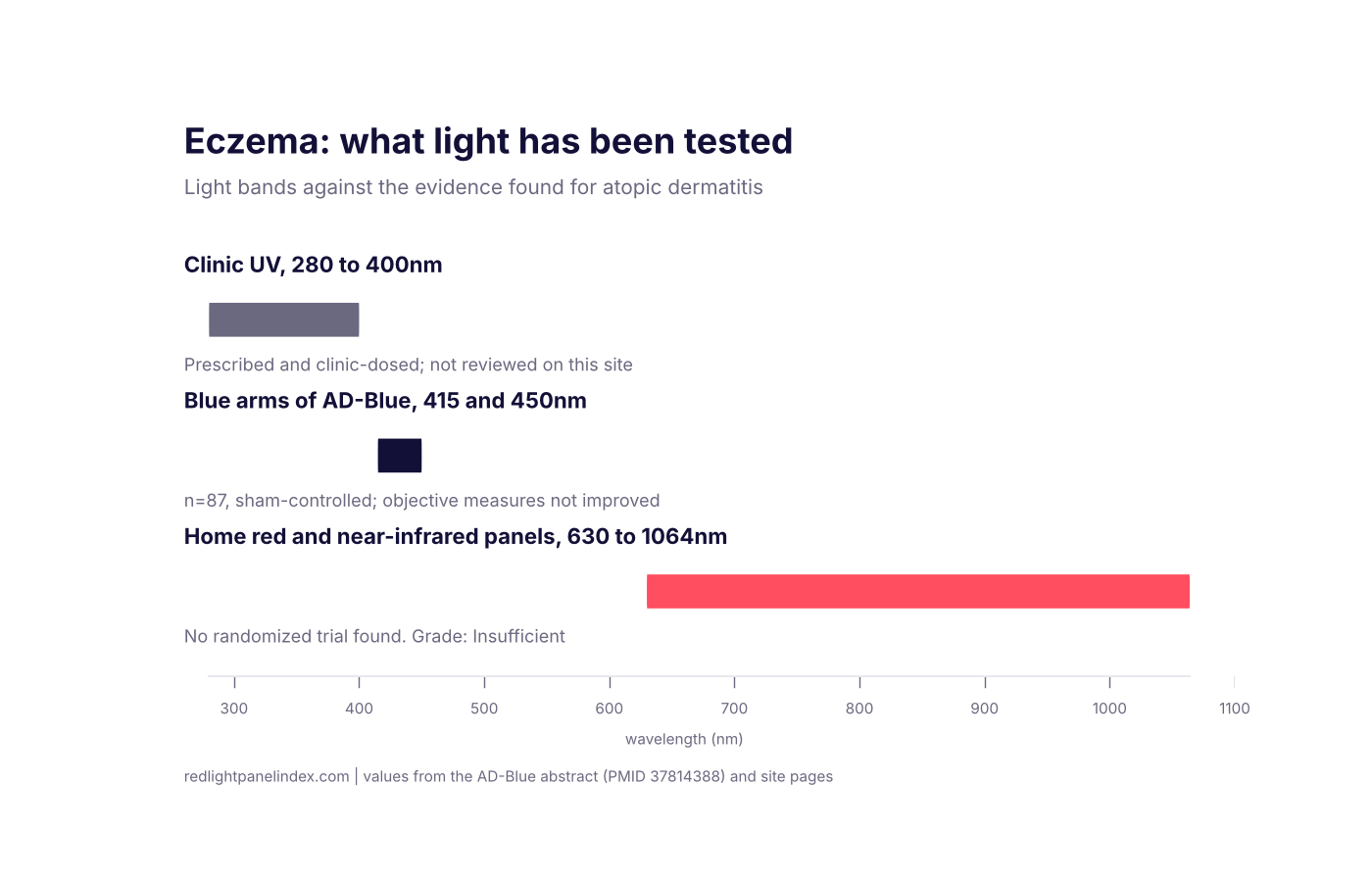
The evidence for red and near-infrared light on eczema (atopic dermatitis) is graded Insufficient: no randomized human trial of red or near-infrared light for atopic dermatitis was found for this site's research, so there is nothing to grade as a result. The closest well-designed LED trial used blue light, not red or near-infrared, and it was negative on its objective measures.
Choosing a panel? Our ranking of the best red light therapy panels is computed from published, method-labeled specs across 188 devices. For eczema, the spec that matters is the wavelength mix, because the only sham-controlled light trial used blue wavelengths that most red and near-infrared panels do not emit.
How this page grades the evidence
This site uses four grades: Strong, Moderate, Limited and Insufficient, explained in how this site grades evidence. Insufficient means there is too little human evidence to say whether the light does anything for the condition. It does not mean the light has been shown to fail, and it does not mean it has been shown to work. For eczema the honest summary is that the question has not been tested with red or near-infrared light in a randomized trial.
The one sham-controlled trial: AD-Blue
The AD-Blue trial (PMID 37814388) is the closest well-designed study. It is worth describing carefully, because it is easy to mistake for evidence about red light.
Who was studied. The trial enrolled 87 patients with atopic dermatitis. It was randomized and double-blind, with a sham-irradiation control.
What was tested. There were three arms: full-body blue light at 415nm, full-body blue light at 450nm, and sham irradiation. Neither blue arm was red or near-infrared light. For where blue sits in the spectrum and how it differs from the bands in a typical panel, see the 480nm blue light explainer.
What was found. Itch, measured on a visual analog scale (Itch-VAS), improved significantly against sham only in the 450nm arm, a change of -1.6 (p = 0.023). The 415nm arm did not reach significance on itch. The combined patient and clinician score (PO-SCORAD) fell significantly in the 415nm arm, a change of -11.5 (p = 0.028 against sham), but that was a secondary measure. EASI, SCORAD, IGA and DLQI did not change significantly.
How it is read. The published protocol named EASI as the primary endpoint, and EASI did not change significantly, so the overall result is read as negative. The authors concluded that full-body blue light did not improve any of the objective measures of the disease. They also noted a favorable safety profile and moderate reductions in itch and IL-31 levels.
These details come from the trial's abstract as summarized on our red light vs UV phototherapy page; the full text was not available for this review.
What the trial means, and what it does not
- It is a blue light result. It says nothing direct about 630 to 850nm red and near-infrared light.
- The objective outcome was negative. A reduction in itch in one arm and a score change in the other, on secondary measures, were reported alongside no change in the measures that define disease severity.
- Two arms, two different signals. Itch improved in one blue arm and the combined score in the other. With 87 patients split across three arms, that pattern is hard to interpret and should not be read as a dose-response finding.
- No home-dose information. A full-body clinic device is not a home panel, and the trial does not give a distance, time or frequency that transfers to home use.
What was not studied
- A randomized, sham-controlled trial of red light (around 630 to 670nm) for atopic dermatitis.
- A randomized trial of near-infrared light (around 810 to 850nm) for atopic dermatitis.
- Children, who make up a large share of people with eczema. The AD-Blue trial and the light literature summarized here do not give a basis for advice on children (see the kids and teens safety guide for the general cautions).
- Long-term follow-up after a course of light sessions.
- Any comparison of a home panel against a clinic treatment.
- Any trial that specifies a home dose for eczema.
If you want to see how a condition with a single small trial is graded, the psoriasis page rests on one nine-patient trial and is graded Limited, which is one step above Insufficient. Eczema has not reached even that level for red or near-infrared light.
Clinic UV phototherapy is a different thing
Dermatology clinics use ultraviolet light, usually narrowband UVB, for eczema and psoriasis. It is prescribed, dosed and monitored by a clinic and carries UV risks that clinics manage. Home red and near-infrared panels emit no UV. The two are not interchangeable, and the evidence for clinic phototherapy cannot be borrowed to support a home panel. The comparison is laid out in red light vs UV phototherapy.
A practical section for anyone still curious
There is no tested home dose for eczema, so nothing here is a recommendation. If you and your dermatologist decide a panel is a reasonable add-on, these points are the practical ones:
- Wavelength. Check the panel's published peaks on the wavelengths page and in the device's database entry. Red and near-infrared panels cover roughly 630 to 1064nm, which is outside the blue range tested in AD-Blue. The optical window page explains why those bands were chosen for tissue light.
- Dose. If you try a panel, keep sessions short and conservative and work out distance and time with the dose calculator. More light is not better, and irritated or inflamed skin may react differently from healthy skin.
- Spec labels. Compare irradiance only when the measurement method is stated; the irradiance vs total power page explains why.
- Patch test first. Start on a small area and stop if the skin becomes more irritated.
If the goal is skin quality rather than eczema itself, the photoaging page and the scars page cover skin topics with some controlled-trial evidence, though both are graded Limited.
Cautions
- A panel is not a substitute for prescribed treatment. Eczema can flare, become infected or need medical management. Do not delay or replace what your dermatologist has recommended.
- Photosensitizing medicines. Some drugs change how skin responds to light. Read the guide to photosensitizing medications and ask your prescriber or pharmacist first.
- Eyes. Protect them as the eye protection guide describes, particularly when treating skin near the face.
- Safety in general. The safety and side effects page covers reported adverse effects and who should be careful.
- Marketing claims. Be skeptical of any panel marketed for eczema. No red or near-infrared trial supports that claim, and a blue channel is not a reason to buy for eczema given the AD-Blue result.
Frequently asked questions
Is there any evidence red light therapy helps eczema? Not in a randomized trial of red or near-infrared light that we could find. The evidence grade is Insufficient.
Does blue light help eczema? One randomized, double-blind, sham-controlled trial (PMID 37814388) tested two blue wavelengths and was negative on its objective measures, with some reductions in itch and a patient-reported score reported as secondary findings.
Is red light the same as UV phototherapy? No. UV phototherapy is a prescribed clinic treatment with different biology and different risks. A red panel emits no UV.
Will this page change? Yes, if a randomized trial of red or near-infrared light in atopic dermatitis is published. The grade will be revised against what that trial reports.
Bottom line
For eczema, red and near-infrared light is Insufficient on the evidence: no randomized trial was found, and the one rigorous LED trial used blue light and did not improve the objective measures of disease. A panel, at most, is an optional add-on to be discussed with a dermatologist, never a replacement for treatment. The methodology page explains how pages here are researched and updated.