Clinic phototherapy for psoriasis and eczema uses ultraviolet light, usually narrowband UVB, delivered under medical supervision and with real UV risk, while a home red or near-infrared panel emits no UV and is a different treatment with a much thinner evidence base for these two conditions. The two are not interchangeable, and the evidence for dermatologist-supervised UV phototherapy cannot be borrowed to justify a home panel.
Choosing a panel? Our ranking of the best red light therapy panels is computed from published, method-labeled specs across 188 devices. For psoriasis or eczema, the spec that matters is the wavelength mix, because a panel's red and near-infrared bands sit far from the ultraviolet range clinics use.
Why the two get confused
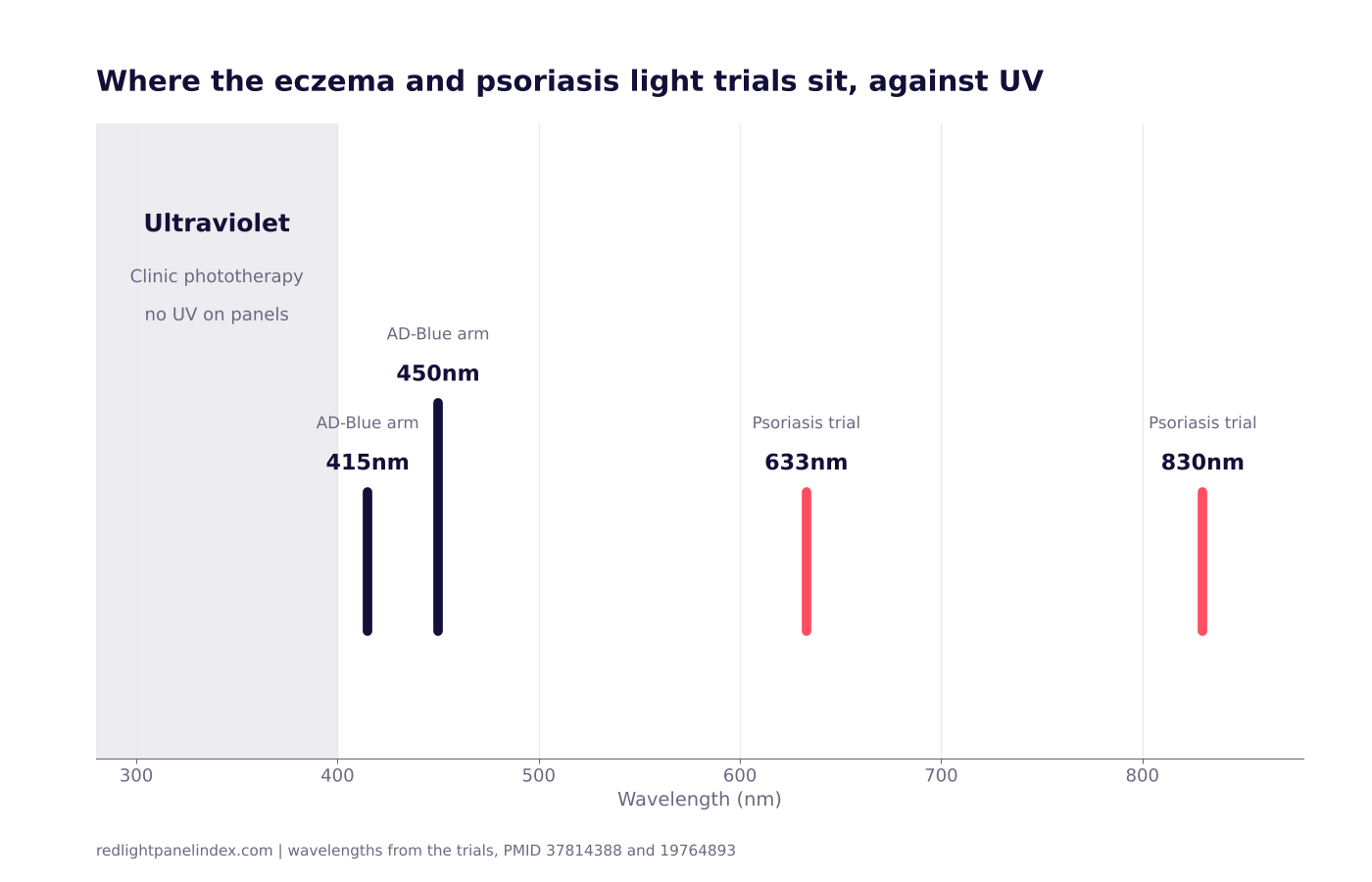
Both are called "light therapy," both can be described as phototherapy, and both are offered to people with stubborn skin conditions. That shared vocabulary hides a large difference in wavelength. UV sits below 400nm. Red and near-infrared panels work at 630 to 1064nm, and the optical window explainer covers why panels use that range. The site's chromophore page describes what absorbs red and near-infrared light in tissue, and that absorption is a different process from what UV does.
The psoriasis evidence page states the difference directly: dermatologists' ultraviolet phototherapy works through a different, DNA-level mechanism than red light, and has far stronger evidence. The same page grades red light for psoriasis Limited and treats it at most as a gentle adjunct.
What clinic UV phototherapy is
Narrowband UVB is a standard clinic option for psoriasis and eczema. It is a prescribed treatment: a dermatology clinic sets the dose, tracks the skin's response and manages the risks of UV exposure. It acts on immune activity in the skin. Because it is UV, it carries the UV risks the clinic is there to manage. This page does not cover UV dosing or safety in detail, because that belongs to a dermatologist and not to a panel buyer, and the site does not publish UV protocols.
The practical point for a panel buyer: none of the red or near-infrared panels in the database is a UV device, and nothing on a red light panel's spec sheet should be read as a substitute for clinic phototherapy.
What the red and near-infrared evidence looks like
Psoriasis. The main published trial is small. Per the psoriasis evidence page, nine patients whose psoriasis had resisted other treatment received combined 633nm red and 830nm near-infrared LED light, and the trial reported clearance of 60 to 100 percent (PMID 19764893). The site calls it illustrative rather than definitive because nine patients is a very small sample. There is no established home dose for psoriasis, and the page recommends discussing light therapy with a dermatologist. Standard treatments such as topical steroids, UVB phototherapy and biologic drugs are far better evidenced.
Eczema (atopic dermatitis). No randomized human trial of red or near-infrared light for atopic dermatitis was found for this site's research. The closest well-designed trial used blue light. The AD-Blue trial was a randomized, double-blind, sham-controlled study of 87 patients with atopic dermatitis, with three arms: full-body blue light at 415nm, at 450nm, and sham irradiation (PMID 37814388). Blue light at 450nm, but not 415nm, produced a significant improvement in itch against sham (Itch-VAS change of -1.6, p = 0.023). PO-SCORAD, a patient and clinician score, fell significantly in the 415nm arm (change of -11.5, p = 0.028 against sham), but that was a secondary measure. The other measures, including EASI, SCORAD, IGA and DLQI, did not change significantly, and no safety signals were reported. The authors concluded that, despite a favorable safety profile and moderate reductions in itch and IL-31 levels, full-body blue light did not improve any of the objective measures of the disease.
The trial's published protocol named EASI as the primary endpoint, and EASI did not change significantly, which is why the overall result is read as negative even though two secondary measures moved.
The full write-up is on the eczema evidence page. Blue light is also not what home red panels mainly emit, as covered in the 480nm blue light explainer.
Side by side
| Clinic UV phototherapy | Home red or near-infrared panel | |
|---|---|---|
| Wavelength | Ultraviolet, below 400nm | 630 to 1064nm |
| Who sets the dose | A dermatology clinic | You, using a dose calculator and a brand's guidance |
| Evidence for psoriasis | Far stronger, per the psoriasis page | Limited: one nine-patient trial |
| Evidence for eczema | Not covered on this site | None found for red or near-infrared in a randomized trial |
| UV risk | Yes, managed by the clinic | None, because there is no UV output |
| Role | Primary treatment option | At most a gentle adjunct, if used at all |
The UV column reflects the site's psoriasis page; this site does not review UV trials. For what suits your skin, ask a dermatologist.
Setting honest expectations
If you have psoriasis or eczema, a red light panel is not a reasonable replacement for what your dermatologist prescribes. Based on what has been published, the sensible framing is this: a panel is an optional, low-evidence add-on at best, and it should not delay or replace treatment that has been tested. If your clinic offers UV phototherapy and you are considering a panel as well, tell the clinic, and ask whether any medicine you take is photosensitizing; the photosensitizing medications guide lists the drug classes.
A few other points. Red and near-infrared light have no UV, so the UV skin-cancer concerns that apply to UV devices are not the issue with a panel. The safety page covers what is known about panel risks. A tanning bed is not a stand-in for either treatment: it emits UV without a clinic's dosing and supervision, and the red light vs tanning bed guide sets out the difference.
What was not studied
No randomized trial in this register tested red or near-infrared light against UV phototherapy for either condition, so there is no head-to-head result. No trial gave a home dose for psoriasis or eczema. The psoriasis trial had no control group, and the eczema trial used blue light, not red or near-infrared. This site does not review UV phototherapy trials, so no UV figures are given here.
Verdict by use case
- You have diagnosed psoriasis or eczema and want the best-evidenced option. Clinic treatment, including UV phototherapy where your dermatologist recommends it, is the better-evidenced route. A panel is not a substitute.
- You are already in treatment and curious about a panel. Raise it with your dermatologist first, especially if you take a photosensitizing medicine. Treat it as an optional add-on with Limited evidence for psoriasis and none found for eczema.
- You want a panel for another reason, such as recovery or skin appearance. Nothing here argues against that. Check the grade on the matching evidence page or condition page, and read the wavelength guide so you know what the panel emits.
- You are comparing a panel with a tanning bed or a salon bed. Neither is clinic phototherapy. See the red light vs tanning bed guide.
- You are comparing panels on blue-light features for eczema. The sham-controlled blue light trial was negative on its objective measures, so a blue channel is not a reason to buy for eczema. The 480nm blue light explainer covers which panels have one.
The short version
UV phototherapy and a red light panel differ in wavelength, evidence, supervision and risk. For psoriasis the site grades red light Limited, based on a nine-patient trial. For eczema no randomized red or near-infrared trial was found, and the closest sham-controlled trial, using blue light, was negative on its objective measures. Keep your dermatologist in charge, and use the dose calculator only if you and your clinician decide a panel is worth trying.