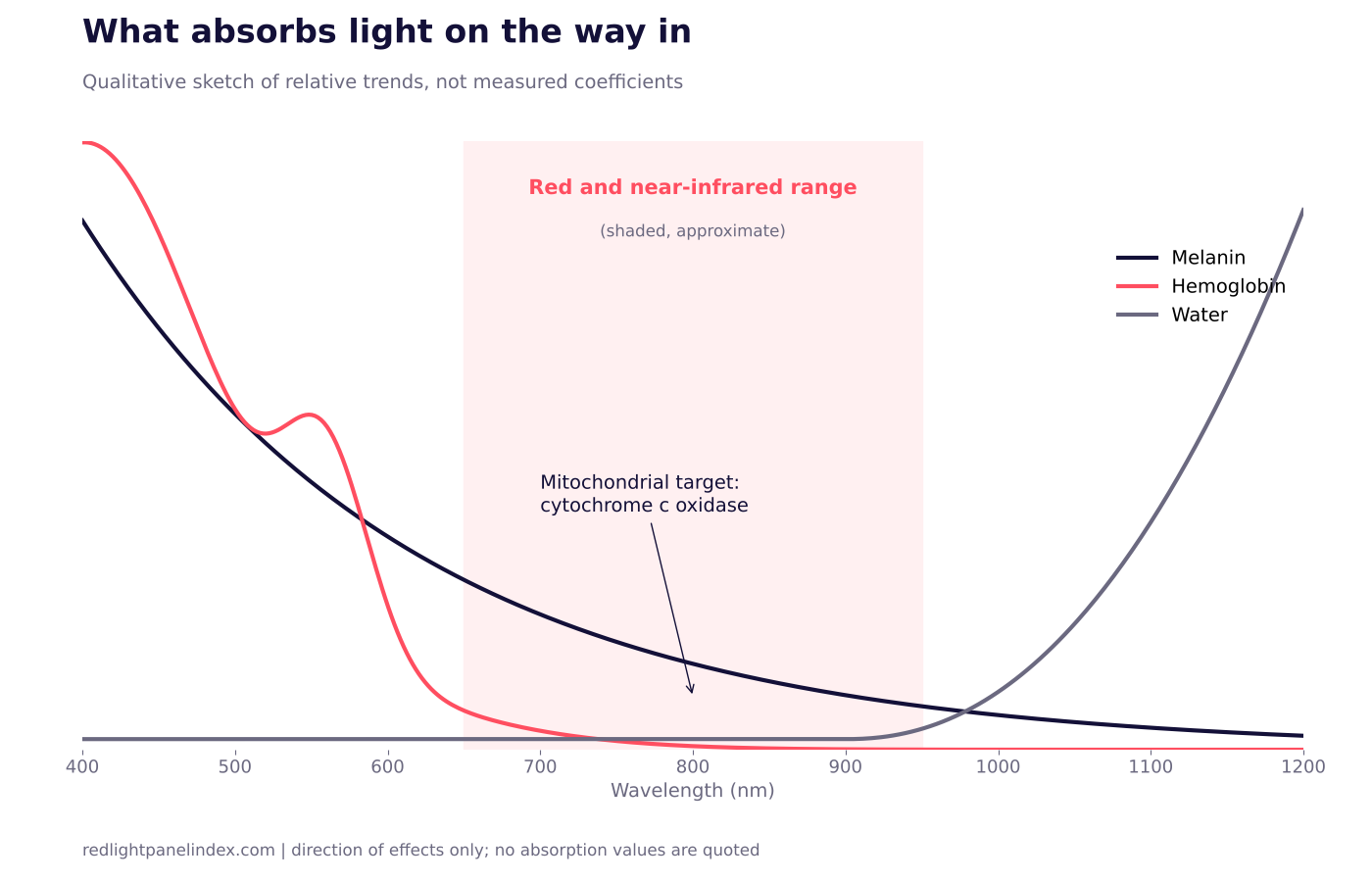
A chromophore is any molecule that absorbs light of a particular wavelength; in tissue, the ones that matter for red light therapy are hemoglobin in blood, melanin in skin, water, and the mitochondrial enzyme cytochrome c oxidase. Where each one absorbs sets how much light is lost on the way in and how much is left to act on a cell, which is why the same panel delivers different doses to different people and different depths.
Choosing a panel? Our ranking of the best red light therapy panels is computed from published, method-labeled specs across 188 devices. For absorption, the spec that matters is the wavelength mix, because the molecules above absorb different wavelengths very differently.
Light has to be absorbed to do anything
Light only affects tissue if something absorbs it. A photon that passes straight through does nothing, and one absorbed by the wrong molecule is usually turned into a little heat. The working idea behind photobiomodulation is that a specific chromophore absorbs the light and starts a chain of cellular events. A review of low-level light in skin, with Avci as first author, describes it this way: photons are absorbed by mitochondrial chromophores in skin cells, which in turn is followed by changes in electron transport, ATP, nitric oxide release, blood flow and signaling (PMID 24049929). That review is a summary of the field, not a trial, so treat it as the standard description of the proposed mechanism, not as proof that every effect occurs at home-panel doses.
The same fact has a flip side. Every other absorber on the path to the target is a tax on the light that arrives, and the size of the tax depends on wavelength.
The four absorbers
Cytochrome c oxidase is the target. It is an enzyme in the mitochondria, and the page on cytochrome c oxidase covers it in detail. The mitochondria and ATP article explains why a mitochondrial absorber would matter. Red and near-infrared wavelengths are the ones the field associates with this enzyme.
Hemoglobin is the pigment in red blood cells. It absorbs strongly in the visible range, which is why blue light barely gets beneath the surface of the skin, and the absorption falls away as the wavelength moves into the red and near-infrared. Skin with a rich blood supply therefore takes a larger share of the shorter red wavelengths.
Melanin is the pigment that sets skin tone. Like hemoglobin it absorbs shorter wavelengths more than longer ones, so more melanin means more light absorbed in the upper layers and less delivered below. This is the main reason skin tone matters for dosing.
Water makes up most of tissue and absorbs more as wavelength increases into the infrared. The page on 850nm versus 1064nm puts it plainly: water absorbs infrared light more strongly as the wavelength moves further out, so a longer wavelength is not simply a deeper one.
The site does not publish absorption coefficients for any of the four, so this page describes the direction of each effect and does not quote numbers.
The optical window
Put those together and there is a stretch of the spectrum where hemoglobin and melanin have mostly dropped off and water has not yet taken over. Red to near-infrared light sits in that stretch, which is why panels are built around it. Wavelengths below it are absorbed in the first millimeter or so; wavelengths well above it are absorbed by water. Our page on the optical window covers the same idea from the other direction, with the wavelength bands panels carry placed against it. See the wavelengths overview for the bands panels actually use.
What this means for penetration
A computational study by Ash and colleagues modeled how wavelength, beam width and skin type change the distribution of light energy in tissue, using a Monte Carlo method on a multi-layered skin model (PMID 28900751). Its headline results, as reported in the abstract, are that penetration depth increases with wavelength, with a maximum calculated depth of 5378 micrometers, and that a 10 mm beam delivers 73 to 88 percent of the fluence of an infinitely wide beam at 1 to 3 mm depth. It is a model, not a measurement in living people, and it does not include every absorber or every body site.
For a home panel, two practical points follow, both covered in the penetration depth article:
- Near-infrared wavelengths lose less to hemoglobin and melanin than red ones, so they are calculated to reach farther. The 810nm versus 850nm comparison notes that modeling puts 850nm slightly deeper.
- Reaching farther is not the same as reaching a useful dose. The only direct measurement the site cites, at 10 to 15 W, found 0.45 to 2.90 percent of 810nm light at 3 cm, far above home-panel power.
Skin tone and the Fitzpatrick scale
The Fitzpatrick scale classifies skin by how it reacts to sun, from type I (burns easily, tans rarely) to type VI (rarely burns, deeply pigmented). Because melanin is a chromophore that competes for the light, higher phototypes absorb more in the surface layers. In the Ash model, skin tone is one of the variables that changes the fluence distribution, which is the reason it is on their list at all.
What that does and does not mean:
- It does not mean red light therapy is unsuitable for darker skin. It means a given surface dose delivers somewhat less to deeper tissue, and more of it is absorbed near the surface.
- It does not mean there is a published correction factor for a panel. The site has no verified rule to quote, so a dedicated article on skin phototype and dosing is planned and this page does not offer one.
- Practical approach: start with the dose a panel's brand and the studies suggest, use the dose calculator to track it, and watch how skin responds. People with darker skin or a history of pigment problems should ask a clinician before starting.
Hydration and other variables
Water is a chromophore, so tissue water content changes absorption in the longer near-infrared range. The penetration depth article lists tissue hydration as one factor that moves real-world depth numbers. Blood flow changes the hemoglobin content of the target area, and so can temperature and exercise. None of these can be controlled precisely at home, which is one more reason to treat any penetration figure as a range, not a promise.
Using this when you choose a panel
- Look at the mix, not the count. The wavelengths listed in the database tell you which absorbers your light mostly meets. A panel heavy in red leans on the surface; one with near-infrared reaches further under the same conditions.
- Do not read "deeper" as "better". The target decides the wavelength, and the irradiance page and the dose calculator decide how much.
- Check claims of penetration. A claim of several inches is far outside the modeled maximum above, which is about 5 mm.
Limits
This is a general explanation of absorption, not medical advice. The field's mechanism remains a proposed one, the main references here are one review and one computer model, and no human trial in this article measures absorption by chromophore directly.