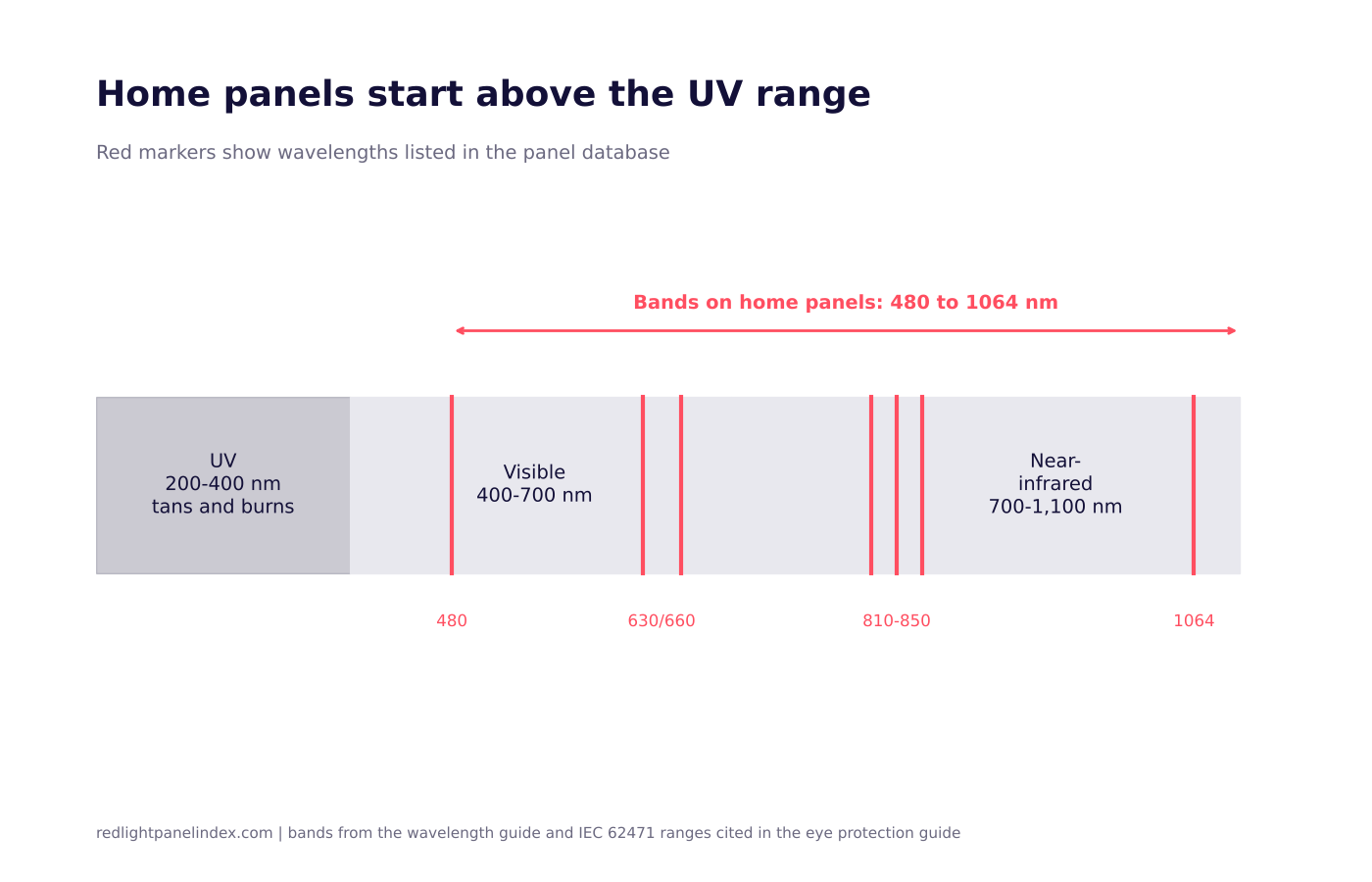
A red or near-infrared light therapy panel does not tan you. Tanning and sunburn come from ultraviolet (UV) light, and home panels are built around red and near-infrared bands that sit well above the UV range, so there is no UV for the skin to react to.
Choosing a panel? Our ranking of the best red light therapy panels is computed from published, method-labeled specs across 188 devices. For the UV question, the spec that matters is the wavelength list: it should show red and near-infrared bands, with no band below the visible range.
Why wavelength settles the question
Light is described by its wavelength, measured in nanometers (nm). A photobiological safety standard cited in our eye protection guide, IEC 62471, places actinic ultraviolet at 200 to 400 nm. That is the band that matters for skin tanning and burning. Visible light starts just above 400 nm, and red light sits at roughly 620 to 700 nm, with near-infrared running from about 700 nm to roughly 1,100 nm.
Compare that with the wavelengths panels actually carry. Our wavelength guide lists the bands found across the 188-panel database: 480 nm blue on 22 panels, 630 nm and 660 nm red, 810, 830 and 850 nm near-infrared, and 1060 to 1064 nm deep infrared on 33 panels. The lowest band on that list, 480 nm, is visible blue, not UV. Every band is above the 400 nm edge of the ultraviolet range, which is why a panel built from those LEDs has no UV output to produce a tan. The photon energy and wavelength page shows the arithmetic behind why UV photons carry roughly twice the energy of red ones.
Because home panels are built around red and near-infrared bands, our photosensitizing medications guide notes that the documented drug reactions are mainly to ultraviolet-A and do not carry over directly. That page is the place to look if you take a medication that increases sun sensitivity.
What the visible glow is
When a panel is running, you see a deep red glow. That is the red LEDs, typically around 630 or 660 nm. Near-infrared bands such as 810, 850 or 1064 nm are not visible to the eye, so a panel with a high share of near-infrared can look dimmer than it is. The glow you see is therefore only part of the output, and it says nothing about UV, because UV is not present in the design.
Two practical consequences:
- A panel that looks bright red is not "stronger" than a dimmer-looking one; the invisible near-infrared share is part of what you receive. See red versus near-infrared for how the two bands differ.
- Looking dim is not a sign the panel is off. Use the manufacturer's indicator or controls to confirm it is running.
What a "red light tanning bed" at a salon usually is
Some salons advertise red light beds near their tanning equipment. In most cases this is an LED bed that uses red and sometimes near-infrared diodes, not a UV tanning bed with a red cosmetic filter. The two are different machines with different lamps. If a listing is unclear, ask the salon directly what wavelengths the bed emits and whether it has any UV lamps. A bed that lists only red and near-infrared LED bands is the same kind of light source as a home panel, only larger.
A bed that has UV lamps will tan skin, and that tan comes from the UV, not from any red light the bed also emits. If you see a tan after sessions in a combined unit, the cause is the UV component.
How to read a listing
Marketing language around beds and panels is loose, so check the specifics rather than the product name. Look for a stated wavelength list; a listing that names only red and near-infrared bands tells you what the light source is. Look for the words "UV" or "ultraviolet" and note whether the unit has separate tanning lamps. Be wary of any listing that promises a tan and "red light benefits" in one session without saying which lamps do which. For a home panel, the model's page in our database shows the wavelengths and how the output is split between them, which is the same check the ranking methodology applies to every brand.
Red light is not a tan substitute
Because red and near-infrared panels cannot produce a tan, they are not a way to darken skin before a vacation or to substitute for a tanning bed. They also should not be treated as a sunscreen or as sun protection: they do nothing to shield skin from UV exposure, and the UV in sunlight or a tanning bed is a separate exposure with separate risks.
Do panels have any skin risks at all?
Yes, though they are different from UV risks. At close range a panel can feel warm, and the dose depends on irradiance and time, so a longer session or a closer distance raises the dose. Our dose calculator shows how irradiance and session length combine, and the distance guide explains how distance changes the delivered dose. Start at the lower end of a conservative protocol and watch how your skin responds.
Eyes are the other consideration. Our eye protection guide explains that the clearest published retinal harm from a consumer LED skin device involved blue light, not red, and that goggles matter most when a panel includes a blue or violet channel, when you treat the face at close range, or when a medication or eye condition changes how the retina handles light. If you are checking a device for a 480 nm channel, the wavelength list on its database page will show it.
A note on heat and glow
Neither the red glow nor a feeling of warmth is a sign of UV, and a tinted heat lamp bulb glows red for a different reason than a panel does (see panel vs infrared heat lamp). Warmth at close range comes from the light being absorbed by skin, and it is the reason the distance and session-length guidance on this site exists. If you ever notice redness that looks like a sunburn after a session, shorten the session, increase the distance, and ask a clinician if it persists.
Quick answers
Can red light therapy give me a tan? No. A red or near-infrared panel emits no UV, and UV is what tans skin.
Can it sunburn me? Not from UV, since there is none. Skin can still feel warm or look pink if a session is too long or too close, so keep to a conservative dose.
Is a red light bed the same as a tanning bed? Not unless it has UV lamps. A red LED bed is the same kind of light source as a panel. Ask what lamps it contains.
Do I still need sunscreen? Red light does not protect against UV, so your normal sun protection habits are unchanged.
Which wavelengths should I look for? That depends on your goal. Start with the wavelength guide and the penetration depth page, then compare models in the ranking.
The short version
Wavelength is the whole answer. UV lives at 200 to 400 nm and tans and burns; red and near-infrared panels operate above it, so they do neither. What they do instead is a separate question, graded condition by condition on our evidence pages, and none of that grading is about tanning.