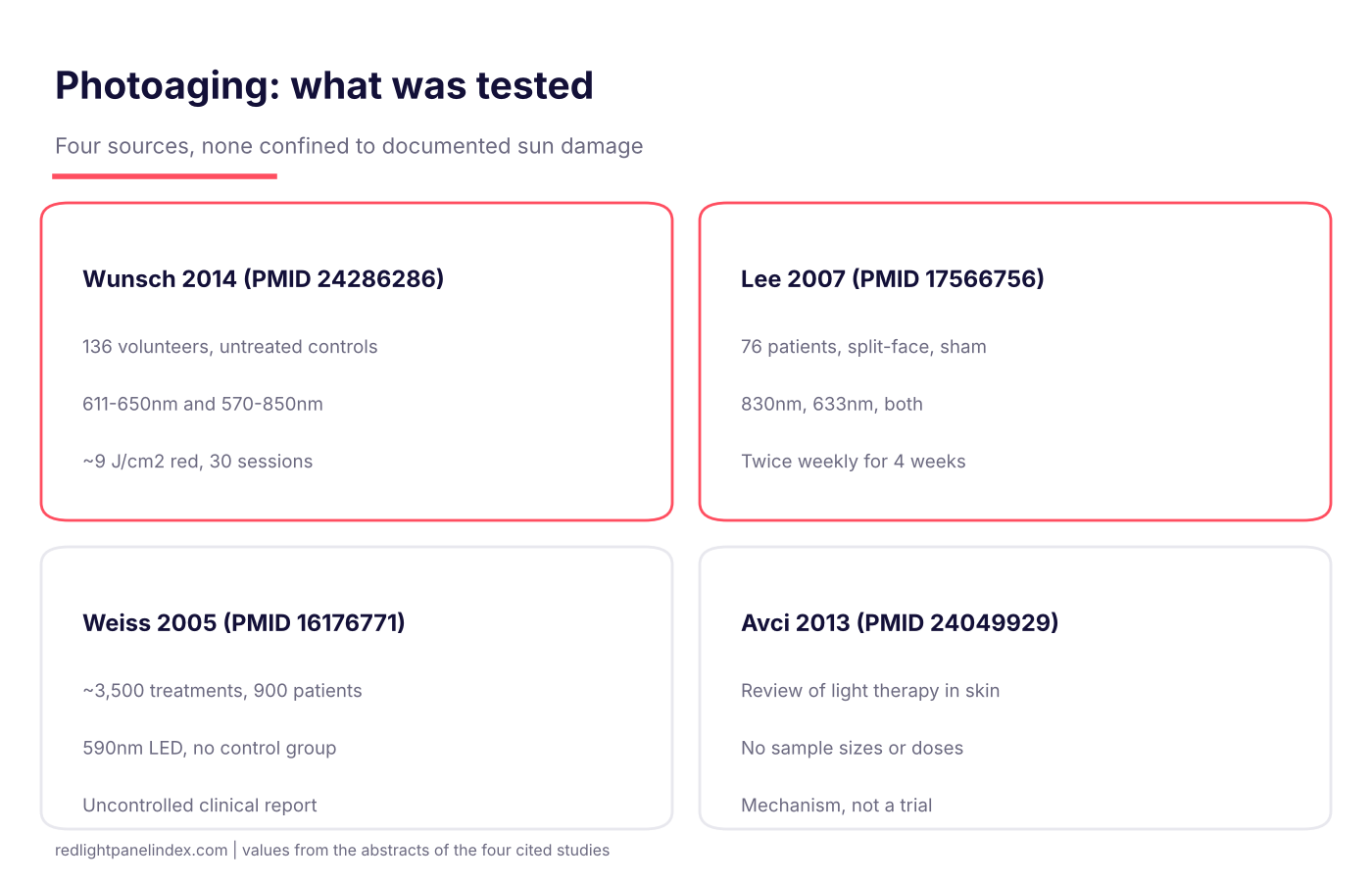
The evidence grade for red light on photoaged, sun-damaged skin is Limited. Controlled trials reported better texture, roughness and collagen measures in people with aging skin (PMID 24286286, PMID 17566756), but the studies describe skin aging in general, none is a trial confined to documented sun damage, and the largest clinical report is an uncontrolled case series (PMID 16176771). This page looks at what each source actually tested, so a buyer can see how far the evidence reaches.
Choosing a panel? Our ranking of the best red light therapy panels is computed from published, method-labeled specs across 188 devices. For photoaged skin, the spec that matters is the published irradiance at 630 to 660nm, because that is the band the skin trials used.
Why the grade is Limited
This site grades evidence as Strong, Moderate, Limited or Insufficient; the evidence grades explained page defines each. The broader skin and anti-aging evidence page grades skin rejuvenation higher, because several controlled studies point the same way. This page is narrower. Photoaging means skin changes caused by accumulated ultraviolet exposure: coarse texture, fine lines, uneven tone and loss of elasticity. Those overlap with ordinary aging, and the studies below enrolled people with aging skin without separating sun damage from the rest. A grade should describe the question asked, and for sun-damaged skin specifically the honest grade is Limited.
What the studies reported
Wunsch and Matuschka, 2014
This is the largest controlled study in the register: 136 volunteers, of whom 113 were randomly assigned to four active groups and 23 were untreated controls (PMID 24286286). Two polychromatic, non-thermal sources built for large-area use were compared. One covered a narrow red band of 611 to 650nm. The other covered a broad 570 to 850nm range. Dose was normalized to about 9 J/cm2 in the red band, and volunteers were treated twice a week for 30 sessions, about fifteen weeks.
Outcomes were blinded evaluation of clinical photographs, ultrasound-measured collagen density, digital profilometry of roughness and patient satisfaction. The abstract reports significant improvement in complexion, skin feel, roughness and collagen density against untreated controls, and no advantage for the broader spectrum over the red band. It gives no percentages, so none are quoted here. The control arm was untreated, not sham, so volunteers knew whether they were receiving light. The site's full review of the Wunsch trial covers the design in more detail.
Lee and colleagues, 2007
A prospective, randomized, placebo-controlled, double-blinded split-face trial enrolled 76 patients with facial wrinkles (PMID 17566756). Arms were 830nm alone, 633nm alone, both together, and a sham light, delivered by LED twice a week for four weeks. The report states objective wrinkle reduction of up to 36 percent and elasticity gain of up to 19 percent in the active groups, and histology showing more collagen and elastic fibers. Those are the best values across groups, not averages, and the dose is not stated, so the result cannot be turned into a session on a panel. The split-face review lists the caveats.
Weiss and colleagues, 2005
This is a clinical-experience report from dermatologic surgery practices, not a trial: about 3,500 treatments in 900 patients over two years using 590nm LED (PMID 16176771). LED alone was used for rejuvenation in more than 300 patients, and in 600 more it was added to other thermal, vascular or ablative treatments. The authors state that LED photomodulation reverses signs of photoaging through a nonthermal mechanism. That is the one source here that uses the word photoaging in its own conclusion, and it is also the weakest design: no control group, no quantitative measures in the abstract, and a wavelength (590nm) that is not the 660nm band most home panels center on.
Avci and colleagues, 2013
A review of low-level light therapy in skin, not a trial (PMID 24049929). The abstract describes red and near-infrared absorption by mitochondrial chromophores, with downstream effects on ATP, nitric oxide, blood flow and signaling, and reports dermatologic uses including wrinkles, scars and burns. It also says the therapy may reduce ultraviolet damage, as treatment and prophylaxis. The abstract reports no sample sizes or doses. It explains why the idea is plausible, which the site's mitochondria and ATP page covers, and it is not evidence that a given panel will reverse sun damage.
What was not studied
- Documented sun damage as the entry criterion. None of the controlled studies selected people by degree of ultraviolet damage or compared sun-exposed with protected skin.
- Skin type. The abstracts do not report skin phototype, and the skin phototype and dosing page notes how little dose data exists across tones.
- Pigmentation and age spots. No source here reports a controlled outcome for sun spots or uneven pigmentation. The Lee summary mentions melanin only in passing.
- Skin cancer or precancerous lesions. Nothing in this evidence addresses them, and red light is not a screening or treatment for them.
- Long follow-up. The trials ran four to fifteen weeks. Whether gains persist after stopping is not reported.
- Home panels. Wunsch used purpose-built sources, Lee a clinical LED setup on half the face, and Weiss a clinic device.
Practical use for a home panel
Treat this as a slow, modest, maintenance-type use, and set expectations to the trial timelines. The most tested pattern is twice a week for about fifteen weeks, as the results timeline guide lays out. Red and near-infrared bands in the trials sit near 630 to 660nm and 830nm, which the 630nm, 660nm and 830nm pages describe.
To plan a session, enter the panel's published irradiance and your working distance into the dose calculator. Wunsch normalized to about 9 J/cm2 in the red band, which is a concrete target. Check how the irradiance figure was measured before trusting it, using the irradiance page, because a solar-meter reading and a spectrometer reading are not interchangeable. The how often guide covers frequency. For a ranked shortlist built on those fields, see the best panels for skin and anti-aging.
Related skin questions have their own pages: the rosacea evidence and the scars evidence each cover a condition where photoaged skin often has overlapping concerns.
Cautions
- Red light is not UV phototherapy and does not replace sun protection (see red light vs UV phototherapy for the difference). If ultraviolet exposure continues, damage continues, and no trial here tested light as a substitute for daily sunscreen.
- Any new, changing or non-healing spot on sun-exposed skin needs a dermatologist, whatever light device you use.
- Some medications and skin products increase light sensitivity; the photosensitizing medications guide lists the main ones.
- Protect your eyes during face sessions, as the eye protection guide explains.
- Results in these studies were gradual. Judging a panel after two weeks is judging it before any trial did.
The summary: red and near-infrared light was associated with better texture and collagen measures in aging skin, and the evidence that it addresses sun damage in particular rests mostly on one uncontrolled report and one review.