A red light therapy session should last as long as it takes your panel's measured irradiance to deliver the dose a published trial actually used, not a fixed number of minutes picked out of habit. That means working backward from a target dose in J/cm2 and a real irradiance figure, the same two inputs this site's dose calculator runs, rather than defaulting to 10 or 20 minutes because that is the number most articles repeat.
Choosing a panel? Our ranking of the best red light therapy panels is computed from published, method-labeled specs across 188 devices. For session length, the spec that matters is the panel's measured irradiance at your actual working distance, since that is the number the formula runs on.
The formula, rearranged for time
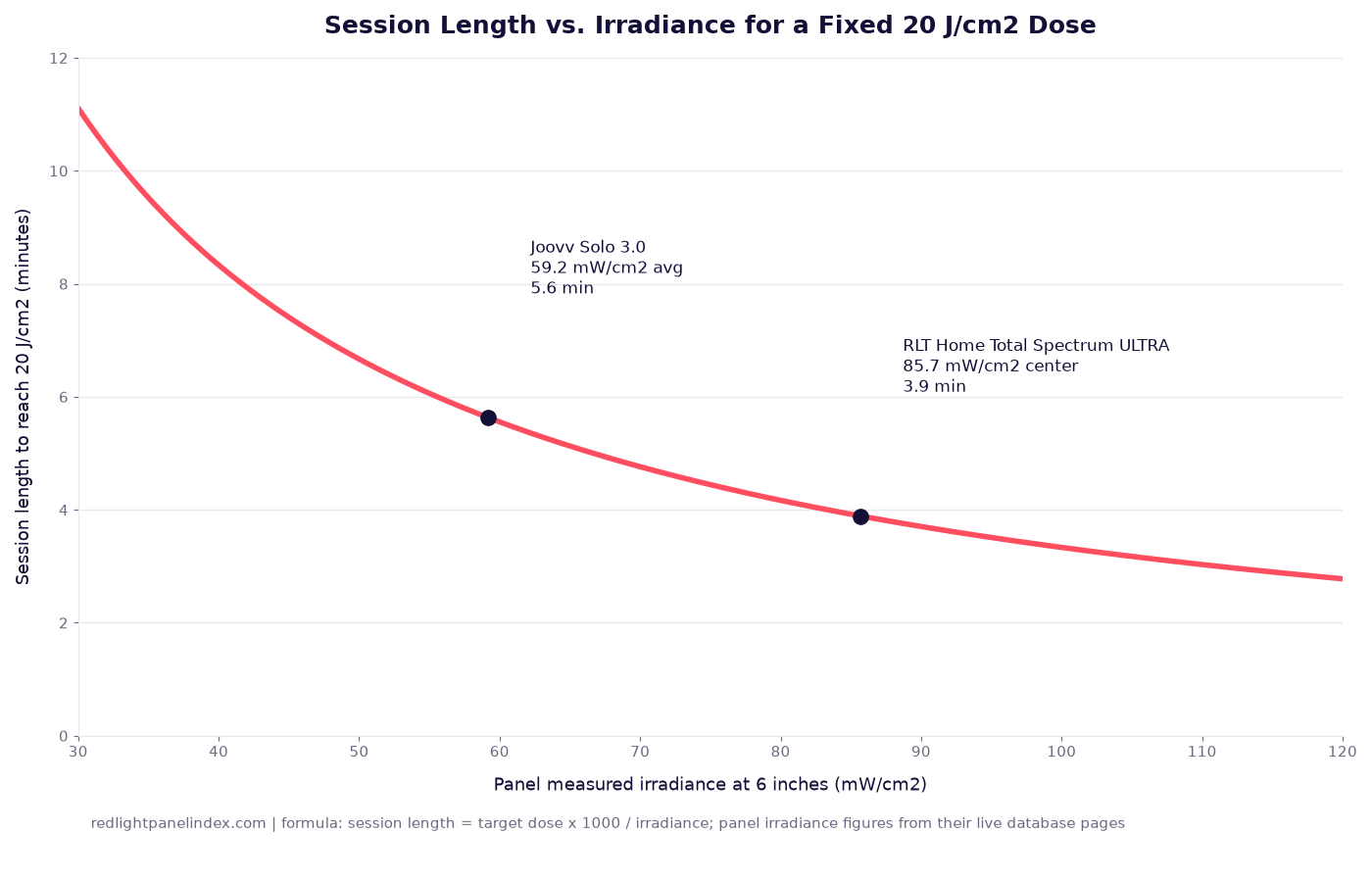
This site's J/cm2 explainer states the dose formula as dose (J/cm2) equals irradiance (mW/cm2) times seconds, divided by 1000. Solved for the variable you actually control, that becomes: session length in seconds equals the target dose times 1000, divided by irradiance. Feed a target dose and a measured irradiance figure into the dose calculator and it returns the session length directly; the two worked examples below just show the arithmetic behind that result.
Two worked examples
Hair-growth target. The RLT Home Total Spectrum ULTRA publishes an independent LightLab International spectrometer reading of 85.7 mW/cm2 (center) at 6 inches. The largest published hair-growth trial this site reviews used a 67 J/cm2 dose per session with a 655nm laser (PMID 24078483; see this site's review of that trial). Reaching the same dose under this panel at 6 inches: 67,000 divided by 85.7 is about 782 seconds, roughly 13 minutes.
Joint or muscle target. The Joovv Solo 3.0 publishes an independent Light Therapy Insiders spectrometer reading of 59.2 mW/cm2 average at 6 inches. Targeting a mid-range 20 J/cm2, inside the dose calculator's commonly studied range for joint pain protocols: 20,000 divided by 59.2 is about 338 seconds, 5 minutes 38 seconds.
Neither example reproduces a trial's exact device or geometry; a laser point and a broad panel do not illuminate tissue the same way even at a matching J/cm2 figure. They show how the same formula, run on a real measured irradiance figure, turns a published dose into a session length you can actually set a timer to.
What changes the target dose itself
The 20 J/cm2 and 67 J/cm2 targets above are not universal numbers; they come from specific trials treating specific tissues. This site's dosing guide lists the range of doses actually used across the trials it tracks, from about 3 J/cm2 in a short diabetic neuropathy protocol up to 25 J/cm2 per session in a whole-body pain trial using a low-irradiance LED bed. Picking a session length starts with picking which of those targets actually matches your goal, since a skin-focused dose and a deeper joint or muscle dose are not interchangeable even when both come from published trials.
Why the irradiance figure has to be real
The session length above is only as good as the irradiance number that goes into it. This site's irradiance page tracks measured figures mostly at 6 inches, because that is the distance most brands choose to publish, and the claimed vs measured page found that across a 44-panel dataset, a brand's own claimed irradiance runs a median 2.18 times higher than an independent spectrometer reading of the same panel. Running the formula above on a claimed figure instead of a measured one would understate the true session length by roughly half. Distance matters just as much: this site's guide to distance covers how quickly irradiance falls off between 6 and 24 inches, so a 6-inch irradiance figure plugged into the calculator while sitting 18 inches away will understate the real session length needed, sometimes badly.
The ceiling not to chase
Extending a session well past the length the formula gives, on the theory that more exposure can only help, runs against the biphasic dose response documented in cell and animal studies of low-level light therapy: benefit rises with dose up to a point, then flattens or reverses (PMID 20011653, PMID 22461763). This site's explainer on that curve covers the mechanism in more depth, and a study review of the two papers behind it walks through exactly what each one found and did not find; the practical takeaway here is narrower: treat the trial-tested dose as the target to hit, not a floor to build on. Neither review sets an exact ceiling in J/cm2 for a home panel, so there is no larger "safe maximum" number to substitute for the trial dose above it, only the caution against assuming longer is automatically better once a working dose is already being delivered.
Adjusting for a bigger or smaller panel
The formula does not change when a panel covers more or less of your body at once; it only changes the irradiance figure you plug in, and even that only if a larger panel actually measures differently than a smaller one at the same distance. A panel that covers your whole back at 85.7 mW/cm2 and a smaller panel that covers only your knee at the same measured irradiance need the same session length to deliver the same J/cm2 dose to the tissue each one is aimed at; panel size changes how much surface area gets treated in one sitting, not how concentrated the light is at any single point on that surface. Treating a bigger panel as though its larger coverage also means a shorter session, without checking whether its irradiance figure is actually higher, is a common way the formula gets applied incorrectly.
Session length is one variable; frequency is another
How long a single session runs and how often you return for another one are separate decisions governed by the same principle. This site's guide to session frequency states it directly: photobiomodulation's biphasic dose response means the effect can flatten and reverse beyond an optimal range, and reports that two properly dosed sessions a week beat seven overdosed ones across the trials it reviews. Setting the right session length under this guide, then following that separate guide's frequency recommendation, covers both variables the dose response depends on.
Putting it together
Start from a target dose that matches your goal, pulled from a real trial rather than a round number; get your panel's measured irradiance at the distance you actually sit, from its database page or your own spectrometer reading; and let the dose calculator turn those two numbers into a session length in minutes and seconds. Hold that session length steady across a full course of weeks, as the dosing guide recommends, rather than adjusting it session to session, and resist stretching it further once it is already delivering the dose a trial used to see a result. This site's beginner's 30-day protocol puts that calculated length into a printable four-week schedule alongside a matching frequency and distance.
If your panel's own database page states more than one measured irradiance figure, from different independent testers or different measurement points on the same panel, use the more conservative of the two for this calculation. A session length built on the higher figure will understate how long you actually need to sit under the panel to reach the same dose, which quietly turns a trial-matched protocol into an under-dosed one without changing anything you can see or feel during the session itself.