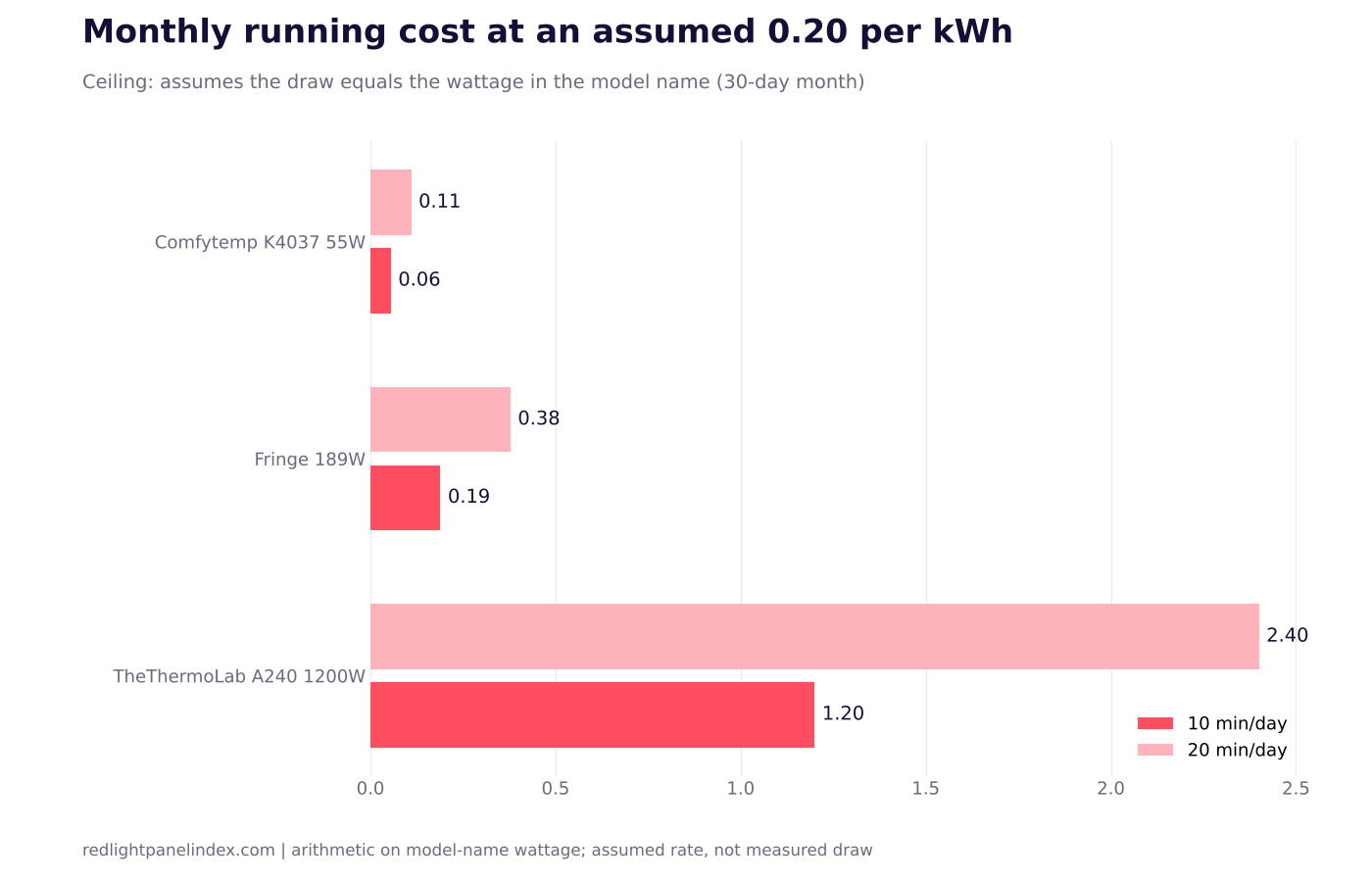
A red light panel costs very little to run: at the wattage in its model name, even a large panel used 10 minutes a day comes to roughly a dollar or two a month at typical household rates, and small panels cost cents. The honest limit is that most brands do not publish a measured wall draw, so every figure below is a ceiling built from the name wattage, not a meter reading.
Choosing a panel? Our ranking of the best red light therapy panels is computed from published, method-labeled specs across 188 devices. For running cost, the spec that matters is the electrical draw the brand actually states, which is rarely the same as the number in the model name.
The formula
Running cost needs three numbers: the draw in watts, the hours of use, and your price per kilowatt-hour (kWh).
- kWh used = watts / 1,000 x hours
- Cost = kWh x your rate per kWh
Your rate is printed on your electricity bill. Because rates vary a great deal by region and by season, this guide does not claim a national average. It uses three round assumptions, 0.10, 0.20 and 0.30 per kWh, in whatever currency your bill uses, so you can find the one closest to yours and read across.
For session length, the guide assumes 10 minutes a day and 20 minutes a day, every day of a 30-day month, which is 5 and 10 hours a month. Those are assumptions for arithmetic, not dosing advice; the dose calculator is the place to work out how long a session should be for a given panel and distance, and the session length guide and frequency guide cover the reasoning.
What wattage to use
This is where a calculation like this usually goes wrong. The wattage in a model name can mean three different things, as the page on optical versus electrical power explains: a rated draw, a sum of the nominal ratings of the LEDs, or a round marketing number. Only the first is what your meter counts.
The database does not hold a measured wall-draw figure for panels. So the examples below take the wattage in the model name as an upper bound and say so. If a manufacturer prints the rated input on the label or in the manual, use that instead; it will usually be the best figure you can get without a plug-in power meter.
The three models used here are the same ones used on the optical-power page, so the figures line up, with prices as shown on the database pages (verified 2026-08-13):
- Comfytemp K4037 55W Panel, $120.
- Fringe Red Light Therapy Panel 189W, $450. The 189W is 63 LEDs at 3W each, a sum of nominal ratings.
- TheThermoLab A240 1200W, $855.
Energy used per month
At the name wattage, the energy used by each model is:
| Model | Name wattage | kWh at 5 h/month (10 min/day) | kWh at 10 h/month (20 min/day) |
|---|---|---|---|
| Comfytemp K4037 55W | 55 W | 0.275 | 0.55 |
| Fringe 189W | 189 W | 0.945 | 1.89 |
| TheThermoLab A240 1200W | 1,200 W | 6.0 | 12.0 |
For comparison, a household's monthly electricity use is normally counted in hundreds of kWh, so even the largest figure in the table is a small slice of a bill.
Cost per session and per month
Cost at 10 minutes a day (5 hours a month), by assumed rate per kWh:
| Model | At 0.10 | At 0.20 | At 0.30 |
|---|---|---|---|
| Comfytemp K4037 55W | 0.03 | 0.06 | 0.08 |
| Fringe 189W | 0.09 | 0.19 | 0.28 |
| TheThermoLab A240 1200W | 0.60 | 1.20 | 1.80 |
Doubling the session to 20 minutes a day doubles every figure. A single 10-minute session at 0.20 per kWh comes to about 0.002 for the 55W panel, 0.006 for the 189W panel and 0.04 for the 1200W panel.
The pattern is easy to see: running cost is proportional to wattage and to time, and the time-and-rate part is small enough that it should never drive the choice between two panels. The purchase price, which is hundreds of dollars on these three pages, dwarfs a year of electricity: even the 1200W model at the highest assumed rate and 20 minutes a day is about 43 a year on these assumptions (3.60 a month).
Why the name wattage is a ceiling
Two things can push the real draw away from the name figure.
First, a nominal LED sum is not a draw. LEDs are often run below their rating, and the power supply adds its own losses. The real draw could be lower than the name, or, for a poorly specified product, the name could be a round number that matches nothing. The database does not let us say which.
Second, the name wattage says nothing about light output. The optical-power page shows that a 55W panel in the database states a higher irradiance (method not given) than a 189W one, so a lower running cost does not mean a weaker panel and a higher one does not mean a stronger one. Judge the light by irradiance and its method, and the electricity bill separately.
When wattage does matter
Running cost is small, but wattage still has three practical consequences:
- Circuit load. A typical US household circuit rated at 15 amps and 120 volts supports 1,800 W (120 x 15). A 1,200 W draw is two-thirds of that on one panel, before anything else on the circuit, so check what else shares the outlet. Rules for continuous loads are stricter than the headline rating; ask an electrician if you are unsure.
- Heat. More wattage that does not become light becomes heat, which matters in a small room or for a panel with fans.
- Voltage. Panels sold for one country's mains may need a converter elsewhere. A dedicated guide on international voltage is planned; until it is live, check the label for the accepted input range.
How to check your own panel
The only way to know the real draw is to measure it. A plug-in power meter (the kind sold for appliances) sits between the wall and the panel and shows watts directly. Run the panel on its normal mode and read the number after a minute, then plug the watts into the formula above. Do it for each mode you use, since some modes run fewer LEDs.
If you cannot measure, use the rated input on the label, and failing that treat the name wattage as the ceiling and the real cost as no higher than the table. Also note that a panel with a larger treatment area typically draws more, and the same session on a bigger panel costs more electricity; it may also let you treat more of the body per minute, so cost per area treated can come out closer than the raw wattage suggests.
Summary
- Cost = watts / 1,000 x hours x rate per kWh.
- At the name wattage and 10 minutes a day, running cost on three database models ranges from a few cents to about 1.80 a month at a high assumed rate.
- Name wattage is an upper bound, not a measurement; the database has no measured draw figure.
- Choose a panel on measured light, price and terms, and use running cost only as a tie-breaker.
- The numbers here are arithmetic on assumed rates and session lengths, general information rather than a quote for your home.