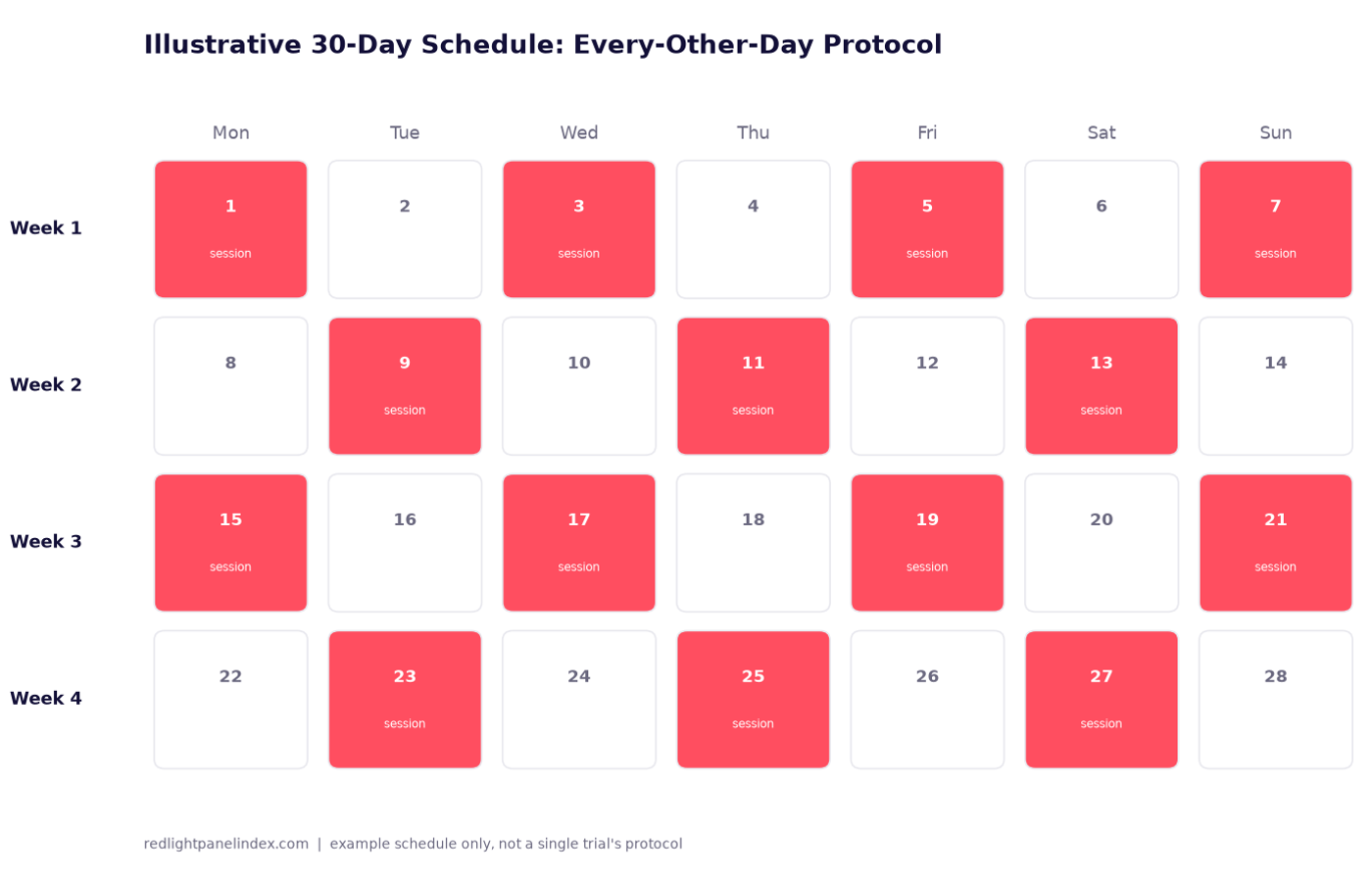
A beginner's 30-day protocol comes down to three numbers set once in week one and held steady for four weeks: a frequency that matches your goal, a session length calculated from your panel's measured irradiance rather than a round number, and a sitting distance you keep consistent from session to session. The plan below turns those three numbers into a printable week-by-week schedule.
Choosing a panel? Our ranking of the best red light therapy panels is computed from published, method-labeled specs across 188 devices. For a beginner protocol, the spec that matters most is a method-labeled irradiance figure at a distance you can actually hold, since that number is what your session length is calculated from.
Week 1: set your three numbers
Before the first session, fix the inputs the rest of the month runs on.
Pick one goal. This site's guide to session frequency reports different frequencies for different goals: about two sessions a week for skin, held for at least four weeks before judging; every other day for hair, sustained across sixteen weeks; every other day to three times a week for joint or muscle pain, in courses of four weeks or more; and nightly, red light only, for sleep. Trying to chase two goals with one schedule in the first month makes it hard to tell what the schedule actually did, so pick the one you care about most and let it set your frequency for the rest of this plan.
Get a real distance and irradiance figure. This site's guide to distance puts most panels' working range between 6 and 24 inches from skin, closer for a spot treatment on one joint or patch of skin, farther for full-body coverage. Pick the distance that matches your goal, then find your panel's database page for a measured irradiance figure at that distance, since brand-claimed numbers typically run well above what an independent spectrometer reads at the same spot.
Calculate a session length, don't guess one. This site's session length guide states the formula plainly: session length in seconds equals a target dose in J/cm2, times 1000, divided by your measured irradiance in mW/cm2. Feed your goal's target dose and your panel's measured irradiance into the dose calculator and it returns a session length in minutes and seconds. Write that number down; it does not need to be recalculated again this month unless you change panels or distance.
Days 1 through 3 or 4 of week one are your first sessions at whatever frequency your goal calls for. Nothing changes yet; you're just confirming the schedule is workable and the sitting distance is comfortable.
The four-week calendar
The table below lays out a full month for each of the four frequencies named on the session frequency guide. Fill in your own start date and check off sessions as you go; the pattern, not the exact calendar dates, is what matters.
| Goal | Week 1 | Week 2 | Week 3 | Week 4 |
|---|---|---|---|---|
| Skin | 2 sessions | 2 sessions | 2 sessions | 2 sessions |
| Hair | Every other day | Every other day | Every other day | Every other day |
| Joint or muscle | Every other day to 3x | Every other day to 3x | Every other day to 3x | Every other day to 3x |
| Sleep | Nightly | Nightly | Nightly | Nightly |
Notice that none of the four rows ramp up. This site's guide to frequency is explicit that "doubling your sessions is not a way to double your results," a caution rooted in the biphasic dose response this site's dose-response explainer covers: benefit from photobiomodulation rises with dose up to a point, then flattens or reverses. A 30-day beginner protocol holds the same frequency and the same session length across all four weeks rather than escalating either one, and treats the trial-based target dose as a target to hit, not a floor to build on.
Week 2: hold the schedule, don't adjust it
By week two the novelty of a new routine has usually worn off, and this is the point where it's tempting to start adjusting: a longer session because a short one "doesn't feel like enough," or a closer distance to feel more warmth. Resist both. This site's session length guide notes that extending a session well past the calculated length, on the theory that more exposure can only help, runs against the same biphasic pattern that governs frequency. If a session at your calculated distance and length feels uncomfortably warm, the distance guide recommends backing off to 10 or 12 inches and lengthening the session rather than pushing through discomfort at the closer distance, then leave both settings fixed again for the rest of the month.
Week 3: this is usually the flattest stretch
Most red light therapy trials tracked by this site's results timeline don't report a visible change at the two-to-three-week mark for goals like skin or joint pain; effects in the underlying research typically build across a full four-week course or longer before they're measurable. Week three is the week most people are tempted to conclude the protocol "isn't working" and either quit or start changing variables. Neither response is supported by how the trials behind this schedule were actually run: the skin frequency above, for instance, comes from protocols judged at four weeks minimum, not at three. Keep the same three numbers from week one and finish the course before drawing a conclusion.
Week 4: finish the course, then decide
At the end of four weeks, compare where you are against the frequency your goal was built on. Skin and joint or muscle protocols on this site's frequency guide are judged at the four-week mark, so this is the point where an honest before-and-after comparison is possible for those two goals. Hair protocols run considerably longer, sixteen weeks in the trial this site's frequency guide draws its schedule from, so a 30-day hair course is one-quarter of the way through a much longer commitment, not a complete trial in itself; the useful decision at day 30 for hair is whether the schedule is sustainable, not whether it has visibly worked yet.
If you're continuing past day 30, the same three numbers from week one carry forward unchanged: recalculate your session length only if you switch panels, change your sitting distance, or your database page updates its measured irradiance figure. If you're stopping or switching goals, start this plan over from week one with the new goal's frequency, since a skin protocol and a joint-pain protocol don't share the same session length target even on the same panel.
Cautions
This protocol is a scheduling framework built from figures published elsewhere on this site, not a substitute for the caution lists on those pages. Check this site's photosensitizing medications guide before starting a nightly or near-daily schedule if you take a medication that increases light sensitivity, and see the safety and side effects page for the general precautions that apply to any light-based routine, including eye protection during a session. None of the frequencies above are a guarantee of a specific result; they describe the schedules used in the research this site reviews, not a promised outcome for any individual using a home panel.