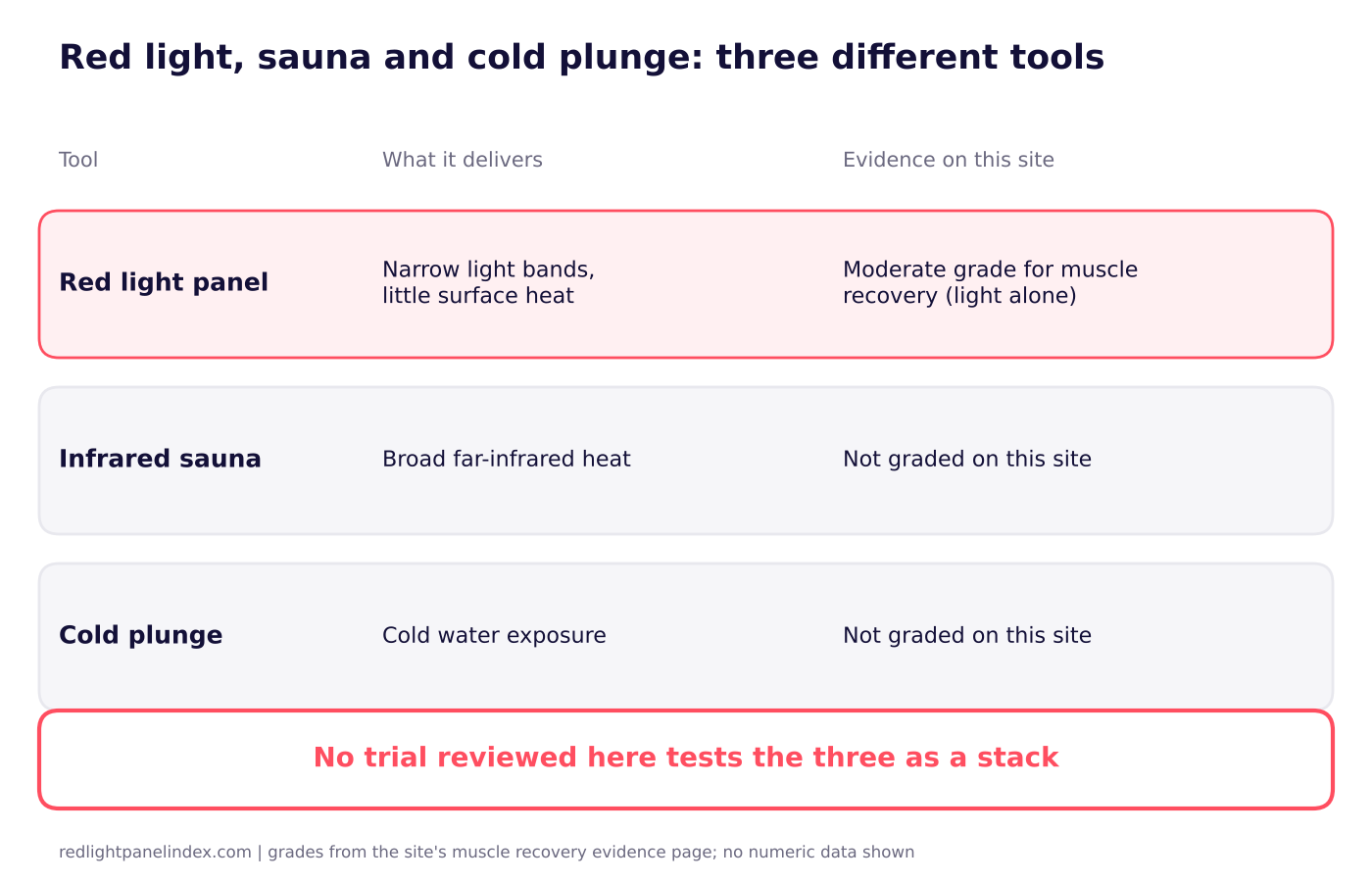
You can use a red light panel on the same day as a sauna or a cold plunge, and a sensible order is panel first on dry skin, then heat, then cold, but no trial has tested that combination, so the order is practical judgment and not a proven protocol. What the evidence does support is narrower: near-infrared light has moderate-grade trial evidence for muscle recovery outcomes on its own, and the other two tools are separate interventions this site does not grade.
Choosing a panel? Our ranking of the best red light therapy panels is computed from published, method-labeled specs across 188 devices. For a recovery routine, the spec that matters is method-labeled irradiance, because it sets how long each session needs to be.
What each tool does
The three tools act through different mechanisms, which is the main reason they are not interchangeable.
| Tool | What it delivers | How the site treats the evidence |
|---|---|---|
| Red and near-infrared panel | Narrow wavelength bands, little surface heat | Graded on the muscle recovery evidence page as Moderate |
| Infrared sauna | Broad far-infrared heat that warms skin and raises core temperature | Not graded here; see panel vs infrared sauna |
| Cold plunge | Cold water exposure | Not graded here |
The panel is proposed to work through light absorption in the mitochondria, a photochemical route covered on the mitochondria and ATP page. A sauna works by heat. A cold plunge works by cold. A sauna does not deliver a photobiomodulation dose, and a panel does not deliver sauna-level heat. Sauna and cold are general physiology that this site does not review, and any claim about them in this guide is limited to what is plain from the nature of heat and cold.
What the evidence covers and what it does not
The muscle recovery page reports trials that paired near-infrared light with exercise and measured soreness and strength recovery, and it calls the research promising but heterogeneous. Pooled pre-exercise data come from the Leal-Junior meta-analysis, and soreness data are on the DOMS evidence page. Those trials studied light alone, or light added to exercise.
None of the pages on this site, and no trial summarized on them, tested:
- red light followed by a sauna session,
- red light followed by a cold plunge,
- all three in one session or one day, against any of them alone.
That is the honest limit. Anyone who tells you a stack has been shown to outperform each part is describing something the trials reviewed here did not measure. The sections below are therefore about practical logistics, with the uncertainty stated.
Ordering logic
Ordering is a common question and there is no tested answer, so use reasoning you can check.
- Panel first, on clean, dry skin. Light reaching the skin is what the session depends on, and sweat, lotion or sunscreen can get in the way. After a sauna your skin is wet and flushed, which makes a poor starting surface. Doing the panel session first avoids that. The same eye-protection and medication cautions apply as always; see the eye protection guide and the photosensitizing medications guide.
- Heat second, if you use it. If you want both, putting the panel before the sauna keeps the panel session comfortable and short, because you are not already overheated and tempted to cut it.
- Cold last, if you use it. Cold after heat is the usual contrast pattern people follow. Keep it separate in your mind from the panel: nothing in the light research depends on cold.
An equally defensible choice is to put the panel session on a different part of the day from the sauna or plunge. That removes the sequencing question altogether and makes it easier to tell which tool you respond to, which matters if you ever want to judge whether the panel is doing anything for you.
How heat and light interact
The honest answer is that this has not been studied as a combination, but two facts are clear from how the devices work.
- A panel adds little heat. The panel vs sauna guide explains that LED panels are photochemical tools with little surface heat at a normal working distance, while sauna heaters emit broad far-infrared that is absorbed at the skin surface. So adding a panel session does not meaningfully add to the heat load of a sauna day.
- Warm skin is not a dose. Being hot does not change the dose the panel delivers. Dose is irradiance times time, and the dose calculator works that out from your panel's measured output and your distance. Heat only changes how comfortable the session is.
One real interaction is practical: heat and cold both change how your body feels afterward, so if you feel faint or lightheaded after a sauna or a cold plunge, that is a reason to stop and rest, not to start a panel session at all.
A simple way to run it
Use the panel the way the rest of the site describes, and treat sauna and cold as separate additions you choose for your own reasons.
- Panel session: use your trial-based target dose and your panel's measured irradiance. The session length guide and the distance guide cover the numbers. The 30-day protocol shows how to hold distance and session length steady for four weeks.
- Exercise timing: the before or after a workout guide covers when light fits around training. Pre-exercise use has the more consistent evidence for in-session performance, and post-exercise use has thinner, mixed evidence for soreness.
- Frequency: more sessions are not better. See how often to use red light therapy and the biphasic dose response page for why doubling sessions does not double results.
- One change at a time. If you add a sauna or a plunge to a routine that already includes a panel, change one thing every few weeks. Otherwise you cannot tell which change you are noticing.
Which panel suits a recovery routine
For recovery routines, coverage and near-infrared output matter most. The athlete recovery panel ranking compares models on method-labeled irradiance, wavelength mix, coverage, price with a verification date, and warranty and trial terms. Our methodology page, "how rankings work," explains the criteria. A panel with enough area to cover the working muscle group and a stated near-infrared band is the practical starting point. The targeted vs full panel guide helps you size that choice.
Cautions
- Medical conditions. Sauna and cold plunge both stress the cardiovascular system. If you have heart, blood pressure or circulation concerns, are pregnant, or take medications that affect heat or cold tolerance, ask a clinician before using either. This site does not review them.
- Hydration and alcohol. Heat and cold are poor companions for dehydration or alcohol.
- Never use a panel while overheated or unwell. A hot, dizzy session cut short is better than a full one pushed through.
- Eyes. Protect your eyes from panel output as described in the eye protection guide.
- No stacking claims. If a product page says its stack is clinically proven, look for the trial. For red light plus sauna plus cold, this site found none.
- Light conditions. Check the safety and side effects page for skin and medication cautions.
Bottom line
Use the panel for what it has evidence for, near-infrared light and muscle recovery at a calculated dose, and treat sauna and cold plunge as separate tools you add for your own reasons. A sensible order is panel first on dry skin, then heat, then cold, or panel on its own at a different time of day. That order is practical judgment, because no trial has tested the stack.