1064nm is a deep near-infrared wavelength that the published research tied to it has tested with lasers, not with home LED panels, and only two brands in the site's database give it a meaningful share of their LEDs. If you are considering a panel for this band, the questions that matter are how much of the output sits at 1064nm and whether the research you are relying on used anything like a panel.
Choosing a panel? Our ranking of the best red light therapy panels is computed from published, method-labeled specs across 188 devices. For 1064nm, the spec that matters is the share of LEDs assigned to that band, together with the method behind the irradiance figure.
What 1064nm is
1064nm sits at the far end of the near-infrared range that home panels use, beyond the more common 810nm, 830nm and 850nm bands. It is the wavelength of a widely used type of laser, the Nd:YAG, which is why most of the human research on it comes from laser devices. For a side-by-side look at it against the standard near-infrared band, see 850nm versus 1064nm.
Longer is not simply deeper. Tissue is mostly water, and water absorbs infrared light more strongly as wavelength increases, so any claim that 1064nm "goes deepest" needs a caveat (see the optical window for where the band sits between pigment and water absorption). The site's penetration depth page covers what modeled penetration figures do and do not show, and this page does not attach a depth number to 1064nm because the site's sources do not support one.
What the research covers
Two studies are the usual reference points, and both used lasers.
The first is a controlled study in healthy volunteers that applied a 1064nm laser to the forehead and tested attention, memory and mood. Its abstract reports a laser diode delivering 250 mW/cm2 and a fluence of 60 J/cm2, with 20 people in the treated group and 20 in a placebo control group (PMID 23200785). The site has a full study review of that trial, including what it does and does not say about a home panel.
The second is a randomized trial from 2025 comparing a 1064nm Nd:YAG laser with an injection of epidermal growth factor in patients with painful jaw muscle disorder, treated over four weekly sessions (PMID 39912963). The abstract reports that pain fell in both groups and that the two treatments did not differ significantly on pain, pain-free opening or quality of life; only the laser group showed a significant gain in maximum opening. The paper lists a small sample and a three-month follow-up as limitations. The laser was a clinical Nd:YAG device with a stated spot size and pulse settings, applied in a stamping technique over the chewing muscles. That is a clinician's procedure, not a panel session.
Neither study tested a panel, and neither supports a claim that a panel with a 1064nm band reproduces its results. The site's brain and mood evidence page grades that area Insufficient, and the same caution applies to the band.
What home panels offer
The site's deep-tissue 1064nm ranking names two models that clear its criteria for density of 1064nm. The ranking is built on the same fields used for every brand; see how rankings work.
| Model | 1064nm share | Irradiance and method | Price |
|---|---|---|---|
| Helio Blaze | 16.7% of LEDs | 71 mW/cm2 at 6 in, a manufacturer claim; the database page notes only another variant was spectrometer tested | $2,799, verified September 2026 |
| RLT Home Total Spectrum MAX | 14% of LEDs | 100.53 mW/cm2 at 6 in, spectrometer measurement (Electropossible Ltd, HP350IR) | $1,795, verified September 12, 2026 |
The two irradiance figures use different methods, so they are not directly comparable, and both are totals across all wavelengths, not the 1064nm portion alone. The irradiance explainer covers why the label matters. Both pages show the band as one of six or seven in the mix. Several other brands list a band near 1064nm at densities too low to qualify, so a spec sheet that merely says "includes 1064nm" tells you very little.
Why the share matters more than the label
A panel's LED mix is the closest thing a spec sheet has to a statement about where its output goes. On the Total Spectrum MAX the page lists 480nm at 6%, 630nm at 19%, 660nm at 19%, 810nm at 19%, 830nm at 14%, 850nm at 9% and 1064nm at 14%. That means 1064nm gets a larger share than 850nm on that panel, which is unusual. It is still a share of LEDs, and LEDs at different wavelengths do not all emit the same power, so the share is a guide and not a measurement of delivered 1064nm energy. The Helio Blaze page lists 630nm, 660nm and 810nm at 20% each, 830nm at 13.3%, 850nm at 10% and 1064nm at 16.7%.
The practical consequence is that a panel marketed for "deep infrared" can only deliver what its mix allows. If you want the red and near-infrared bands with the strongest published trial base, the wavelength pages for 810nm and 830nm are the better place to start, and the dose calculator lets you compare sessions across panels on equal terms.
Worked example: the gap to the laser trial
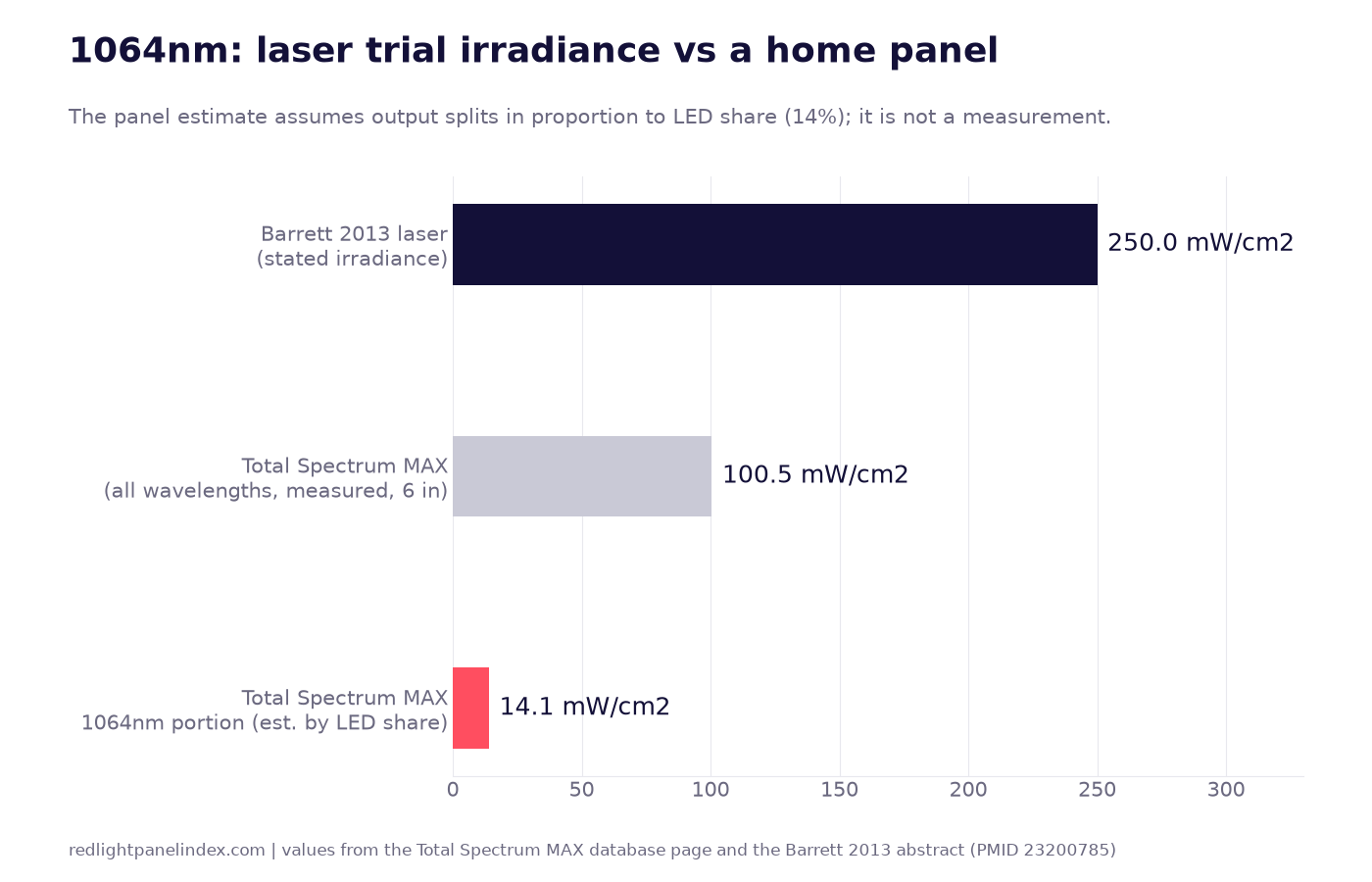
Take the Total Spectrum MAX. Its page lists 100.53 mW/cm2 at 6 inches and a 14% LED share at 1064nm. If output were split in proportion to LED share, which is an assumption and not a measurement, the 1064nm portion would be about 14 mW/cm2.
The laser study stated 250 mW/cm2 and 60 J/cm2. At 250 mW/cm2, 60 J/cm2 corresponds to 240 seconds, or four minutes (60 J/cm2 divided by 0.25 W/cm2). At about 14 mW/cm2, reaching 60 J/cm2 of 1064nm would take roughly 4,300 seconds, or about 71 minutes, and that would be at the panel's surface-level figure at 6 inches, over a body-sized area rather than a forehead spot. The dose calculator does this arithmetic for any irradiance, distance and time. It tells you the dose, not whether the dose is appropriate for you, and the same fluence from a different device is not the same exposure.
How to read a 1064nm claim
- Look for the share. A band present on a few percent of the LEDs contributes little energy.
- Check the method and distance. A measured figure at 6 inches and an unlabeled claim are different grades of evidence.
- Ask what the band is for. If the reason is a study, find out whether the study used a laser, a head-mounted device or a panel.
- Weigh the price. The two qualifying models differ by about a thousand dollars, and the extra band is one input among several, alongside coverage, warranty and trial terms.
Cautions
Nothing here is a reason to expect a specific effect. Infrared light on or near the head also raises eye-safety questions; read the site's eye protection guide before using any panel near the face. People with a medical condition, a history of seizures, or who take photosensitizing medication should speak with a clinician first.
What to take from this
1064nm is a legitimate research wavelength, but the research is laser research. For a home panel, treat the band as an optional extra worth paying for only when it has a meaningful LED share, a labeled irradiance figure and a use case you have thought through. For most readers the better-supported near-infrared bands, covered on the 810nm and 830nm pages, deliver the same practical benefit of a deeper-reaching band at a far larger share of output.