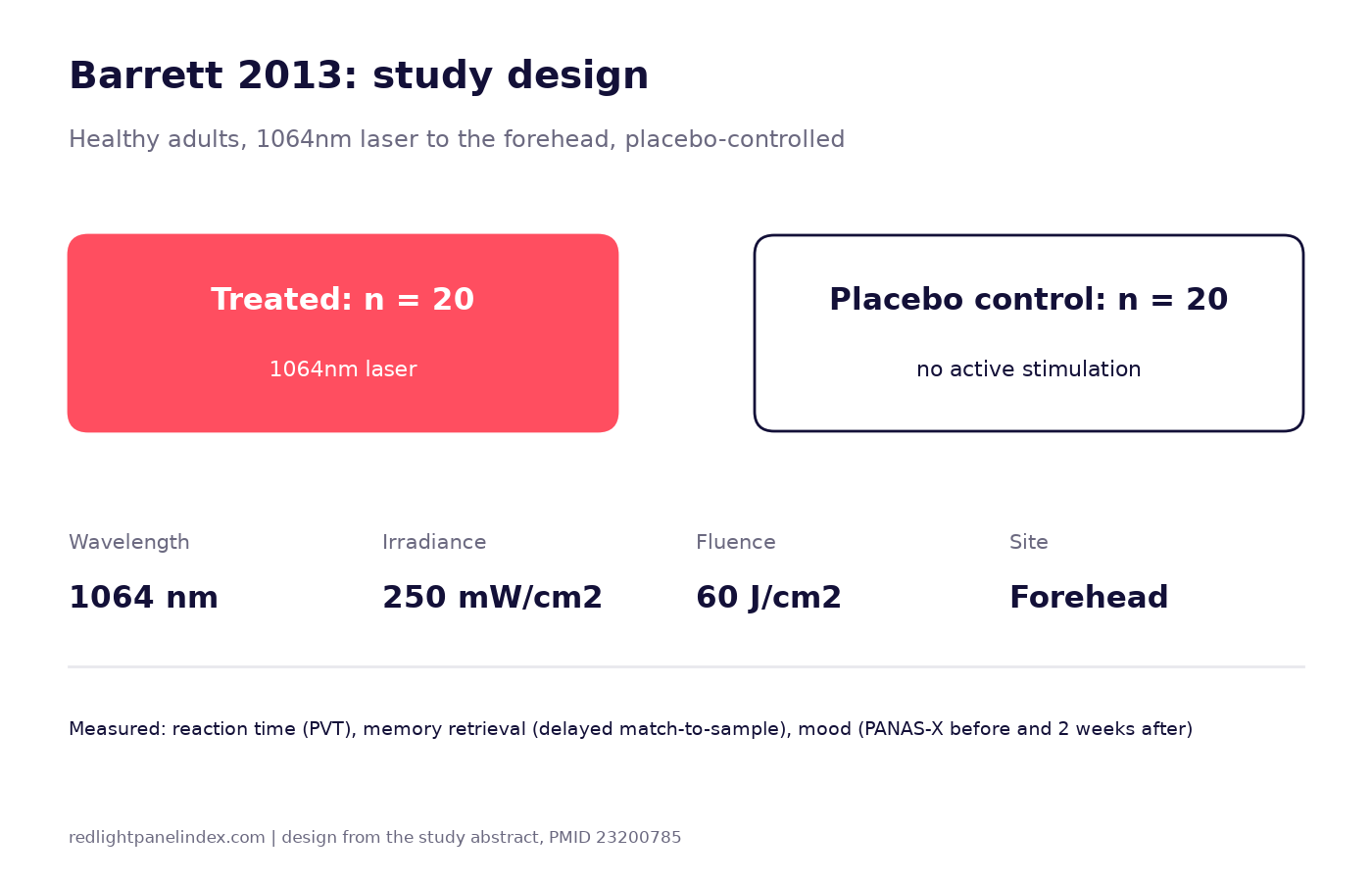
A 2013 placebo-controlled study applied a 1064nm laser to the forehead of healthy adults and reported better performance on an attention task and a memory task in the treated group (PMID 23200785). It is a laser trial at a stated dose in 40 healthy people, so it is useful background for the 1064nm conversation and weak support for any claim about a home panel.
Choosing a panel? Our ranking of the best red light therapy panels is computed from published, method-labeled specs across 188 devices. For a study like this one, the spec that matters is irradiance at 1064nm, with the measurement method stated.
What the study asked
The authors, Barrett and Gonzalez-Lima, tested whether low-level laser stimulation of the forehead produces beneficial effects on frontal cortex measures of attention, memory and mood in healthy volunteers. They describe it as the first controlled study of this kind in humans. The wavelength was chosen because 1064nm is a near-infrared band associated with deep tissue reach; the site's 1064nm explainer covers why longer is not simply deeper.
Who was studied
Healthy volunteers: 20 in the treated group and 20 in a placebo control group, 40 in total. The abstract notes that the reaction-time effect was strongest in people with high novelty-seeking scores. It is not a trial in a patient population, and it does not address any condition that needs treating.
Device and parameters as stated
The abstract gives a 1064nm laser diode, an irradiance of 250 mW/cm2 and a fluence of 60 J/cm2, applied to the forehead. Dividing the fluence by the irradiance gives 240 seconds, so the exposure per site implied by those two figures is about four minutes. Details such as spot size and session count were not available to this review from the abstract, so none are given here. To check the same arithmetic for any panel, use the dose calculator.
What was measured and found
Three outcomes are reported in the abstract:
- Sustained attention. Reaction time in a psychomotor vigilance task (PVT) was significantly better in the treated group than in the placebo group.
- Memory. In a delayed match-to-sample task, the treated group showed significant improvement in memory retrieval latency and in the number of correct trials.
- Mood. Mood was tracked with the Positive and Negative Affect Schedule (PANAS-X), given immediately before treatment and two weeks after it. The mood findings are not reproduced here because the review could not read them in the abstract.
No effect sizes or percentages are quoted on this page, because none were available from the text this review read.
Limitations
- Small sample. Twenty people per group is enough to report a significant difference but not enough to tell how large or how durable the effect is.
- Healthy volunteers only. Results in healthy adults do not carry over to people with a condition.
- Short follow-up. The mood measure was taken at two weeks.
- Outcome choice. The subgroup finding for high novelty-seeking people is a secondary observation and should be read as such.
- Single laboratory. The site's brain and mood evidence page grades the whole area Insufficient, in part because the supporting studies are few and small. Related small trials on the site include a single-session forehead pilot in depression and the ELATED-2 sham-controlled trial.
Why a laser study is hard to translate
Three differences separate this trial from a panel session. The first is irradiance: the laser stated 250 mW/cm2, while the panels in the database report totals in the tens to low hundreds of mW/cm2 across all wavelengths. The second is area: a laser delivers its beam to a defined spot, whereas a panel spreads output over a body-sized area, so even a matching irradiance would deliver different energy to the forehead. The third is how the number was obtained: a laser's stated output and a panel's spectrometer reading are different kinds of figure, which is why the irradiance explainer treats the measurement method as part of the value. A study that reports a dose from a laser calibration cannot be matched to a panel by comparing the two headline numbers alone. None of these differences proves a panel cannot do anything; they mean the study cannot be used to say that it does.
Questions the study leaves open
Readers often ask whether one session is enough or whether people should repeat it.
The abstract does not tell a reader how long the effect lasts, whether repeated sessions change it, or whether the improvement would appear in people with lower baseline performance. It also does not show that the wavelength was the active ingredient: a trial that used 810nm or 850nm at the same dose would be needed to say that. The site's 810nm explainer covers the near-infrared band that most transcranial research has used, and the 850nm versus 1064nm comparison lays out how the two bands differ in panels.
What this means for a home panel
The trial device was a laser diode delivering 250 mW/cm2 to the forehead. The two panels in the database with a meaningful 1064nm share, the Helio Blaze and the RLT Home Total Spectrum MAX, list 71 mW/cm2 (a manufacturer claim) and 100.53 mW/cm2 (spectrometer measurement) at 6 inches respectively, and those are totals across every wavelength on the panel, with 1064nm at 16.7% and 14% of LEDs. If the MAX split its output in proportion to LED share, which is an assumption, its 1064nm portion would be about 14 mW/cm2, around one eighteenth of the laser's irradiance, and spread over a much larger area. Matching the study's 60 J/cm2 at that level would take over an hour.
So the honest reading is that the study shows a wavelength was active in a laser protocol, not that a panel session delivers the same exposure. The deep-tissue 1064nm ranking compares those two models on method-labeled fields, and nobody should buy a panel expecting this study's result. Do not point a panel at the head without reading the site's eye protection guide, and talk to a clinician before using light for any mood or cognitive concern.