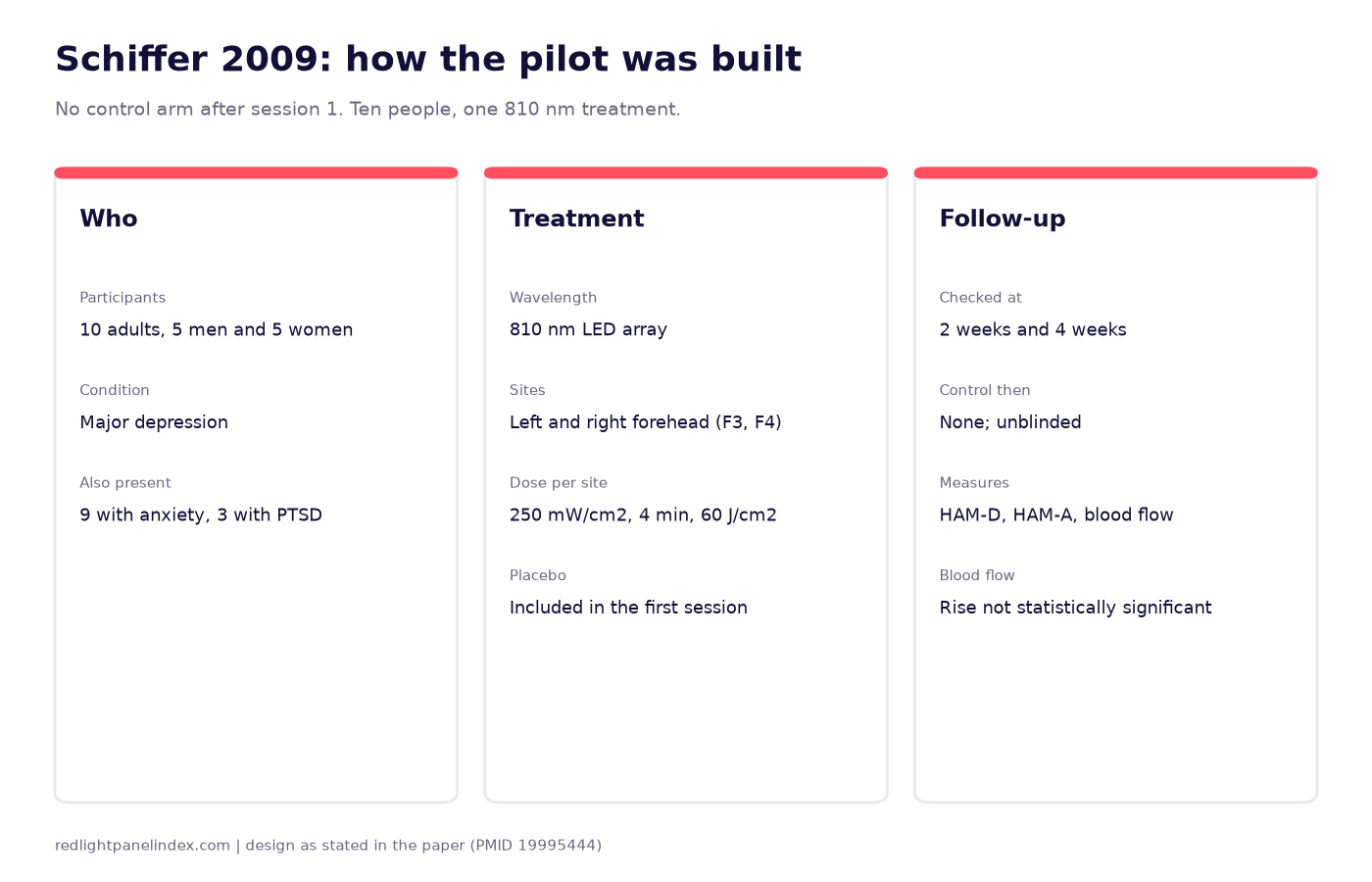
A 2009 pilot study of 10 patients with major depression gave a single treatment of 810nm near-infrared light to the forehead and followed them for 4 weeks; at 2 weeks, 6 of 10 met a remission cutoff on the Hamilton depression scale (PMID 19995444). It is a small study with no control group at follow-up, so it is best read as a reason to run bigger trials and not as evidence that the light worked.
Choosing a panel? Our ranking of the best red light therapy panels is computed from published, method-labeled specs across 188 devices. For a study like this one, the spec that matters is irradiance at a stated distance, because the trial reported its dose at 4 millimeters from the skin.
What the study asked
The pilot asked a narrow question: after one near-infrared treatment to the forehead, do depression and anxiety scores change over the next few weeks, and does blood flow in the brain change? Its title describes psychological benefits 2 and 4 weeks after a single treatment. It was designed as a first look, to decide whether a larger trial was justified.
Who was studied
Ten adults, five men and five women, all with major depression. Nine also had anxiety, seven had a past history of substance abuse and three had post-traumatic stress disorder. These are people with complicated histories, which is useful for seeing whether anything happens, and makes the group hard to generalize from.
Device and parameters as the paper states them
According to the paper, the device was an LED array emitting 810nm near-infrared light. It was applied to the forehead at the left and right sites known as F3 and F4 in the standard EEG placement system. The irradiance at the skin, at a distance of about 4 mm, was 250 mW/cm2. Each site was treated for 4 minutes, which gives a fluence of 60 J/cm2 per site. The paper estimates that only a small fraction of that, about 2.1 J/cm2, reached the brain, based on an assumed 3.7 percent penetration; that is an estimate from the authors, not a measurement in these patients.
The first session included a placebo condition in random order, which is how the study could compare active light with placebo at the start. The 2 and 4 week checks came after that.
What was measured and what was found
Mood was tracked with the Hamilton depression scale (HAM-D) and the Hamilton anxiety scale (HAM-A), plus a measure of regional cerebral blood flow. The abstract reports that at 2 weeks after treatment, 6 of 10 patients had a remission, defined as a score of 10 or less, on the HAM-D, and 7 of 10 reached that level on the HAM-A.
The blood flow result is weaker. The authors report that the increase in regional cerebral blood flow did not reach statistical significance. They also note that some of their secondary findings were sensitive to how the outcome was measured and did not hold for every measure. Only the figures above come from the abstract, and this page does not add any percentage the paper does not report.
Limitations
The authors name several:
- Sample size. Ten patients is too few to represent the wider population of people with depression.
- Design. The 2 and 4 week outcomes were not placebo-controlled, and follow-up was unblinded, so expectation and natural change cannot be separated from the light.
- Mechanism. The authors write that how near-infrared light might improve mood is not understood.
- Blood flow. The blood flow increase was not statistically significant.
- Next step. They call for double blind, randomized, placebo-controlled trials before any clinical use.
From the writer's side, add that depression scores often fall over weeks in untreated groups too, and that remission thresholds on a 10-person group can move with one or two people. Six of ten sounds large; it is six people.
Why it still matters
This pilot is cited because it came early and used a dose that later work did not copy. A 2018 sham-controlled trial, ELATED-2, used 823 nm at 36.2 mW/cm2 for 20 to 30 minutes, twice a week for 8 weeks (PMID 30346890). The two studies differ in wavelength, irradiance, session time and design, so the second is not a replication of the first. The condition page on transcranial light and depression sets them side by side and grades the combined evidence Limited. The trial itself is reviewed in the ELATED-2 study review.
What this means for a home panel
The gap between this trial's device and a panel is large, and it is worth stating plainly.
- Irradiance. The pilot delivered 250 mW/cm2 at about 4 mm. Panel specs are usually given at several inches, and the irradiance explainer shows why a number without a method cannot be compared. Many panels deliver a fraction of that figure at the distance people actually sit.
- Area and target. The pilot treated two forehead sites. A panel lights a large area, and most of its output does not land on the sites the study used.
- Wavelength share. 810nm was the whole output of the trial device. On a panel it may be one band among several, a point the 810nm page illustrates with database figures.
- Dose. To see what a panel session adds up to, the dose calculator converts irradiance and minutes into J/cm2. Compare the result to the trial's 60 J/cm2 per site, keeping in mind that the paper itself estimated only a small share reached the brain.
- Depth. The penetration depth page explains why modeled penetration figures are ceilings.
A panel is not a validated stand-in for the trial device, and one session on 10 people is not a basis for using it for mood. Anyone with depression should talk to a clinician, and the brain and mood evidence page says the same. For a different kind of light and mood question, the whole-body red light and sleep study is also reviewed here. Because the light is near-infrared and invisible, read the eye protection guide before aiming anything at the forehead.