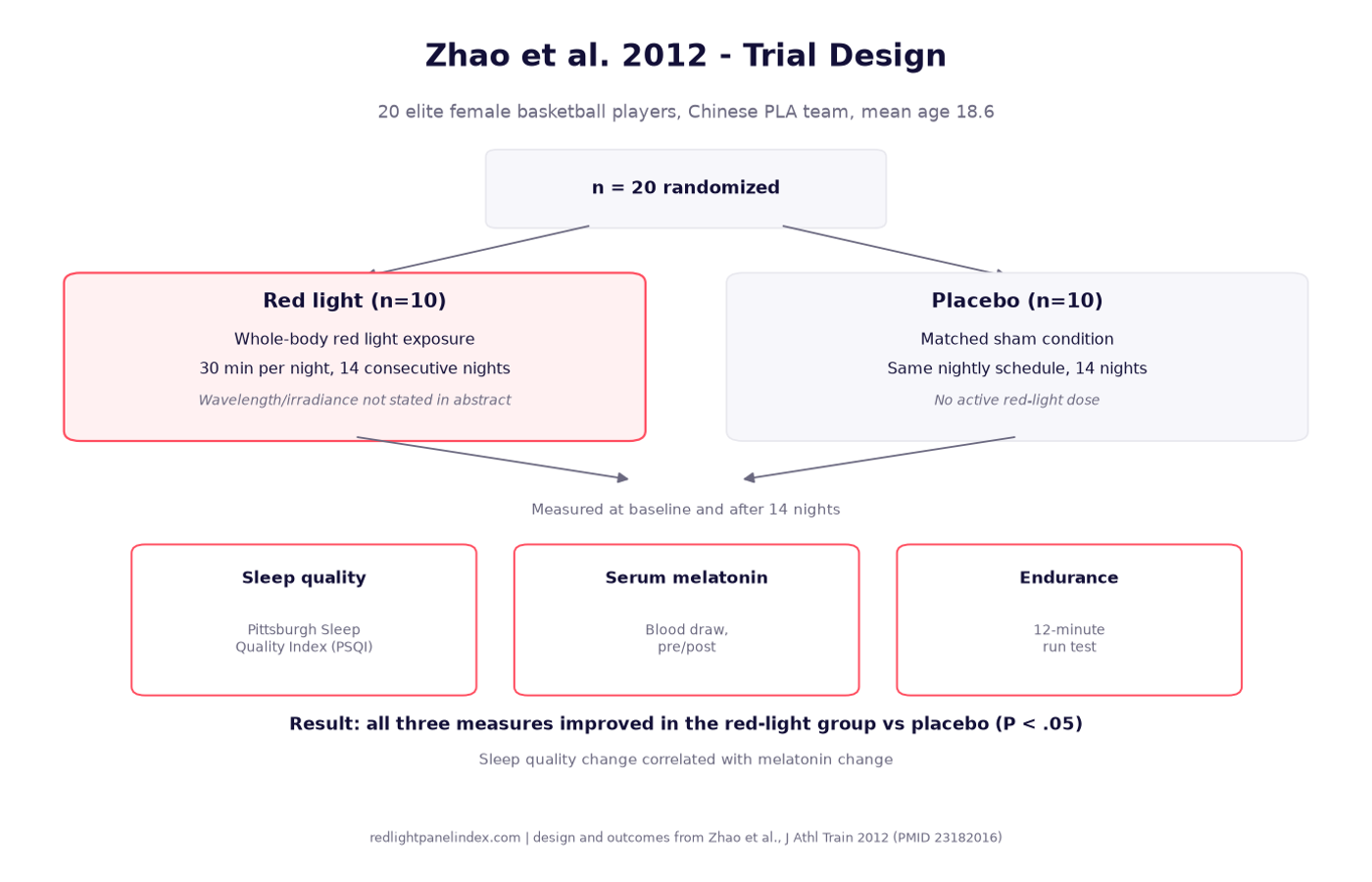
A small placebo-controlled trial published in 2012 found that elite female basketball players who received 30 minutes of whole-body red light exposure nightly for 14 nights reported better sleep quality and higher serum melatonin than a matched placebo group, alongside better endurance test results (PMID 23182016). It is the only whole-body red-light sleep trial in this site's evidence register, and it is worth reading past the headline because the device, the population and the dose are all a long way from a wall-mounted home panel.
Choosing a panel? Our ranking of the best red light therapy panels is computed from published, method-labeled specs across 188 devices. For sleep specifically, the spec that matters is whether a wavelength and irradiance are even named, since this trial does not name either.
What the study asked
Athletic training staff had observed, informally, that some athletes slept better after light exposure, but the mechanism worth testing was whether whole-body red light could measurably shift two things known to move together in sleep physiology: subjective sleep quality and serum melatonin, the hormone most directly tied to the body's sleep-wake signal. Zhao and colleagues set out to test that link directly in athletes recovering from heavy training, using a placebo-controlled design so any change could be attributed to the light exposure itself rather than to expectation, training load, or the natural rhythm of a competitive season.
Who was studied
Twenty elite female basketball players from a Chinese People's Liberation Army team took part, with a mean age of about 18.6 years. The group was split evenly: 10 athletes received red-light treatment and 10 received a placebo condition on the same schedule. This is a young, highly trained, single-sex population under a fixed training and competition schedule, which is a very different starting point from an adult using a panel at home for general sleep support.
Device and parameters, as stated
The abstract describes a whole-body red-light exposure delivered nightly for 30 minutes per session, over 14 consecutive nights, compared with a matched placebo condition on the same schedule. The publicly readable abstract does not state a wavelength, an irradiance figure, or a delivered dose in J/cm², so none of those numbers can be reported here; a study review only states what the paper itself states, and inventing a wavelength or dose to fill the gap would misrepresent the trial. What is clear is the exposure geometry: whole-body, not a single body part, which is itself a meaningfully different setup from a panel aimed at one region of skin. Anyone trying to estimate a comparable home dose from this trial has to start from the dose calculator with an assumed distance and irradiance, not from a number this paper actually reports.
What was measured and what was found
Three outcomes were tracked at baseline and again after the 14-night protocol: sleep quality using the Pittsburgh Sleep Quality Index, serum melatonin from a blood draw, and endurance performance using a 12-minute run test. The paper reports that the red-light group showed improved sleep quality, higher serum melatonin, and better endurance performance than the placebo group, a difference the authors describe as statistically significant (P < .05), and that the change in sleep quality correlated with the change in melatonin. No specific score values, percentage changes, or effect sizes are given in the publicly available abstract, so this review reports direction and significance only, not magnitude.
Limitations
The sample is small: 10 athletes per arm is enough to detect a real effect if that effect is fairly large and consistent, but it is not a sample that supports confident generalization beyond the population studied. The population itself is a limitation for anyone outside it; elite athletes in heavy training have different sleep pressure, hormone patterns, and recovery needs than a general adult population, so an effect seen here may or may not show up the same way in someone who is not training at a competitive level. The missing device parameters are also a real gap: without a stated wavelength or irradiance, this trial cannot be compared directly against any specific panel's specs, and it cannot be replicated by a reader who wants to match the protocol. The 14-night window is short, and the paper does not report whether the sleep or melatonin changes persisted after treatment stopped. Finally, a whole-body chamber is not a commercially available home device in the way a panel is, so even a reader who wanted to reproduce this exact protocol at home has no direct product to point to.
What this means for a home panel
The honest gap here is bigger than in most study reviews on this site. This trial does not name a wavelength, so it says nothing about whether a panel's mix of red or near-infrared wavelengths is the right match for a sleep effect, and it does not name an irradiance or dose, so it cannot be used to size a session length on any specific panel. What it does show is that red light delivered broadly across the body at night, in a controlled comparison against placebo, was associated with better sleep quality and higher melatonin in this specific population, which is a modest but real data point in favor of the general idea that red light in the evening does not carry the same melatonin-suppressing effect that blue light does.
That is a narrower claim than "red light improves sleep." The sleep evidence page grades the overall trial base for sleep as Limited for exactly this reason: this trial and one other are the whole of the direct evidence, both are small, and neither maps cleanly onto a specific home panel's wavelength or dose. A reader using a panel at home for sleep is extrapolating from a whole-body chamber with unstated parameters to a flat panel used at a working distance for a fraction of the session length, which is a real difference, not a technicality. Red light therapy is not treatment for insomnia or any diagnosed sleep disorder, and this trial does not claim otherwise; it reports an association in a specific, narrow population, and that is what a reader should take from it.