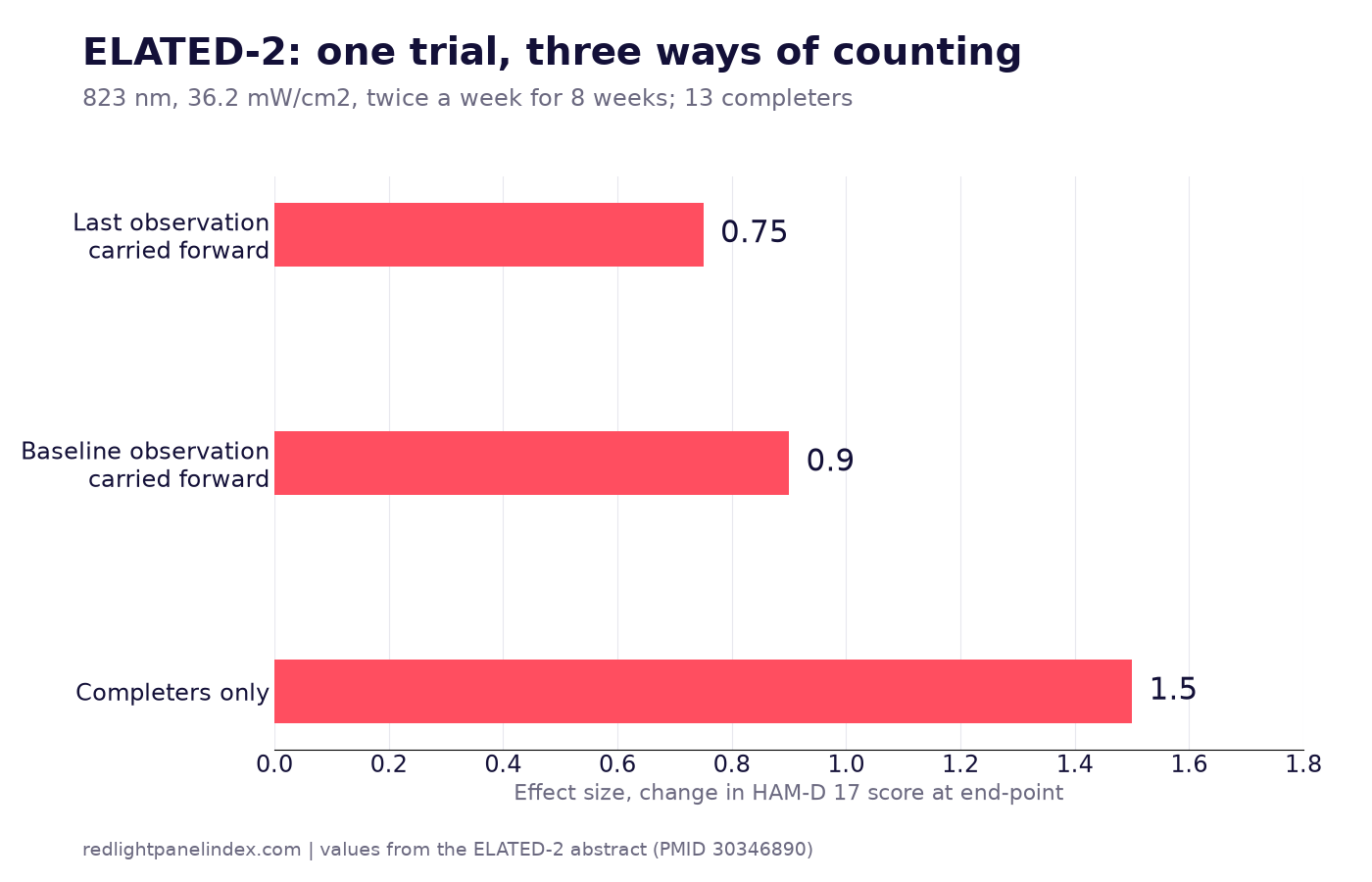
ELATED-2 was a small, double-blind, sham-controlled pilot trial of 823nm near-infrared light applied to the head of adults with major depressive disorder, and it reported medium to large effect sizes on the Hamilton depression scale (PMID 30346890). Because the sample was small and the authors themselves call for replication, it is a signal worth following and not a result to expect from a home panel.
Choosing a panel? Our ranking of the best red light therapy panels is computed from published, method-labeled specs across 188 devices. For a trial like this one, the spec that matters is irradiance at a stated distance, because the dose was defined at the scalp, not across a room.
What the study asked
The trial asked whether transcranial photobiomodulation (t-PBM) with near-infrared light, added to a person's existing care, lowers depression scores more than a sham treatment. "Pilot" is part of the title: it was designed to test feasibility and give a first estimate of effect, not to prove that the treatment works. The condition-level view, including how this trial sits next to an earlier open pilot, is on the transcranial depression evidence page.
Who was studied
Participants were adults with major depressive disorder. The abstract reports effect sizes from three different counts of people: 21 under a baseline-observation-carried-forward analysis, 19 under last-observation-carried-forward, and 13 completers. That spread tells you something by itself: not everyone who started finished the 8 weeks. The abstract describes the treatment as fairly well tolerated, with no serious adverse events.
Device and parameters as the paper states them
According to the abstract, the light was 823 nm continuous wave. It was delivered to the dorsolateral prefrontal cortex on both sides at the same time, over an area of 28.7 x 2 cm2, at 36.2 mW/cm2, with a fluence of up to 65.2 J/cm2. Sessions lasted 20 to 30 minutes and took place twice a week for 8 weeks. The comparison arm was a sham treatment, and neither participants nor assessors knew which arm they were in.
Two details matter for anyone comparing this with a consumer device:
- The irradiance was defined at the target. 36.2 mW/cm2 is the stated figure for the study device, applied against the head. A panel's spec-sheet number is measured at a distance, often 6 inches, which is a different thing. The irradiance explainer shows why the measurement method matters.
- The wavelength is near-infrared, close to 810nm. The 810nm explainer covers why transcranial research clusters in this part of the spectrum, and how little of a typical panel's output is assigned to it.
What was measured and what was found
The primary measure was the change in the 17-item Hamilton Depression Rating Scale (HAM-D 17) total score at end-point. The abstract reports the effect size for the antidepressant effect as 0.90, 0.75 and 1.5, described as medium to large. Those three numbers are not three results; they are one result counted three ways.
| Counting method | Effect size reported |
|---|---|
| Last observation carried forward | 0.75 |
| Baseline observation carried forward | 0.90 |
| Completers only | 1.5 |
Which line is the most cautious? Two of the three analyses fill in missing data for people who dropped out. The completers line counts only the 13 people who finished, which is the smallest group and the largest number. Reading the 0.75 to 0.90 range as the conservative estimate, and 1.5 as the optimistic one, is a fair way to hold the data. This page adds no percentage improvement, because the abstract reports none.
Limitations
The authors state that the sample size was small and that replication is warranted. Beyond that, from the reviewer's side:
- Small groups produce unstable estimates. An effect size of 1.5 from 13 people can move a lot when more people are enrolled.
- Sham trials of light are hard to blind. The treatment is warm and the eye can see red light on some devices, though near-infrared at 823 nm is largely invisible. The sham-controlled trials explainer covers how blinding is tested.
- Adjunct design. The light was added to existing treatment, so the result does not describe light on its own.
- 8 weeks is short. The abstract reports end-point change, not how long any change lasted.
- No dose comparison. The trial tested one dose, so it cannot say whether more or less light would do better.
What this means for a home panel
The honest gap is large. The trial device concentrated a stated dose on two prefrontal sites for up to 30 minutes, twice a week, for 8 weeks. A wall or stand panel spreads its output over a body-sized area and is rarely aimed at one scalp site. To see how far a session is from the trial's dose, enter a panel's irradiance and minutes into the dose calculator, which returns energy per square centimeter and lets you set it against 65.2 J/cm2.
Even if the numbers lined up, the comparison would not hold, because skull transmission is a separate limit. The site's penetration depth page reports that in skull research, 0.45 to 2.90 percent of 810 nanometer light reached 3 centimeters of depth, from a high-power source. A panel delivers far less at the surface.
A different laser trial in healthy adults, at 1064nm rather than the near-infrared band used here, is covered in the Barrett 1064nm study review.
Cautions
- Depression is a medical condition. Anyone with symptoms should speak to a clinician; this trial tested light as an add-on, and nothing here supports replacing care.
- Near-infrared light is invisible and gives no warning when it is bright. The eye protection guide explains why the eyes need care for anything aimed at the head.
- The broader brain and mood evidence page grades the whole area Insufficient. This single pilot does not change that.
Bottom line
ELATED-2 reported medium to large effect sizes for forehead near-infrared light against sham in a small group, and its authors ask for larger trials. It is a reason to run those trials, and not evidence that a home panel changes mood.