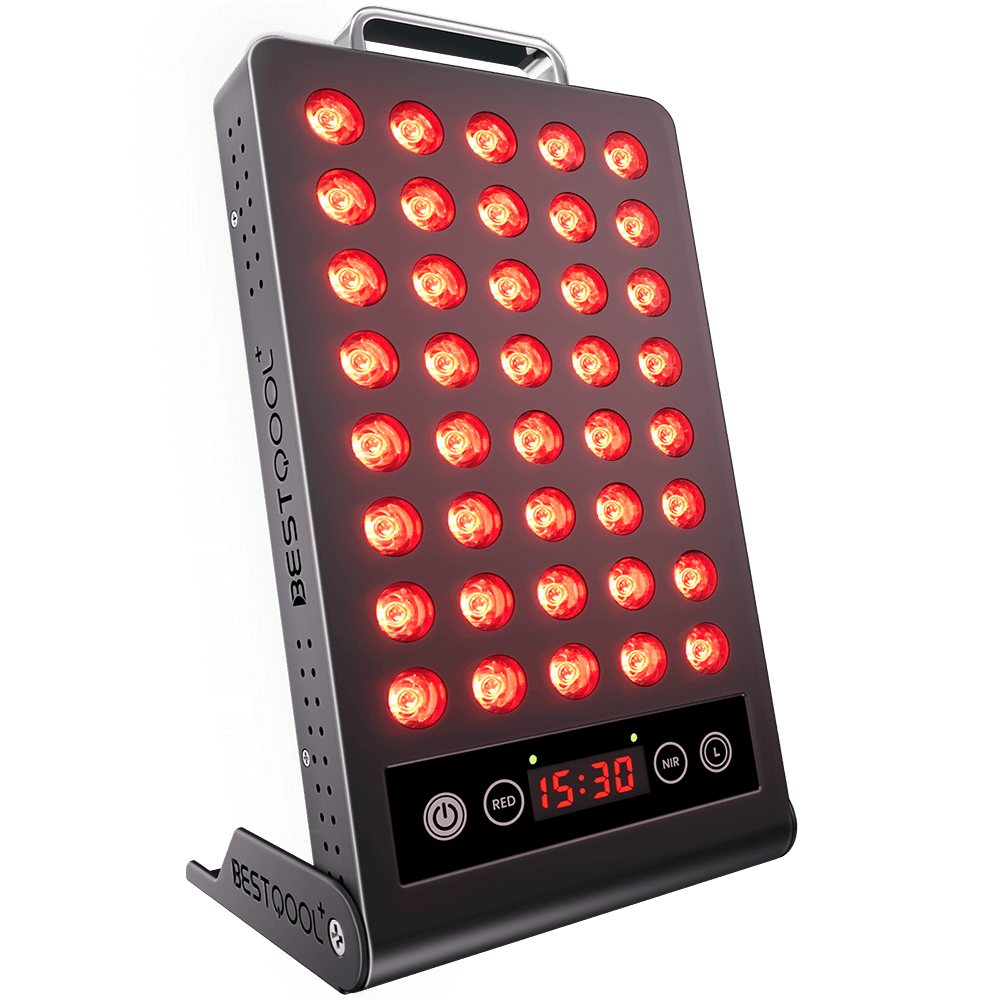
The best red light panel for evening use is the one you can set to red-only, keep short and keep dim, and on the published specs the Bestqool BQ40 is the only one of the four panels below with separate red and near-infrared channel control documented in the database. That ranking is about controllability, not proven sleep benefit: the direct sleep evidence is one small trial of whole-body red light in athletes, and no panel has been shown to improve sleep.
Choosing a panel? Our ranking of the best red light therapy panels is computed from published, method-labeled specs across 188 devices. For evening use, the spec that matters is whether the red and near-infrared channels can be controlled separately, with no blue or white indicator light.
What the sleep evidence does and does not show
The sleep evidence page grades the trial base Limited. The main study enrolled 20 elite female basketball players, who received 30 minutes of whole-body red light nightly for 14 nights against a placebo condition, and reported better sleep quality and higher serum melatonin in the light group (PMID 23182016). Our study review covers its gaps: the abstract names no wavelength or irradiance, the group was small and athletic, and the device was a whole-body exposure, not a wall panel.
Two plain cautions follow. Red light is not a treatment for insomnia or any diagnosed sleep disorder. And no light produces melatonin; the more modest claim is that red and near-infrared light do not suppress it the way blue-heavy light does. That is why this list ranks controls, and why the useful buying question is "can I keep this panel from adding the wrong light at night?"
How these panels were ranked
The ranking uses only fields in the site database, applied the same way to every brand (see how rankings work). The sleep-specific criteria are the first four rows; the rest are the usual cost and risk fields.
| Criterion | Why it matters for evening use |
|---|---|
| Separate red and NIR channel control | Lets you run red only, or lower the near-infrared share, in the evening |
| Dimming or low-intensity modes | A bright panel in a dark room is more than most evening sessions need |
| Documented flicker behavior | Visible strobing is a comfort issue in a dim room |
| No blue or white indicator or blue band | Blue-heavy light is what suppresses melatonin |
| Irradiance with method and distance | Needed to set a short session length |
| Price with verification date, warranty, trial | The cost of being wrong |
Honest limitation: for the last three evening fields, the database mostly records "not stated." No brand in the database publishes a measured flicker figure for any model, and indicator light color is listed for none of these four. The ranking therefore rests on the one field that is documented for some models, channel and mode control, and on wavelength mix.
| Rank | Model | Channel and mode control | Wavelengths | Irradiance (method) | Price (verified) | Warranty and trial |
|---|---|---|---|---|---|---|
| 1 | Bestqool BQ40 | Digital panel, auto timer, separate red and NIR channel control | 660, 850 nm | 70 mW/cm2 at 3 in, method not named | $149 (2026-08-12) | 2 years; 30-day trial |
| 2 | Hooga HG300 | Built-in timer only | 660, 850 nm | 73 mW/cm2 at 6 in, method not stated | $199 (2026-09-12) | 3 years; 60-day trial |
| 3 | Joovv Solo 3.0 | App modes: Recovery+ (10 Hz pulsed), Ambient, Wake; no channel control described | 660, 850 nm | Brand: over 100, distance not stated; independent: 59.2 average at 6 in | $1,699 (2026-08-13) | 2 years; 60-day trial |
| 4 | RLT Home Total Spectrum COMPACT | 9 modes, on-panel controls; channel control not stated | 480, 630, 660, 810, 830, 850, 1064 nm | 99.0 mW/cm2 at 6 in, spectrometer (brand-commissioned lab) | $1,095 (2026-09-12) | 3 years; 60-day trial |
The picks
1. Bestqool BQ40: documented red and NIR channel control
The BQ40 is ranked first on a single documented advantage: the database lists a digital control panel with an auto timer and separate red and near-infrared channel control, so an evening session can be set to 660 nm only. It is also the least expensive of the four at $149 as of 2026-08-12. It is a small panel, 11.3 by 5.6 inches with 40 dual-chip LEDs, which suits a short, close session.
Cautions are real. Its 70 mW/cm2 figure is at 3 inches with no measurement method named, a second note on the page cites a higher range with no method either, and the site's rule of thumb is to treat about half of an unverified figure as the working value. Dimming and flicker are not listed. The trial is 30 days, the shortest here, and the page flags the return-fee wording. The brand also markets the panel as "medical-grade," which no performance standard supports for home panels. The flicker explainer describes the phone-camera check you can run when it arrives.
2. Hooga HG300: no blue band, but few controls
The HG300 has only two bands, 660 and 850 nm, so there is no blue channel to switch off, and it comes with a 3-year warranty and a 60-day trial for $199 as of 2026-09-12. That simplicity is its case for evening use. What it lacks is control: the page lists a built-in timer only. Adjustable brightness appears on the brand's ULTRA line, and the PRO line is listed as flicker-free, but neither detail is stated for the HG300. Its 73 mW/cm2 is a brand figure with no method stated, so the working value is about half until a method is shown. Return policy notes: the prepaid label cost comes out of a refund and open-box items are non-refundable.
3. Joovv Solo 3.0: named evening modes, premium price
The Solo 3.0 is the only panel here with modes named for time of day, Ambient and Wake, set through the app, plus a 10 Hz pulsed Recovery+ mode. The database does not describe what Ambient changes, whether it dims the panel or alters the wavelength mix, and no channel control is described, so the name alone is not a spec. It has two bands (660 and 850 nm) and a 2-year warranty. At $1,699 as of 2026-08-13 it costs more than ten times the BQ40. The brand quotes over 100 mW/cm2 without a distance; the independent spectrometer reading on the page is 59.2 average at 6 inches. The stand is sold separately, and return shipping is the buyer's cost. A pulsed mode is an intentional feature, separate from the driver flicker discussed on the flicker page.
4. RLT Home Total Spectrum COMPACT: strong output, blue band to manage
The COMPACT is the only panel here with a spectrometer-labeled irradiance figure, 99.0 mW/cm2 at 6 inches, and a 3-year warranty with a 60-day, no-restocking-fee trial at $1,095 as of 2026-09-12. The caution for evening use is the spectrum: it includes a 480 nm band at about 6% of output, and the database page does not state channel control, dimming, flicker or indicator behavior. The sleep evidence page describes independent channel control for this model; the database page does not state it, so confirm with the brand that the 480 nm band can be switched off before buying for evening use. The lab test behind the irradiance figure was commissioned by the brand, as the page itself notes, and no unaffiliated measurement is listed. RLT Home is one brand among 41 and is held to the same criteria and cautions as the others.
Setting up an evening session
The sleep evidence page suggests using a panel 30 to 90 minutes before bed for 10 to 20 minutes, in a dim room, with the panel as the main light instead of an addition to overhead lights. It also notes that longer or brighter sessions have not been shown to help sleep more. A 630 to 660 nm choice is the usual evening recommendation, which is why the 660nm page is a good companion read.
Session length comes from irradiance and distance, so use the dose calculator with a figure that has a stated method, and halve any figure whose method is unstated. Because shorter is the point here, a lower-output panel at a longer distance is workable for an evening session in a way it would not be for a deep-tissue goal.
What would change this ranking
A published flicker measurement, a documented dimming range or a stated indicator-light color for any of these models would move them, because those are the fields an evening buyer most needs and the database mostly lacks. Until then, treat the table as a ranking of what is documented, and treat the missing fields as questions to ask the brand: Can the blue band be turned off? Can I dim it? Is any indicator light white or blue when the panel is running?