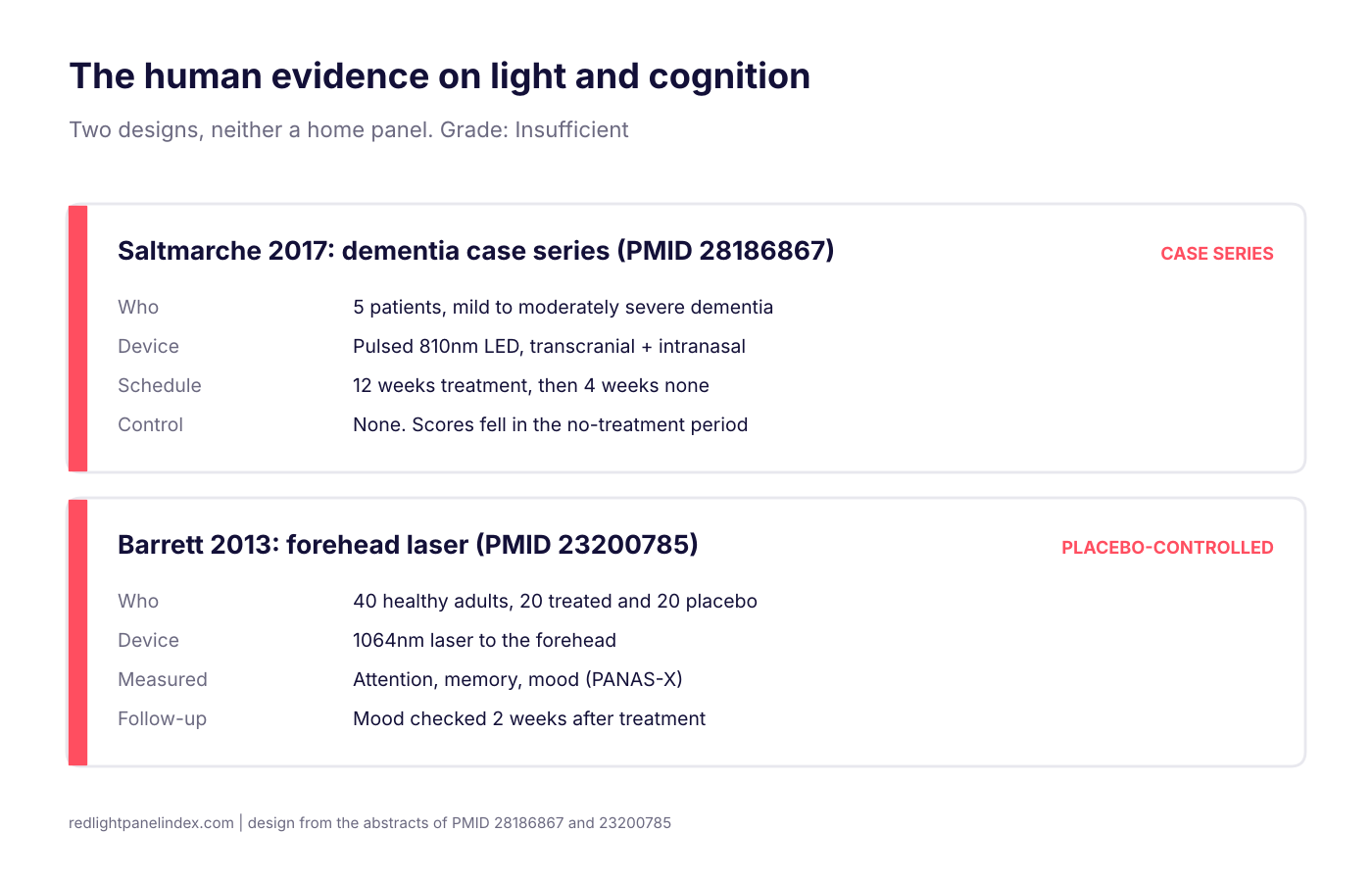
The evidence grade for red and near-infrared light in cognition and dementia is Insufficient: the only human dementia data in this index's sources are a five-person case series with no control group (PMID 28186867), plus a placebo-controlled laser trial in 40 healthy adults that did not study dementia at all (PMID 23200785), and a narrative review that summarizes the field (PMID 29327206). That is enough to justify larger controlled trials, and not enough to say that a home panel does anything for memory loss.
Choosing a panel? Our ranking of the best red light therapy panels is computed from published, method-labeled specs across 188 devices. For brain questions, the spec that matters is verified irradiance at your real distance, because the cognition research used head-worn devices at close range, not panels.
Why the grade is Insufficient
Insufficient means the studies cannot answer the question. For dementia there is one small uncontrolled series. For cognition there is one controlled trial, but in healthy volunteers, with a laser, at a wavelength most home panels barely carry. Neither design tests whether light changes the course of a dementia, and nobody in these sources compared a panel against anything. The site grades the wider brain and mood evidence the same way, and this page is a closer look at the cognition and dementia end of it.
What the studies found
The dementia case series (2017)
Saltmarche and colleagues reported a case series of five patients with mild to moderately severe dementia or possible Alzheimer's disease, with baseline Mini-Mental State Exam (MMSE) scores of 10 to 24 (PMID 28186867). The device was a pulsed 810nm LED system aimed at default mode network regions of the brain. Patients had 12 weeks of treatment, with weekly in-clinic sessions that combined transcranial and intranasal light, plus daily intranasal-only use at home, followed by a 4-week period with no treatment.
According to the abstract, scores improved significantly on the MMSE (p < 0.003) and on the ADAS-cog (p < 0.023) after the 12 weeks. Caregivers reported better function, sleep and mood, with fewer angry outbursts, less anxiety and less wandering, and no negative side effects were reported. Scores declined noticeably in the no-treatment follow-up. The authors concluded that larger, controlled studies are warranted.
Read it with its limits in view. Five people is a very small sample, there was no control group, and the abstract itself discloses that two authors were paid consultants for the study and one was the founder and chief executive of the company that makes the device. A case series can show that something is worth testing. It cannot separate the effect of light from expectation, attention from caregivers or ordinary fluctuation in the illness.
The healthy-adult 1064nm trial (2013)
Barrett and Gonzalez-Lima applied a 1064nm infrared laser to the forehead in 40 healthy adults, 20 treated and 20 placebo (PMID 23200785). According to the abstract, reaction times on a sustained-attention task improved in the treated group, especially in participants who scored high on novelty seeking, and performance on a delayed match-to-sample memory task improved on retrieval latency and number of correct trials. On a mood scale (PANAS-X), the treated group showed more positive affect that lasted longer than placebo, measured before treatment and 2 weeks after.
The site's study review of this trial lists the stated dose as 250 mW/cm2 and 60 J/cm2 to the forehead, which implies about four minutes. The participants were healthy volunteers, the follow-up was short and the study came from a single laboratory. It says nothing about people with memory loss.
The narrative review (2018)
Salehpour and colleagues reviewed brain photobiomodulation across dementia, Parkinson's disease, stroke, brain trauma and depression (PMID 29327206). The review describes the proposed mechanism, in which red and near-infrared light acts on cytochrome c oxidase in the mitochondria, and lists reported effects such as anti-inflammatory and anti-apoptotic responses in preclinical work. It also states the central practical problem: light attenuates exponentially in tissue, so delivering enough light through the scalp and skull is hard, and the authors suggest intracranial and intranasal delivery as alternatives. A review summarizes studies; it does not add new human evidence.
What was not studied
- Controlled trials in people with dementia. None are in this index's sources; the one dementia study had no comparison group.
- Home panels. No cognition or dementia study here used a wall or standing panel.
- Long-term outcomes. The case series ran 12 weeks and scores fell back after treatment stopped.
- Prevention. Nothing here tests whether light delays or prevents cognitive decline in healthy people.
- The 1064nm band in people with memory loss. The 1064nm trial enrolled only healthy adults.
- Head-to-head dose comparisons. No study compared one dose against another.
What this means for a home panel
The studies describe devices placed on the head or in the nose, at defined wavelengths and doses. A panel spreads light over a large area at a distance. The site's penetration depth page gives modeled figures for how little surface power reaches deep tissue, and it treats those numbers as ceilings. The 810nm explainer covers the band used in the case series.
If you want to see how a number translates, the dose calculator turns irradiance and distance into minutes. As a worked example, the 1064nm trial's stated 60 J/cm2 at 250 mW/cm2 is about 240 seconds, and the 1064nm page notes that only a few database models carry a meaningful share of that band; see the 1064nm explainer for which. For wavelengths in general, see the wavelength guide. Related brain questions are covered in the depression evidence page and the traumatic brain injury page.
How to read a claim about light and memory
Three questions sort most marketing from evidence. First, who was studied: healthy volunteers, people with a diagnosed dementia, or no one (a cell or animal study)? Second, was there a comparison group, such as a sham or placebo device? The 2013 trial had one; the 2017 series did not. Third, what was the device and the dose: a laser or LED, at which wavelength, how many mW/cm2, for how many minutes, and on which part of the head? A claim that leaves out all three cannot be matched to any study listed above.
It also helps to separate a mechanism from an outcome. The narrative review describes why light might affect brain cells, but a plausible mechanism is not a measured change in memory or daily function. The grade stays Insufficient until controlled human trials in dementia measure outcomes like the MMSE or caregiver-rated function against a sham. Larger trials are the authors' own stated next step, and until they report, the sensible reading is that the question is open.
Cautions
- A diagnosis of dementia needs a clinician, and nothing on this page is a substitute for care or for caregiving support.
- Do not stop or change prescribed treatment because of a light device.
- Results from a five-person series with a commercial interest should not be read as a prediction for anyone.
- Eye protection matters with any bright near-infrared source; see the eye protection guide.
- Talk to a physician before using light near the head if you take medication that affects light sensitivity or have an implanted device.